
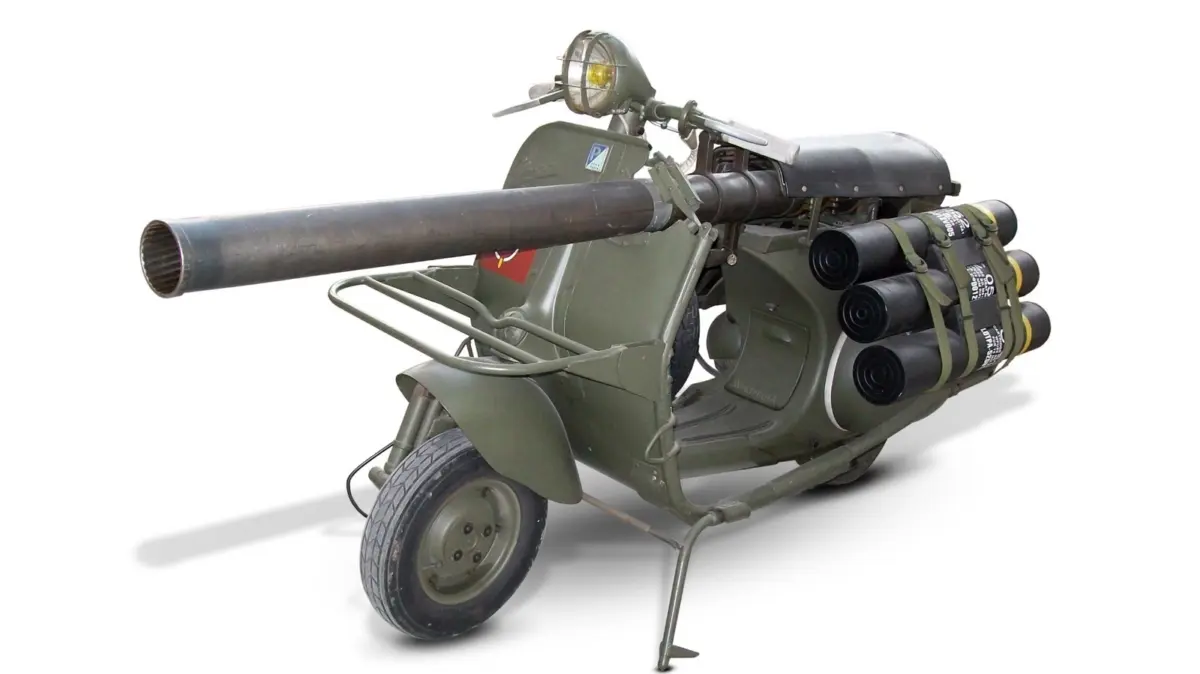
While World War II famously relied on heavy, rugged two-wheeled machines and motorcycles from various fighting nations to transport troops and dispatch messages across difficult terrain, the post-war era introduced an entirely unexpected vehicle to the theater of conflict. Long before they became synonymous with leisurely European getaways, Italian style, and urban commuting, classic Vespas were called up for active military duty in some of the most hostile environments of the twentieth century. The resulting machine remains one of the most unusual military adaptations in automotive and defense history.
When the French military approached the iconic Italian scooter manufacturer Vespa for assistance, the country was already deeply embroiled in the dense, treacherous jungles of Vietnam during the First Indochina War. At the time, standard Vespas were already widely recognized and respected by civilian owners for their mechanical dependability, surprisingly rugged build quality, and ease of maintenance. What France desperately needed, however, was a small, lightweight, and highly mobile tactical vehicle that its elite paratroopers could utilize to navigate the nightmarish jungle terrain far more easily than traditional trucks or jeeps, while still packing a serious punch against enemy armor and fortifications.
The Italian manufacturer answered that urgent call by designing a specialized military variant known officially as the Vespa 150 TAP. In this designation, the acronym "TAP" stood for "Truppe Aero Portate," which translates directly from Italian and French military terminology as airborne troops.
To bring the project to life, Piaggio’s French manufacturing subsidiary, known as Ateliers de Construction de Motocycles et d’Automobiles, or ACMA, took on the responsibility of producing this newly reinforced, heavy-duty 150cc Vespa tailored specifically for combat operations. The foundation for the military scooter was the civilian 150 VL3 model, which ACMA finished in a tactical camouflage color scheme of either desert sand or military green.
Engineers quickly realized that the standard civilian powerplant required significant revision to withstand the rigors of combat. Consequently, the Italians replaced the VL3’s problematic 150cc rectangular engine with a newly engineered 150cc square engine designed to idle with considerably less vibration and mechanical rattle. This updated power unit featured a smaller cylinder bore combined with slightly longer pistons. This mechanical configuration not only successfully reduced the troublesome engine rattle at idle speeds, but it also yielded improved fuel efficiency. The modifications allowed the military scooter to achieve a remarkable operational range of up to 124 miles on a single tank, making it an ideal asset for prolonged wartime patrols and scouting conditions. Production of the TAP 150 at the ACMA factory commenced in 1956, just one year before the facility began manufacturing Vespa’s charming 400 microcar.
Do not fire the guns while on the Vespas
Despite its modest scooter origins, the most striking and defining modification that separated the military TAP from the original civilian 150 Vespa VL3 was the integration of a massive American M20 recoilless rifle. This formidable armament was essentially a heavy 75-millimeter cannon, carefully and securely mounted directly down the centerline of the scooter, running right underneath the driver’s seat and notched precisely into the front protective leg shield and fairing.
As historical breakdowns by organizations like the Tank Encyclopedia have detailed, these heavily armed Vespas were engineered specifically and exclusively to carry the weapons into the field. Once the paratroopers reached their destination or a tactical staging area, the massive 75mm cannon was designed to be physically removed from the scooter chassis, dismounted, and set up on the ground on a dedicated tripod to fire upon enemy troops and armored positions.
The weapons were explicitly never meant to be fired while the operator was actually riding or sitting on the Vespa. While the Vespa 150 engine and chassis possessed a respectable amount of utility and torque, discharging a recoilless cannon of that immense caliber while the two-wheeled scooter was actively in motion would inevitably lead to catastrophic structural failure, immense recoil forces throwing the rider backward, and potentially disastrous, highly fatal outcomes for both the driver and the machine.
To successfully bear the immense weight of the artillery piece and its associated gear, the Vespa required a comprehensive series of structural modifications. These enhancements included heavy-duty reinforcement welded along the entire undercarriage of the scooter, bolstered by rubber-coated framing designed to absorb the severe kinetic impact when the heavily laden Vespa slammed into the ground after a parachute drop.
The tactical doctrine for deploying these miniature anti-tank combat scooters dictated that they would be dropped directly into active operational fields alongside French paratroopers in pairs. In this tandem deployment strategy, one Vespa would carry the massive recoilless gun and its primary operator, while the second accompanying Vespa would transport crucial field supplies, including extra fuel containers, ammunition crates for the cannon, and a dedicated loader to assist with operating the artillery piece in combat. Some tactical deployment configurations even incorporated a small, specialized one-wheeled utility trailer towed behind the scooter to maximize cargo capacity.
Vespa drops right into the Algerian War
By the time Vespa and its French subsidiary fully commenced production of these unusual, tank-destroying scooters, the First Indochina War had already drawn to a close, with formal peace agreements signed in 1954. Consequently, the newly minted 150 TAP scooters missed the jungles of Vietnam entirely. Instead, they finally made their operational debut in 1956, deploying directly into the scorching landscapes of Algeria to support the French military in the ongoing and brutal conflict there.
Throughout the deployment in North Africa, two primary iterations of the TAP saw active service. The initial version was designated as the TAP 56, representing the original 1956 production standard. This was followed later by the TAP 59, which featured a handful of very minor updates and cosmetic refinements when it was introduced in 1959, including the addition of a contemporary plastic ACMA manufacturer badge on the bodywork.
Despite the innovative nature of the platform, the military experiment was short-lived. Piaggio officially brought the production of the 150 TAP to a close in 1959. By the time manufacturing lines were halted, the company had built only about 600 of these tiny tactical fighting vehicles. The overarching concept seemingly failed to capture widespread enthusiasm or adoption within global military doctrines, ensuring that no other weaponized, war-primed Vespa would ever grace the historic archives of the Italian scooter manufacturer.
In the decades since their retirement from active military service, these rare tactical artifacts have occasionally resurfaced in the collector market. Every once in a while, an authentic, surviving TAP pops up for public sale, drawing intense interest from military historians and vintage scooter enthusiasts alike. However, acquiring such a rare piece of automotive and military history comes with a remarkably steep financial barrier. For the few units that are publicly listed through specialized classic vehicle platforms such as Classic Trader—with some specimens appearing for sale multiple times over the years—asking prices have consistently ranged from approximately $33,000 to $46,000 USD, while others simply hide the cost behind an "inquire for price" designation, reflecting their extreme scarcity and unique place in twentieth-century history.