
During the final moments of last season’s runway show, Emilia Wickstead found herself standing alongside her daughter, contemplating the rhythm of the fashion calendar and the nature of the presentation itself. It was a moment of creative restlessness—a desire to move away from the traditional catwalk and toward something more intimate and atmospheric. The result of that introspection was unveiled this season in a departure from the designer’s long-standing tradition: a cinematic presentation held within the familiar walls of her Sloane Street store, crafted in collaboration with the legendary London restaurateur Jeremy King.
The transition from a live runway to a film medium was not merely a logistical shift; it was a deliberate attempt to capture the essence of clothing as it exists in the real world. As the film begins, Jeremy King, a master of curating hospitality environments, sets the tone with a poignant observation: “It’s the ability to combine what you’ve learned and what you see that makes something special.” Wickstead’s admiration for King’s ability to orchestrate an atmosphere is central to this project. She wanted to explore the lived-in reality of her garments—how they breathe, move, and function when removed from the sterile, high-tension environment of a traditional show. The collaboration extended beyond the screen as well, with King’s iconic restaurant, Simpsons on the Strand, providing an elegant backdrop of martinis and snacks for those gathered to watch the premiere.
The film serves as a love letter to the process of creation. It opens with the tactile reality of production: painters meticulously finishing the sets of pastel-colored rooms and seamstresses placing the final, delicate touches on a peppermint strapless fit-and-flare gown. The gown, adorned with a floral print and a soft tulle overlay, is a quintessential example of the brand’s DNA. Once the set is primed, the narrative begins. A model, dressed in an understated pink striped shirt paired with a knit skirt, navigates the space with an air of purpose. She walks quickly, moving between rooms that shift in hue—from lavender to powder blue, pale green to lemon yellow—effectively recontextualizing the garments as she passes through different palettes. It is a study in how environment informs color and how color, in turn, dictates the mood of the silhouette.
Wickstead, who describes herself as an “old-school” designer, operates with a disciplined approach to inspiration. She prefers to select a singular, resonant reference point and explore it with total focus. For this collection, that muse was the American Abstract Expressionist painter Lenore “Lee” Krasner. While history has often placed Krasner in the shadow of her husband, Jackson Pollock, Wickstead is uninterested in that narrative. “I’m only talking about her,” the designer noted, underscoring a desire to celebrate the legacy of a woman who has historically been under-recognized in the art canon.
The collection acts as a dialogue between Wickstead’s signature architectural language and the artistic spirit of Krasner. The designer’s hallmark fit-and-flare dresses and precise, structured necklines remain, but they have been subtly reworked to reflect Krasner’s penchant for constant reinvention. Several long dresses, rendered in silk or black chiffon, feature an asymmetrical bib of fabric that allows for versatility; it can be folded down or tied up, offering the wearer control over the level of décolletage on display. Furthermore, many of the garments incorporate slightly frayed silk chiffon trim, a detail that introduces an element of the "undone"—a direct nod to Krasner’s own philosophy of allowing for a sense of unraveling in one’s work.
Perhaps the most significant material development this season is the introduction of a light cotton tweed. Used across skirts, trousers, and dresses, it marks a first for a Wickstead spring collection. The tweed is intricately woven with threads of beige, pink, and yellow, a color palette that serves as a subtle, sophisticated reference to Krasner’s 1956 painting Prophecy. While the tweed leans into the artist’s color theory, the hand-painted leaf and daisy prints scattered throughout the collection pay tribute to another side of Krasner: her lifelong, deep-seated love of nature.
Maintaining a sense of lightness was a priority for the designer, particularly with an eye toward the reality of increasingly hot summers. To achieve this, Wickstead employed clever construction techniques. She integrated tweed panels onto black chiffon fronts for tops and dresses, and inserted chiffon pleat inlays into the seams of tweed skirts and viscose dresses. These additions provide a breezier, more fluid feel to the silhouettes. In a further exploration of texture, Wickstead utilized feathers for the first time. They appear as a removable, substantial trim on a bias-cut tweed minidress-cum-tunic, as a dramatic, statement-making trim on a yellow longline dress, and as intricately embroidered floral motifs on a yellow A-line minidress and a striking black viscose moiré gown.
The utility of the garments is threaded with a sense of whimsy. The fit-and-flare gowns, finished in floral patterns or pink stripes, feature deep, functional pockets. Wickstead jokingly referred to them as being “for paintbrushes,” acknowledging the irony that while her clientele consists of high-society women and members of the royal family, they are unlikely to be found at an easel. Yet, the inclusion of the pockets serves a functional purpose, grounding the high-fashion aesthetic in a sense of everyday usability.
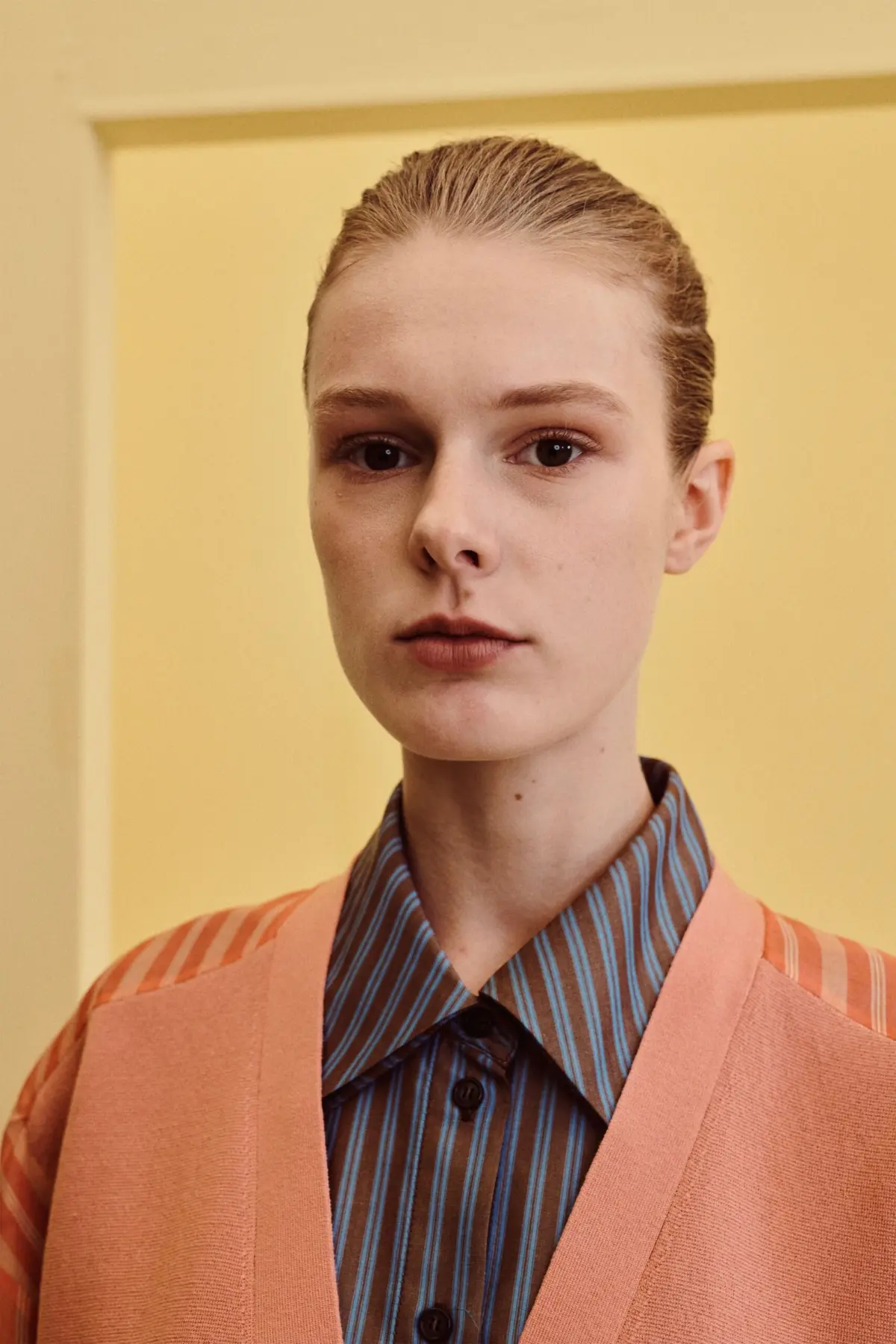
For more relaxed occasions, the collection offers a layered aesthetic. Oversized knits are paired with loose-fit striped cotton artist shirts, and the brand has introduced apron dresses that can be worn hanging loose or cinched at the waist for a more structured silhouette. During the presentation, Wickstead gestured to a pink-and-blue-striped knit and a gray oversized gilet—which featured the daisy print on the pockets and the back—remarking, “I feel like Lee might have worn this to the studio.”
By modifying familiar necklines and waistlines, introducing new textures like feathers, and layering prints, Emilia Wickstead has successfully experimented with her established formula. The result is a collection that provides her customers with fresh ways to interpret her classic aesthetic. As the film concludes and the viewer is left with the image of the model in her final room, the message is clear: these are clothes designed for longevity. Through careful refinement and a deep, intellectual connection to the work of Lee Krasner, Wickstead has created pieces that offer her customers significant mileage, ensuring that the elegance of the studio—and the legacy of the artist—can be carried into the rhythm of daily life.