
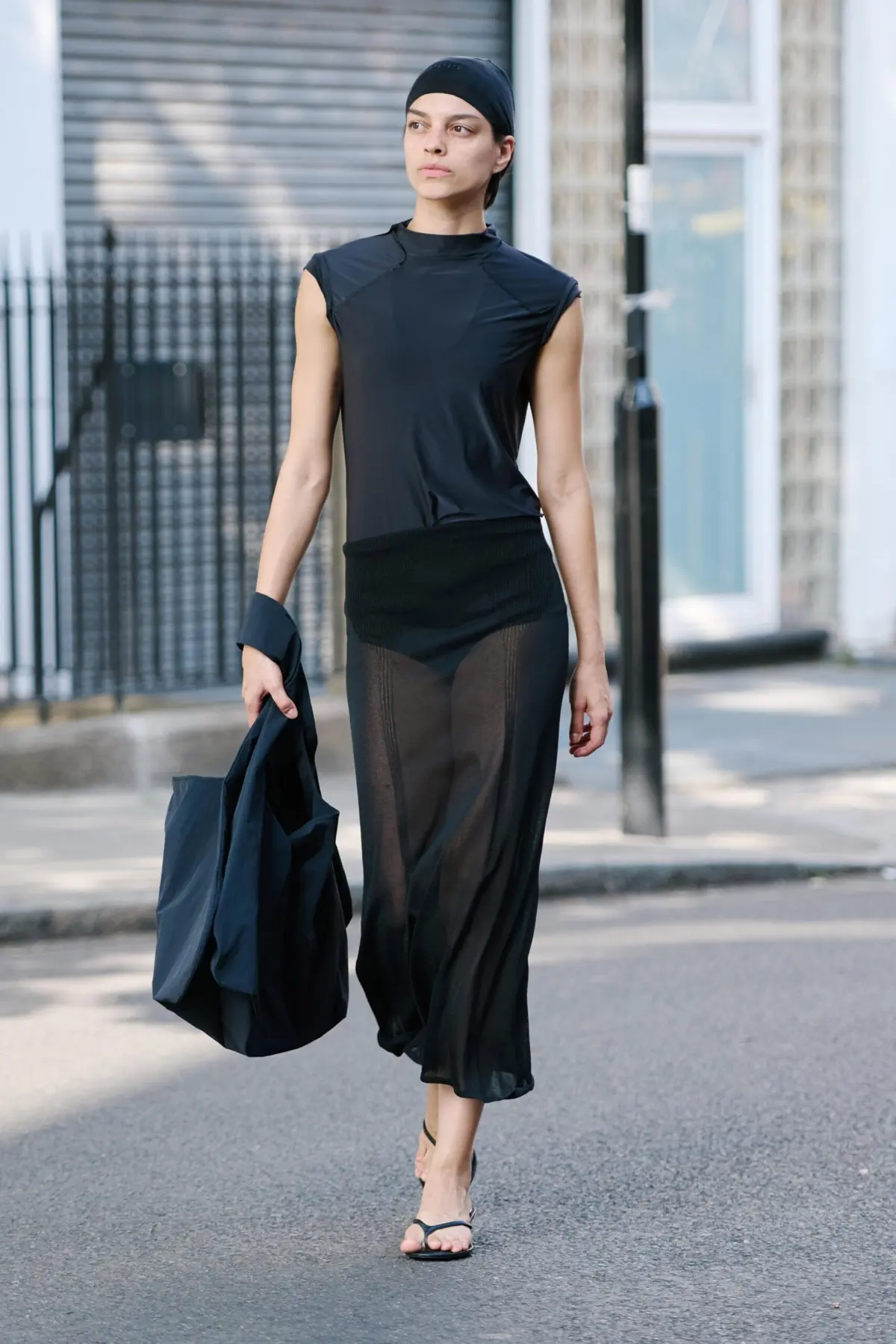
Johanna Parv has long established her reputation as a designer who treats fashion as an exercise in rigorous engineering. Her work does not merely exist to adorn the body; it is designed to inhabit the same challenging environments as the wearer. This season, that philosophy of durability was brought into sharp relief at the preview for her spring collection, where a gargantuan tote bag sat prominently in the corner. The bag, crafted from a robust, crunchy nylon, bore the visible scars of its history: scuffs and scratches collected during a vacation in Marseille, where Parv had tossed it onto jagged rocks and uneven terrain. Far from looking diminished, the piece looked better for its wear—a physical manifestation of Parv’s core design tenet: fashion should be built to withstand the elements, maturing alongside the person who carries it.
This commitment to longevity and functional resilience forms the backbone of Parv’s latest collection, titled "Tempo." The inspiration for the season was born out of a visceral reaction to the realities of a modern London summer. Witnessing the city struggle through blistering, record-breaking temperatures and the persistent, choking dust of a heatwave prompted Parv to pivot toward a protective, capsule-based approach to spring dressing. She was not interested in creating a collection of surreal, sci-fi-inspired garb, even as the global climate begins to feel increasingly unstable. Instead, her goal was to develop a wardrobe that provides genuine comfort and utility for the urban dweller navigating a city in flux.
The collection’s color palette serves as a direct reflection of this "city haze." Parv observed the way the urban landscape shifts under environmental pressure, translating those observations into a spectrum of sandy hues that echo the city’s parched, dry parks, paired with smoggy, charcoal blacks. Interspersed throughout are cool, sharp shots of blue—a deliberate choice intended to represent clear skies as seen through a filter of lingering industrial fumes. While Parv remains steadfast in her reliance on neutrals, these intermittent injections of color provide a newfound dynamism, energizing her highly functional silhouettes and grounding them in the specific, lived experience of the contemporary metropolis.
Central to the collection’s technical success is Parv’s experimental approach to fabric, most notably her use of waterproof wool. Traditionally viewed as a winter textile, wool is utilized here for its superior temperature-regulating properties, a choice Parv champions as the ultimate marriage of form and function. "I quite like the contrast of using wool for summer," she noted during the preview. Her ability to manipulate the fabric—making it appear lightweight and airy—is perhaps the most impressive feat of the collection. This manipulation extends to a wool-cotton denim jacket featuring notched lapels, paired with capris in what the designer describes as a "bike messenger take on a suit." The versatility of the material is further showcased in a luxe merino set, consisting of lounge trousers and a cap-sleeve polo top, which makes a compelling case for wool as a year-round essential, regardless of the thermometer’s reading.
The collection also addresses the pragmatic needs of the London inhabitant, who is perpetually at risk of being caught in an unexpected rain shower. Parv introduces a "trench-cum-cycling" outfit, inspired by a vintage silhouette and executed in a water-repellent gabardine, designed to offer full protection without sacrificing movement. Her explorations into other textiles are equally thoughtful; she utilizes a breathable, lightweight linen, which she compares to aluminum for its unique, moldable qualities, allowing the fabric to hold its shape while remaining comfortable in the heat. A circular knit skirt, featuring integrated briefs—a design that required a full year of development—exemplifies the season’s technical rigor. The collection is rounded out by striped cotton shirts, detailed with high and deep chest pockets that draw direct inspiration from the cycling jerseys of the 1950s and 1960s, blending retro aesthetics with modern urban necessity.
While previous seasons have seen Parv present her work through highly choreographed runway shows, the "Tempo" collection was unveiled in a more intimate, curated exhibition. The timing of the event, which coincided with the intersection of London Fashion Week and London Design Week, felt like a deliberate homage to both the craft of fashion and the broader field of industrial design. Guests were ushered into a darkened room dominated by static, hanging rod sculptures that mimicked the human form. These structures, featuring bolstered metal shoulders and hips, provided a skeletal framework that allowed the clothes to hang as if they were armor. The reinforcements, bonding techniques, complex zips, and meticulously finished seams were all on display, emphasizing the architectural integrity of the garments.
The exhibition further deepened the narrative through digital storytelling. Projected onto the walls were videos of a four-person lineup, consisting of individuals selected for their diverse and intersecting disciplines: Saša Štucin of the design duo Soft Baroque, chef Imogen Kwok, artist and ceramist Phoebe Collings-James, and architect Nara Lee. In additional clips shown in the subsequent gallery space, these women discussed their own relationships with pace—a direct nod to the collection’s title and its underlying exploration of tempo. By casting these figures and documenting their insights, Parv provided an intimate, human dimension to the clothes, situating her work within a broader dialogue about how we move, work, and exist within urban environments.
When asked about her own relationship with pace, Parv’s response is reflected in her practice: she is slow, deliberate, and entirely unhurried in her execution. She is a designer who lingers on every stitch and every structural detail, ensuring that nothing is left to chance. There is an undeniable speed and fluidity inherent to the clothes—a necessity for the active, urban lifestyle they are designed for—but they are the antithesis of ephemeral fashion. Parv’s pieces are built to endure, designed to withstand the wear and tear of daily life in the same way that her scratched nylon bag from Marseille has weathered its journey. Her work suggests that in an age of rapid consumption, there is profound value in garments that are engineered to last, promising that they will keep the wearer comfortable and well-prepared, whatever the weather or the pace of the city might demand.