
Microsoft made a bold strategic pivot at its Ignite conference this week, unveiling a new suite of specialized artificial intelligence models that signal a direct challenge to industry titans like OpenAI and Anthropic. Rather than continuing the industry-wide race to build a single, all-encompassing “God model” capable of mastering every conceivable task, Microsoft is shifting its focus toward high-performance, domain-specific AI tailored for coding, cybersecurity, and image generation. This move represents a calculated shift in the company’s enterprise strategy, prioritizing cost-efficiency and specialized performance over the general-purpose utility that has defined the AI landscape for the past two years.
The flagship of this new lineup is the MAI Code 2 series, a set of models engineered specifically for software development. According to internal performance data shared by Microsoft, the primary MAI Code 2 model delivers approximately 96% of the performance seen in Anthropic’s Claude Opus 5.5 on standard enterprise coding tasks. Crucially, it does so at a mere 5% of the cost. Similarly, when compared against OpenAI’s GPT-6.1 Sol, Microsoft claims its new model achieves 98% of the performance at 40% of the price. While these comparisons provide a compelling narrative for cost-conscious corporate IT departments, they arrive in a rapidly evolving market; OpenAI’s recent release of the GPT-6.2 update means that Microsoft’s comparative metrics are already being weighed against an older generation of competitor technology.
Microsoft’s benchmarking methodology relies on an aggregation of four key evaluations, including code remediation and the complex task of executing multi-file software changes. To ensure transparency, the company noted that three of these tests were conducted on its proprietary evaluation platform, while the fourth utilized third-party results. The cost projections, meanwhile, were calculated based on a 50% promotional discount, a detail that suggests Microsoft is aggressively positioning these tools to gain immediate market share within the developer ecosystem.
Complementing the primary model is the MAI Code 2 Flash, a lightweight iteration designed for high-frequency, routine operations such as rapid code edits and minor debugging. Microsoft positions this model as a direct rival to Claude Haiku 5.5, asserting that it provides comparable performance at just 20% of the cost. The integration of these models into GitHub Copilot—Microsoft’s most prominent developer-facing tool—marks a significant milestone. By replacing third-party AI suppliers with its own in-house technology, Microsoft is effectively vertically integrating its most lucrative software development product, reducing its dependency on external partners while simultaneously improving its bottom line.
The company’s push into specialized AI extends beyond the developer’s terminal and into the critical realm of cybersecurity. Microsoft introduced MAI Cyber 2 Flash, a model trained specifically to assist in vulnerability discovery and security auditing. In tests using the CyberGym-E2E benchmark, the model successfully completed 92.3% of vulnerability-discovery tasks, slightly edging out the 91.5% success rate reported for OpenAI’s GPT-6 Astra. The most striking differentiator, however, is the price point: Microsoft claims the operational cost per task is less than 2% of the expenditure associated with its competitor. To ensure the integrity of these findings, Microsoft took the step of excluding 92 out of 905 tasks from the CyberGym dataset after discovering that the source material overlapped with the model’s training data, a proactive measure aimed at preventing performance inflation. This new security system is slated to begin replacing older legacy models for eligible MDASH customers starting in mid-December.
The underlying philosophy behind this strategy is the realization that in the world of artificial intelligence, "David" can indeed beat "Goliath," provided the playing field is sufficiently specialized. A general-purpose model is forced to allocate its computational budget across an immense breadth of knowledge—ranging from historical analysis and poetic composition to advanced physics and software debugging. Conversely, a model specifically architected for coding or cyber defense can concentrate its entire training and inference budget on the patterns and logic that actually matter for those specific professions.

This specialization does not necessarily mean the smaller models are "smarter" in a universal sense, but it does render them significantly more efficient and economical for well-defined, repetitive tasks. In a business environment where security scanners might analyze thousands of code changes every hour, there is little utility in paying the premium for a general-purpose frontier model that also happens to possess a vast repository of information about the Roman Empire. When a model can dedicate its full power to generating or auditing Python code, the cost-to-performance ratio becomes overwhelmingly favorable for the specialized system. Furthermore, this approach allows for the optimization of the entire surrounding ecosystem, including the auxiliary tools the model calls upon, the automated checks that verify its output, and the datasets used for fine-tuning. OpenAI has signaled it understands this shift as well, as evidenced by their own development of Mini and Nano models intended to handle routine tasks while larger systems remain reserved for complex, non-standard exceptions.
However, the path to specialization is not without its trade-offs. Microsoft’s own documentation admits that the Code 2 series is not yet optimized for fundamental scientific research or long-running, complex autonomous assignments that require deep contextual reasoning. Additionally, the company faces a mature market; Anthropic has already established a presence in the lower-cost, high-efficiency sector with its Haiku models. Microsoft is essentially entering a race that its primary rivals have already been running for some time.
Perhaps the most compelling evidence that Microsoft’s strategy is gaining traction lies in the performance of its MAI Image 2.7 model. In initial tests, the model has demonstrated a high degree of proficiency in realism, creative interpretation, and overall image quality, frequently outperforming both GPT Image and Google’s Nano Banana. On Artificial Analysis’s image-editing leaderboard, which uses an Elo rating system derived from blind human preferences, MAI Image 2.7 currently holds a slight lead over the competition. While the margin is narrow enough that it remains within the statistical uncertainty range, the performance is nonetheless noteworthy.
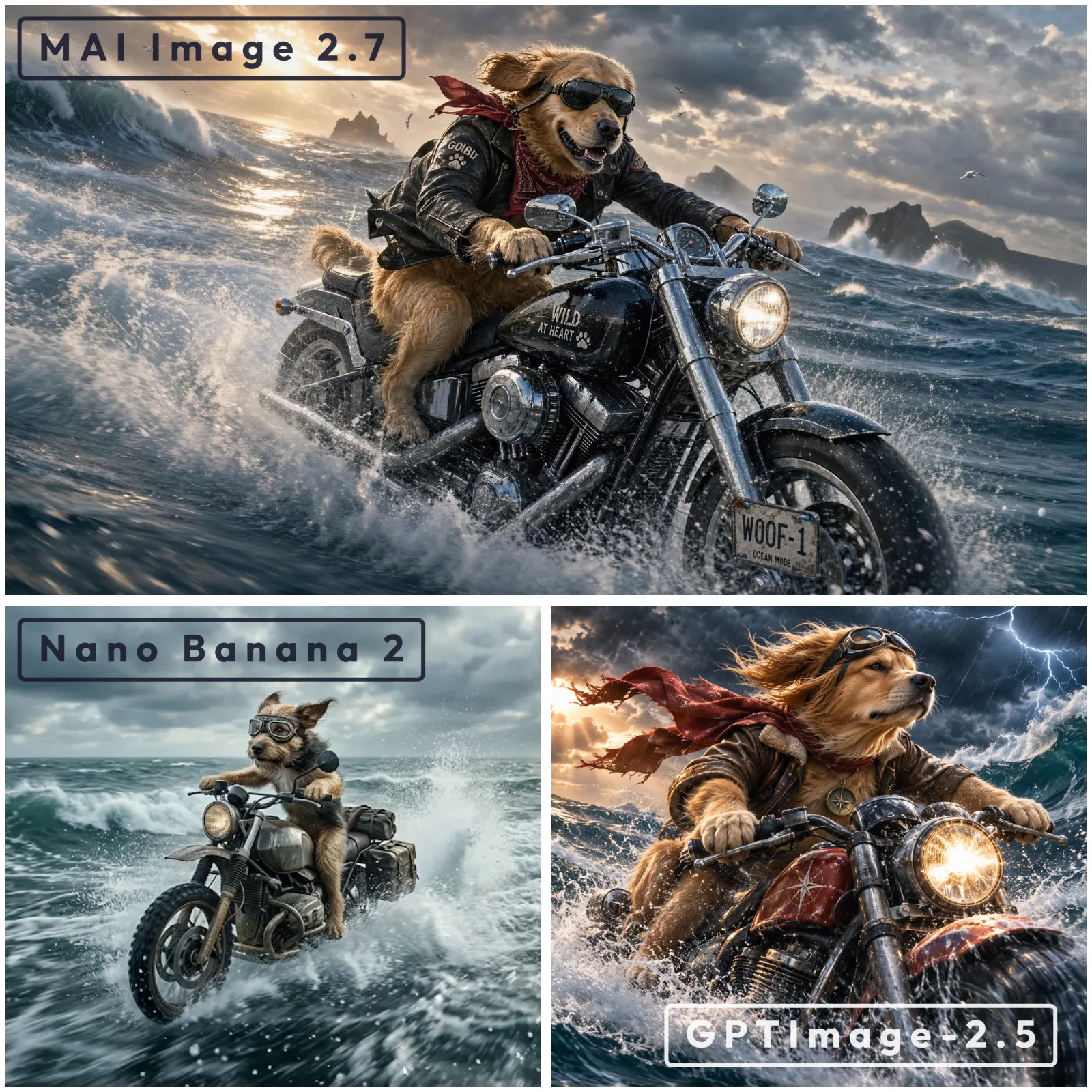
Beyond raw quality, the pricing discrepancy is difficult for enterprises to ignore. Microsoft quotes a rate of approximately $35 per 1,000 images for MAI Image 2.7 and just $10 for the Flash version. For comparison, the maximum quality output for GPT Image 2.6 Sunburst is priced significantly higher, at roughly $211 per 1,000 images, while Google’s offerings occupy a middle ground. While these costs vary based on resolution settings and provider agreements, the trend is clear: Microsoft is using its internal infrastructure to provide a cost-effective alternative that is increasingly difficult for competitors to match.
The latest release of MAI Image 2.7 introduces several practical improvements, including integrated editing via the Canvas workspace and support for transparent backgrounds, though the model remains subject to strict safety and content filters. By offering selected business customers the ability to license and run these model weights within the Azure cloud environment, Microsoft is providing a middle ground between public API access and full open-source adoption. This allows organizations to minimize their reliance on external vendors while maintaining control over their data, a critical requirement for enterprise adoption.
As Microsoft moves into the next phase of its specialized AI rollout, the industry will be watching closely to see if these models can maintain their performance edge outside of controlled testing environments. With Code 2 now live in GitHub Copilot and the rollout of Cyber 2 Flash approaching, the company is betting heavily that the future of enterprise AI lies not in the largest possible models, but in the most efficient ones.