
It is the second-most used material on Earth after water, an accelerating environmental disaster, and a ubiquitous foundation that appears to be falling apart all around us. Meet concrete, the sprawling and precarious subject of a new feature-length documentary by filmmaker John Wilson, a creator uniquely gifted at finding laugh-out-loud absurdity in the mundane and the overlooked corners of modern existence.
The History of Concrete stitches together quick cuts of handheld footage and deadpan narration, operating in the exact same stylistic vein as How To with John Wilson, the acclaimed HBO show that made the filmmaker’s career. Just as in his prior televised explorations of seemingly narrow topics like "how to make small talk" or "how to put up scaffolding," the titular subject of the film is not really the point. Instead, Wilson uses the theme of concrete as a kind of structural connective tissue, taking the viewer on a sprawling, unpredictable journey through the hidden folds of our shared reality.
The absolute pervasiveness of concrete allows this film to venture virtually anywhere without losing its narrative thread. Over the course of the runtime, audiences are whisked away to a family-run mortuary that specializes in human tattoo preservation, a fiercely patriotic brick-laying competition in Las Vegas, and a grueling 3,100-mile spiritual race in which dedicated runners endlessly circle a single block in Queens, New York, for weeks on end.
It would certainly be a stretch to classify the documentary as a traditional climate change film—indeed, it is explicitly styled with the deceptive aesthetic of a Hallmark movie. But with each deliberate turn of the camera lens, Wilson quietly sheds light on an unfolding environmental disaster of planetary proportions. After all, he points out with characteristic deadpan delivery, concrete is the third-biggest contributor to global warming on Earth. And although this dense material remains an indispensable component of modern infrastructure, its remarkably short and increasingly crumbling lifespan turns it into a ticking hazard on a planet growing more disaster-prone by the day.
Wilson’s personal fascination with the material began humbly enough, born from frustration when the basement of his apartment building in Queens began intermittently flooding. He attempted to patch the recurring leak himself using a standard store-bought concrete mix, only to watch helplessly as the water kept finding a way back in. His everyday frustration is, in truth, widely shared across dense urban centers. As climate change intensifies severe storms and steadily raises sea levels, residents in cities like New York are dealing with unprecedented levels of extreme rainfall and coastal flooding. The sheer abundance of concrete in these metropolitan hubs actively worsens flooding by sealing off the earth, preventing stormwater from naturally seeping into the soil. When that same aging concrete eventually cracks, it fails to block the relentless water from filling subway stations and building basements for dozens of days out of the year.
As the documentary progresses, Wilson discovers that our concrete-smothered world is brimming with structural hazards, largely owing to the material’s surprisingly short operational lifespan. Massive infrastructure projects, such as the historic Brooklyn Promenade—which makes up the uppermost deck of a complex four-layered expressway—were never engineered to last more than 40 years, according to Sam Schwartz, a former New York City traffic commissioner interviewed in the film. Today, that vital 1,800-foot-long transportation artery is perpetually covered in superficial patch jobs. Schwartz warns Wilson that a major mass catastrophe could be just a few years away if systemic overhauls are not prioritized.
With these stark facts firmly in mind, any modern city suddenly begins to look like a vast morass of potential disasters. It is little wonder that Wilson spent at least a year filming the widening cracks and decaying surfaces scattered across New York. Some locations, such as a public swimming pool sanitation facility continuously inundated with stubborn leaks, are granted a few minutes of contemplative screen time. Others, including the architecturally famous Spring Street Salt Shed—which viewers see patched incongruously with packing tape—and a ten-year-old skyscraper in midtown Manhattan that may already require total demolition, are presented in a rapid, jaw-dropping montage. As Wilson observes, it begins to feel as though "we’re all in danger somehow."
Perversely, the accelerating impacts of climate change are driving this degradation cycle even faster. Scientific studies consistently show that extreme weather events hasten the structural deterioration of concrete assets around the globe. And while Wilson does not explicitly dwell on this point in the film, it is worth noting that even structurally sound concrete poses distinct hazards as the planet warms. The material significantly contributes to the "urban heat island" effect, a phenomenon that can cause local air temperatures to spike by as much as 7 degrees Fahrenheit. This turns concrete pavement into a scalding 140-degree griddle during summer months, conditions responsible for killing hundreds of vulnerable people in Sun Belt cities like Phoenix every year.
Yet, as a pragmatic contractor bluntly tells Wilson in the documentary, "We’d be up a creek without concrete. It is used for everything." Megacities like New York require vast, continuous quantities of the material to construct new housing and maintain aging urban corridors. Unfortunately, sand—the fundamental ingredient required to produce concrete—is rapidly vanishing as coastlines erode and human civilization consumes some 50 billion tons of the resource every year. While the general public remains largely unaware of the impending crunch, experts have spent years trying to warn society of an unfolding global sand crisis.
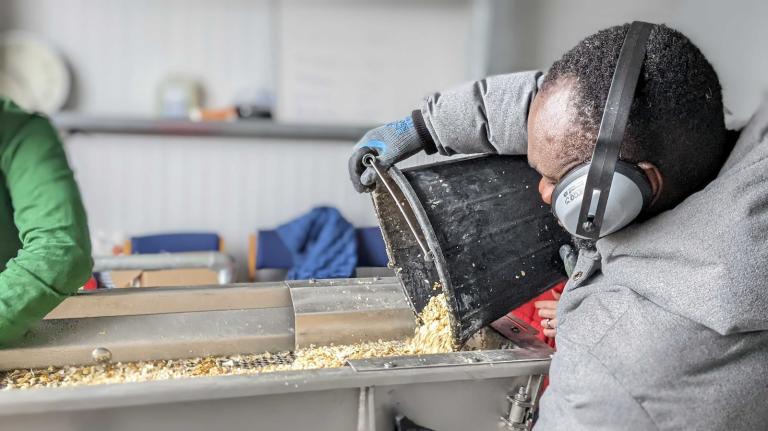
Near the conclusion of the film, Wilson takes a look inside a concrete recycling plant, representing one of the few existing industrial solutions to these compounding problems. These specialized facilities are designed to divert demolition debris away from overflowing landfills and, ideally, produce newly usable aggregate material with lower carbon emissions. However, the particular facility that Wilson located near Brooklyn’s marine terminal was also inadvertently filling nearby residential neighborhoods with dangerous clouds of airborne dust. The intense pollution sparked fierce community protests and ultimately led to the plant’s mandated closure in 2025.
For now, modern society’s heavy dependency on concrete seems just as intractable as its numerous physical and environmental pitfalls. "Once you’re used to something, it becomes hard to change your lifestyle without external pressure," Wilson reflects.
As a reporter who was already acutely aware of the environmental costs of concrete when first moving to New York City as an early-career climate journalist, the physical reality of being surrounded by so much of it was still jarring. It prompted deep questions regarding the commonly cited statistic that urban lifestyles inherently possess a smaller carbon footprint than suburban ones. After all, these academic studies generally account only for the energy and consumer materials residents utilize directly, while routinely leaving out the massive embodied emissions baked into the buildings, sewers, and foundational infrastructure that make city life possible in the first place.
Although back-of-the-envelope calculations still support the idea that dense city living remains the greener choice overall, walking out of the Manhattan theater where The History of Concrete premiered made the gray surroundings snap into sharper focus, as though the film had never actually stopped playing. There is a distinct kind of poetry embedded in Wilson’s work: the banal suddenly becomes beautiful, the bizarre becomes delightful, and systemic heartbreaks are rendered unguardedly funny. His relentless curiosity, bordering at times on voyeurism, serves as an open invitation to join him in the simple, radical act of paying attention.
Stepping back onto the pavement, those details emerge clearly: a toddler lying on her belly outside the gum-plastered entrance of a subway station; a dumpling food truck seemingly trapped in a stubborn street pothole; groups of women in elaborate ballgowns rushing past, their long hems dragging directly into street puddles. It is all part of a concrete world that, despite its impending flaws and hazards, is ultimately worth noticing.