
As the lights dimmed at the latest Shushu/Tong runway presentation in Shanghai, the atmosphere was instantly defined by a singular, charming gesture. Every seat was occupied by a brightly colored umbrella, a clear, evocative nod to Jacques Demy’s 1964 cinematic masterpiece, The Umbrellas of Cherbourg. This whimsical classic served as the primary touchstone for the design duo Liushu Lei and Yutong Jiang, who titled their Spring 2027 collection "Darling Melancholy." While the title suggested a sense of longing or bittersweet reflection, the collection itself offered a vibrant, high-energy interpretation of the French New Wave, filtered through the brand’s signature lens of "unreal" prettiness and youthful exuberance.
The show was a masterclass in aesthetic synthesis, blending the mod sensibilities of 1960s icons Mary Quant and André Courrèges with the contemporary, slightly off-kilter sweetness associated with brands like Miu Miu. The result was a collection that felt both like a historical homage and a forward-looking fashion statement, grounded in the distinctive, hyper-feminine vocabulary that has become the hallmark of the Shushu/Tong label.
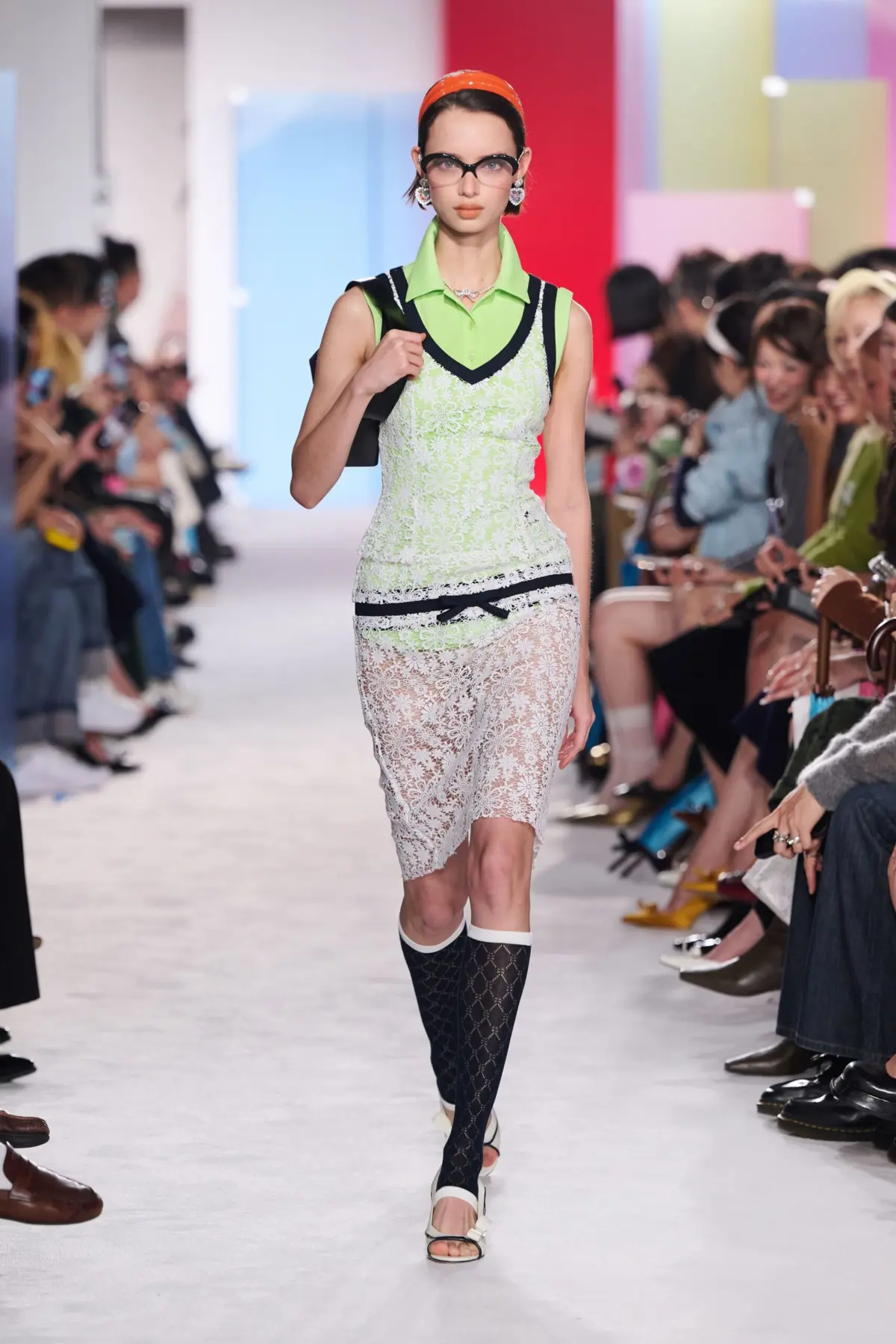
The runway was dominated by a parade of short, girlish silhouettes that seemed plucked from a mid-century dreamscape. There was a palpable focus on intricate details: petal-edged hemlines, voluminous balloon skirts, and delicate macramé lace, all rendered in a palette of candy-colored hues. To prevent the collection from feeling too restrained or overly delicate, the designers introduced a "drizzle" of embellishments. Beaded daisies were scattered throughout, providing a sense of levity and optimism that effectively neutralized any lingering sense of gloom.
Despite the collection’s title, "Darling Melancholy," the mood on the runway remained steadfastly upbeat. In Demy’s film, The Umbrellas of Cherbourg, the narrative is one of profound heartbreak and the passage of time. However, in the hands of Lei and Jiang, that melancholy was not treated as a weight to be carried. Instead, the designers gave it a bright pink umbrella and effectively told it to cheer up. The clothes did not yearn for the past; they celebrated it with a sense of playful irony and immaculate craftsmanship. The pieces were exceptionally pretty and neatly proportioned, maintaining the brand’s reputation for designs that are both visually arresting and disarmingly wearable for their core demographic.
While the primary focus was on the romantic, vintage-inspired aesthetic, the designers were careful to keep the collection feeling modern and relevant. Just as the sweetness of the silhouettes threatened to become overwhelming, a series of sporty details would emerge on the runway, breaking the rhythm and adding a touch of grit to the ensemble. These athletic influences were subtle—a clever nod to the reality of the modern woman’s wardrobe—but they provided the necessary tension to keep the collection from drifting too far into costume territory.
The accessories, however, were perhaps the most definitive element of the show. Each model carried a ladylike, boxy handbag, clutched in the crook of the arm with the rigid precision of a high-fashion accessory. These bags, which resembled vibrant Pop Art toys, served as the final exclamation point to each look. They bridged the gap between the mid-century inspiration and the current obsession with statement accessories, grounding the ethereal, "unreal" nature of the garments in something tactile and grounded.
Behind the scenes, designers Liushu Lei and Yutong Jiang provided further insight into the collection’s DNA. They spoke candidly about their lifelong fascinations with Japanese anime, a sensibility that has long informed the label’s aesthetic. Shushu/Tong has built its reputation on a foundation of schoolgirl uniform codes and a polished, almost surreal level of prettiness. This season, they explained, the goal was to take the spirit of the 1960s and pass it "through an Asian lens." The outcome was a collection that successfully shed any interest in the bittersweet longing typically associated with mid-century cinema.
In this specific collection, the "melancholy" mentioned in the title was effectively relegated to a conceptual framing device—a nod to the aesthetic origins of their inspiration—rather than an emotional reality of the clothing itself. The skirts, the lace, and the bold, saturated colors were entirely devoid of sadness. If anything, the collection was a testament to the power of design to rewrite a narrative. By stripping away the heaviness of the source material and replacing it with impeccable tailoring and whimsical, youthful styling, Shushu/Tong managed to create a collection that felt entirely fresh.
The audience, comprised of the brand’s well-groomed and loyal front-row clientele, watched the procession with the focused, analytical intensity of Very Important Customers. As each look passed, the observers were not merely witnessing a fashion show; they were mentally curating their future wardrobes. The laser-focused attention of these attendees—many of whom are well-known within the industry as trendsetters and high-value buyers—confirmed that the collection had hit its mark. There was a clear, shared understanding that these pieces were not just runway concepts, but highly desirable, wearable assets that would soon become staples for the brand’s most devoted followers.
As the show concluded, the success of the presentation was evident not just in the applause, but in the immediate reaction of the attendees. The collection had achieved a difficult balance: it was grounded in a specific, nostalgic cultural reference, yet it felt entirely disconnected from the limitations of that history. By choosing to prioritize the "pretty" over the "melancholy," Shushu/Tong solidified its position as a label that understands exactly what its audience wants—a blend of high-concept design, meticulous attention to detail, and an unapologetic, joyful approach to femininity.
The "Darling Melancholy" collection serves as a pivotal moment for the brand. It demonstrates a maturation of their design language, showing that they can engage with complex cultural touchstones without losing their signature identity. While the umbrellas on the seats were a nod to a story of heartbreak, the collection they introduced was a story of resilience and, more importantly, a story of style. For Shushu/Tong, the future of fashion seems to lie in this exact intersection: where the cinematic ghosts of the past are invited to the party, given a bright new outfit, and encouraged to leave their sorrows behind. As the Shanghai Spring 2027 season continues, the influence of this particular show—and the high-octane, candy-colored optimism it projected—is likely to be felt across the wider fashion landscape, setting a tone for a season that values the transformative power of a well-tailored skirt and a perfectly placed beaded daisy.