
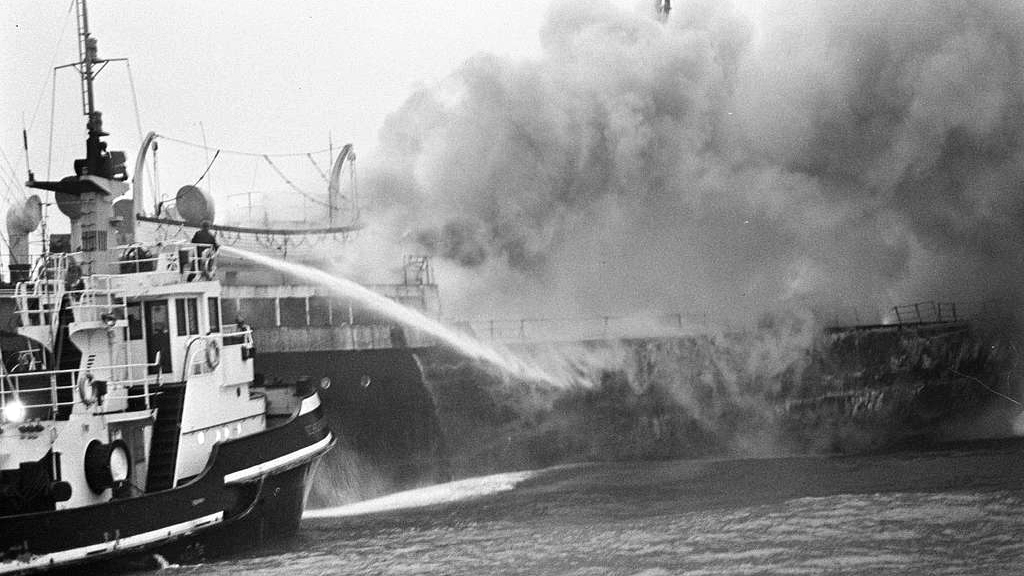
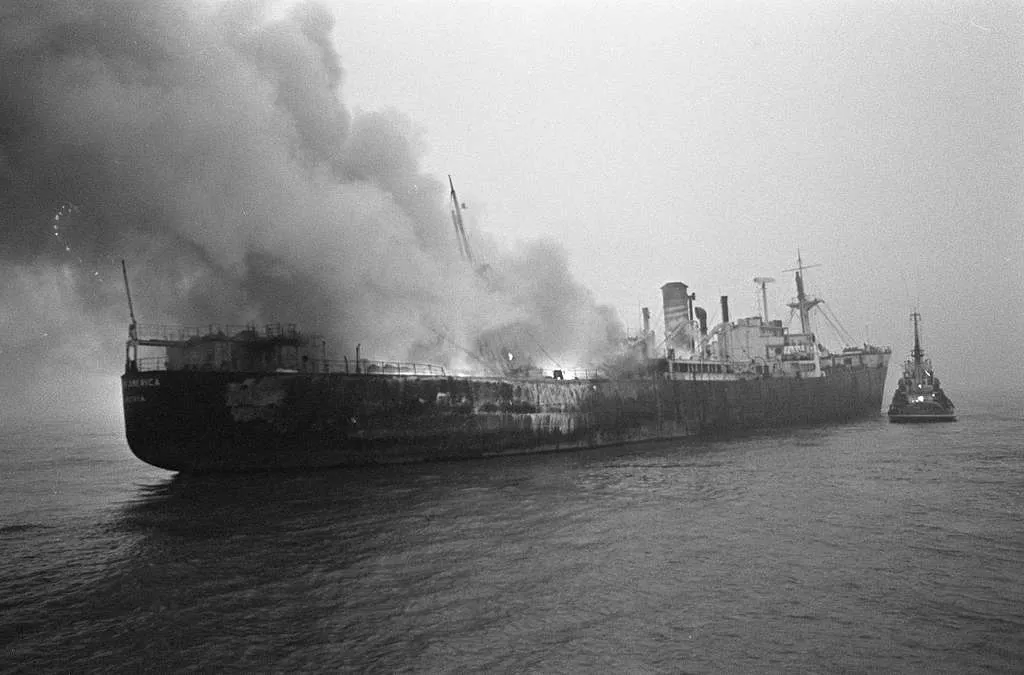
In January 1966, a South African cargo ship caught fire at sea, initiating a maritime crisis that would soon expose a dangerous vulnerability in the global shipping and agricultural industries. When the vessel docked in Bristol, England, firefighters pried open a smoking container, accidentally allowing oxygen to rush in and feed a massive conflagration that burned continuously for five days. Just over a month later, a Liberian steamship caught fire near Rotterdam, igniting a storage area filled with barrels of petrol before sinking entirely. The following month, a Danish ship caught fire off the coast of Long Beach, California, resulting in three injured firefighters, the death of a dockworker, and more than a million dollars in estimated damages.
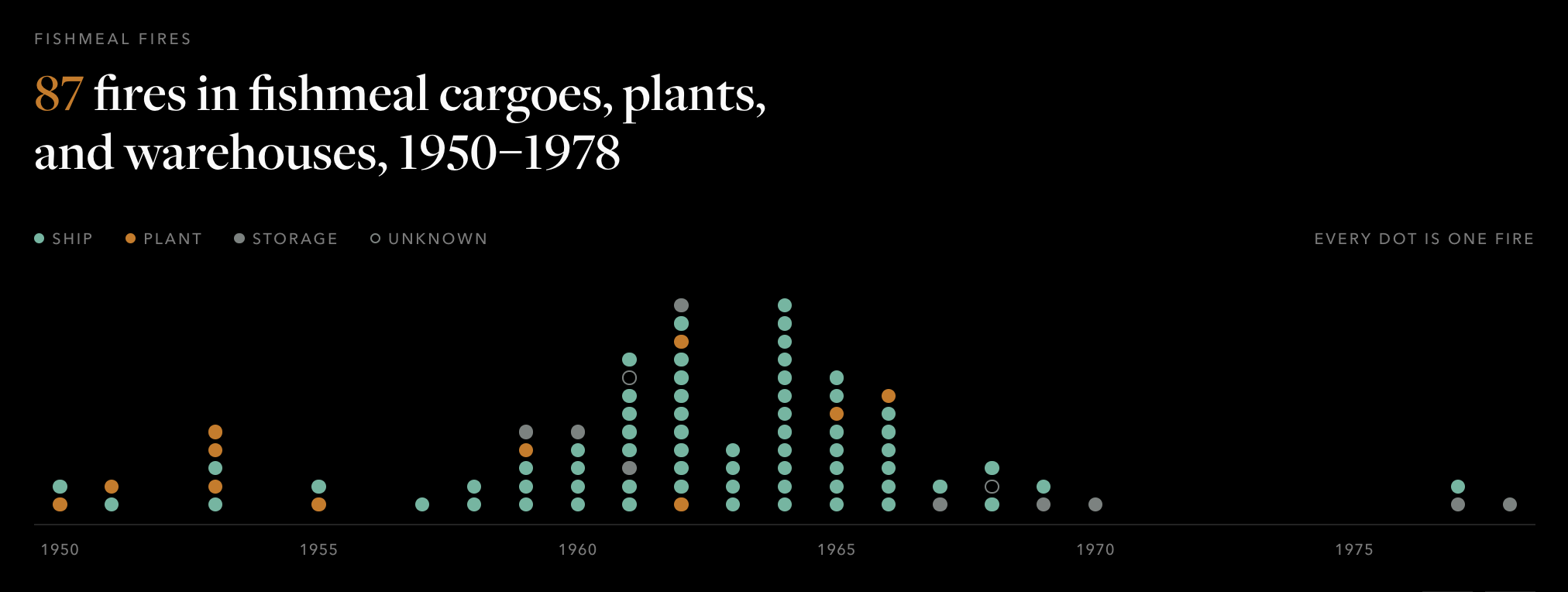
The common culprit behind these disasters was not faulty wiring, engine failure, or human error, but rather fishmeal—a dark yellow powder manufactured by drying and pulverizing fish. Left untreated, fishmeal is notoriously prone to spontaneous combustion as it naturally decays and oxidizes during transit. According to a comprehensive review of historical news coverage conducted by The Outlaw Ocean Project, a Washington, D.C.-based investigative news organization, fishmeal’s extreme combustibility was directly linked to at least 90 ship and plant fires between the 1950s and the 1970s. This volatility presented an ongoing and catastrophic hazard for seafarers, marine insurers, and dock workers worldwide.
The Turning Point: The Introduction of Ethoxyquin
In 1967, American feed producer Cargill announced an apparent industrial solution: ethoxyquin. Originally developed as a fire retardant to prevent rubber tires from drying out and subsequently applied as a preservative on fruits and alfalfa, the production of this synthetic antioxidant was rapidly ramped up to meet the demands of the maritime and agricultural sectors.
Industry leaders quickly embraced the chemical. In 1966, the director of the Canadian Department of Fisheries told an industry publication that antioxidant treatment had made bulk handling an effortless matter, forcefully arguing that its application should be mandatory for all fishmeal shipments.
The chemical proved remarkably effective at subduing the volatile powder. By the 1970s, press-reported fires dropped sharply, falling from a typical 16 ship fires per year, according to data from the Liverpool Underwriters Association, down to just five. Recognizing its efficacy, the U.S. Coast Guard imposed mandatory ethoxyquin treatment on fishmeal shipments by 1976. Three years later, the United Nations body overseeing global maritime activity officially recommended that all fishmeal be treated with the chemical specifically to prevent spontaneous combustion.
Yet, this industrial fix carried a profound biological cost: ethoxyquin is a carcinogen. As early as 1969, a research paper published by United Nations food and agriculture authorities warned that toxic effects had been observed in laboratory animals fed high concentrations of the chemical.
As the use of ethoxyquin expanded exponentially alongside the growth of animal feeds and global aquaculture, independent scientific scrutiny intensified. A 1987 study conducted by British researchers concluded that the chemical caused severe damage and carried a potentially carcinogenic effect in rats. Decades later, in 2015, the European Food Safety Authority warned that a specific impurity within ethoxyquin known as p-phenetidine was capable of inducing mutations in genetic material.
A Fractured Global Regulatory Landscape

Despite mounting scientific concerns, a unified global consensus regarding the safety of consuming farmed seafood raised on ethoxyquin-treated feed has never fully materialized. However, individual nations and regional bodies have increasingly judged the risks high enough to warrant severe restrictions or outright bans. In 2017, the European Commission took decisive action, suspending authorization for the use of ethoxyquin in animal feed across the entire European Union.
Today, the chemical is entirely banned in the United Kingdom and across members of the European Economic Area, including Norway, Iceland, and Liechtenstein. Conversely, ethoxyquin remains legally permitted within specific regulatory limits in animal feed across Australia, Japan, South Korea, and the United States.
This regulatory fragmentation presents a significant oversight challenge for the modern global food supply. With more than half of all seafood consumed worldwide now originating from fish farms—and with the vast majority of those farmed species sustained on diets containing fishmeal and fish oil—scrutinizing feed additives is crucial for evaluating potential contamination across the international food chain.
Although ethoxyquin is not banned in the United States, it has increasingly become the focal point of high-stakes litigation. Over the past several years, the chemical has sparked roughly half-dozen lawsuits, primarily centered on allegations of deceptive marketing and false advertising. Plaintiffs have targeted prominent seafood companies for marketing their products as environmentally sustainable despite the presence of ethoxyquin, while other legal complaints have emphasized the environmental risks the additive poses to fragile aquatic ecosystems.
Legal Challenges and Regulatory Gaps
In 2022, a New York resident initiated a class-action lawsuit against Aldi Inc., a major German supermarket chain operating stores across the United States. The complaint alleged that the retailer’s Atlantic salmon products were deceptively labeled as sustainable despite relying on environmentally destructive practices. Citing the European Union’s sweeping ban on ethoxyquin and scientific studies linking the chemical to mortality and developmental deformations in fish and crustaceans, the lawsuit asserted that the feed additive poses a direct hazard to aquatic life. The legal matter was ultimately settled out of court.
That same year, residents from New York and California filed a joint lawsuit against Gorton’s Inc., a well-known seafood company, challenging the marketing of its frozen tilapia as sustainably sourced. Like the Aldi complaint, this litigation highlighted the European Union’s regulatory ban and the chemical’s proven risks to marine organisms. This case similarly concluded with an out-of-court settlement.
Meanwhile, regulatory enforcement in North America has faced intense scrutiny. In Canada, the Canadian Food Inspection Agency requires animal feeds containing ethoxyquin to carry labels verifying compliance with legal limits. However, the agency does not specify how it tests for the chemical within feed mixtures. According to the agency’s most recent food inspection report from 2022, inspectors also fail to verify whether ethoxyquin residues ultimately transfer into the consumable seafood itself. Furthermore, a 2024 audit of the Canadian agency conducted by the European Union revealed that officials completed only about 40 percent of their planned inspections, citing systematic and significant under-delivery in testing seafood products.
The Shift Toward Alternatives and Ongoing Risks
Facing tightening international standards, major agribusiness and feed corporations have begun altering their supply chains. Cargill stated that it has actively assessed alternative antioxidants since 2005 and no longer utilizes ethoxyquin in its global salmon feed operations, nor in any market where the chemical lacks regulatory authorization. The company also emphasized that it did not originally develop ethoxyquin. Across the industry, producers and feed manufacturers have increasingly pivoted toward natural alternatives, such as rosemary extract and various vitamin E compounds.
James Frank, managing director of the Peruvian fishmeal company MSICeres, noted during a 2022 industry webinar that market pressures are driving rapid change. He explained that a growing number of destinations are rejecting ethoxyquin altogether, beginning with the domestic Peruvian market. Frank added that 100 percent of Peru’s fishmeal exports to Europe, Canada, the United States, and Australia are now entirely ethoxyquin-free, a transition mirrored by major seafood companies operating in the U.K. and Norway.
Nevertheless, the industry’s primary synthetic replacement carries its own troubling baggage. The most popular commercial alternative to ethoxyquin is butylated hydroxyanisole, commonly known as BHA, which is favored by manufacturers for its lower cost and robust antioxidant performance compared to fully natural additives. Yet, like the chemical it was designed to replace, BHA is associated with significant health concerns.
The U.S. National Toxicology Program identified BHA as reasonably anticipated to be a human carcinogen as early as 1991, and Japanese researchers published findings in 2008 demonstrating that the substance caused malignant tumors in laboratory rats. Amid these persistent concerns, the U.S. Food and Drug Administration announced a formal safety reassessment of BHA as a common food preservative.
As global demand for seafood continues to climb, the aquaculture industry is guaranteed to expand further. While future innovations may eventually prompt a widespread transition away from carnivorous farmed species or yield entirely novel replacements for fishmeal, the current reality reflects a persistent industrial loop. For decades, the aquaculture and fishmeal sectors have pivoted from catastrophic ship fires to a carcinogenic fire retardant, only to find themselves navigating yet another cycle of chemical replacement and environmental risk.