
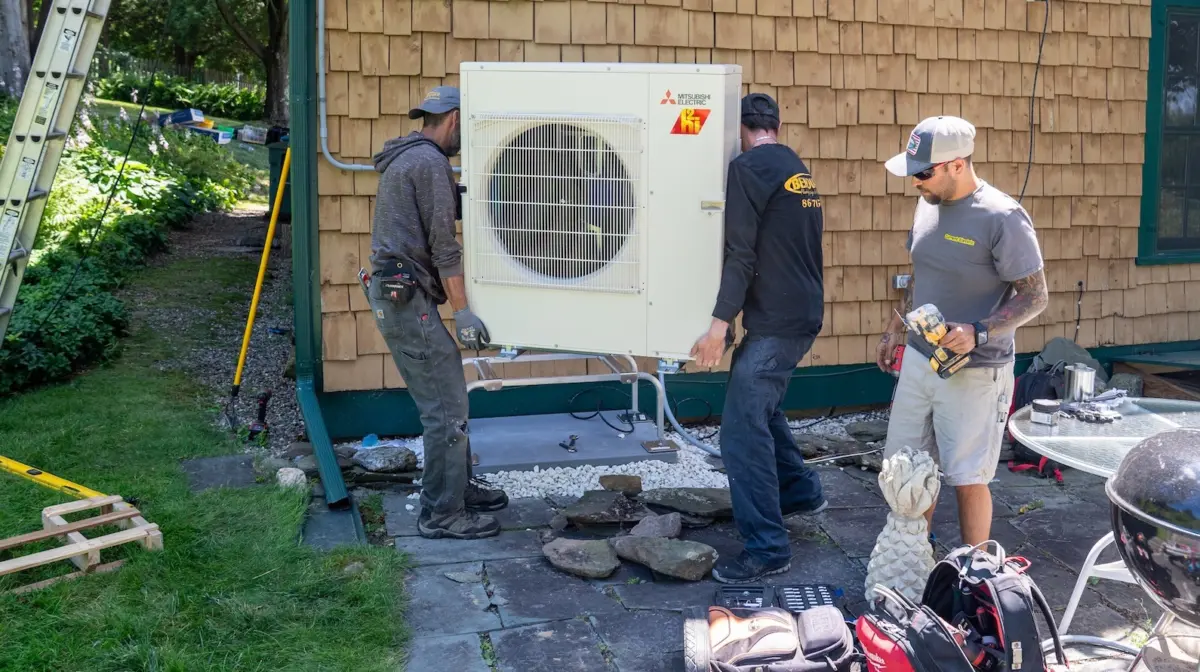
For years, a pair of persistent misconceptions has shadowed the transition toward clean-energy home appliances: that heat pumps stop working when winter temperatures plummet, and that flooding the market with these electric units will inevitably cause the national power grid to collapse.
According to energy experts and new empirical data, both claims are fundamentally incorrect. Far from being a vulnerability, a massive nationwide shift toward heat pumps could actually optimize existing infrastructure, lower electricity rates, and significantly slash carbon emissions across the United States.
Dispelling the Deep-Freeze Myth
A common piece of skepticism surrounding heat pumps is that they are useless in freezing weather because they transfer warmth from outdoor air rather than generating it directly through combustion, unlike traditional gas furnaces. While early iterations struggled in subzero temperatures, modern engineering has completely altered that reality. Today’s models, specifically designed for frigid climates, are engineered to keep indoor spaces comfortable even in the dead of winter.
Skeptics need look no further than the Nordic countries, which have fully committed to heat pumps despite enduring winters that are notoriously harsh. Closer to home, even notoriously cold locations like Juneau, Alaska, have embraced the technology successfully.
With efficiency concerns largely put to rest by technological advancements, Americans are increasingly warming up to the appliances. However, a second, more systemic worry remains prevalent among critics: the fear that powering millions of new electric heating systems will overwhelm local utility providers and cause blackouts.
Unlocking the Grid’s Hidden Winter "Headroom"
A comprehensive report from the energy think tank RMI challenges the narrative that the U.S. power grid cannot handle widespread electrification. The research reveals that thanks to a seasonal phenomenon known as "headroom" in the grid during the winter months, roughly three-quarters of all American homes—translating to approximately 109 million households—could adopt heat pumps immediately without requiring major infrastructure overhauls.
Adopting this technology at scale would not only dramatically reduce greenhouse gas emissions but could also slash electric bills by over 20 percent in several states.
"A substantial number of homes can upgrade to heat pumps within the headroom today," said Ryan Shea, a manager in RMI’s buildings team. "We’d be better utilizing the grid capacity that’s already there, that essentially spreads those costs across more kilowatt-hours, and everyone benefits with a lower electricity rate."
To understand this dynamic, one must examine how electricity demand fluctuates throughout the year. Typically, the peak demand for electricity in the United States occurs during the scorching summer months, when millions of air conditioning units run simultaneously, gobbling up tremendous amounts of power. During the winter, however, many residents rely on gas furnaces for heat, drawing energy from fossil fuel networks rather than the electrical grid. This shift relieves immense seasonal strain on the electrical system.
The result is a vast surplus of unused generation capacity during the coldest months of the year.
"That’s where we see moving to heat pumps, adding that electrical load in the winter, where there is all that available grid capacity, is a way to add load to the grid without needing to build it out more," Shea explained. In practical terms, keeping 109 million heat pumps running smoothly through the winter months would not require constructing heaps of expensive, polluting new gas-fired power plants.
Regional Variations and the Rise of Renewables
Of course, this seasonal buffer is not uniform across every state or region. Climate variations dictate different usage patterns. For instance, cities like Phoenix experience blistering summers that demand heavy air conditioning use, followed by very mild winters that require minimal heating, whereas Boston experiences a more balanced seasonal split.
Furthermore, the methods local utilities use to generate electricity play a critical role in how the grid handles shifting loads. While traditional gas power plants can operate consistently year-round, the rapid expansion of solar power introduces new variables, as solar generation naturally dips during the shorter days of winter.
To compensate for these seasonal fluctuations in renewable energy generation, utilities across the country are actively investing in sprawling battery farms to store excess energy for later use. Some are even experimenting with vehicle-to-grid technology, utilizing the massive batteries in parked electric vehicles as a decentralized network of backup power storage. In certain regions, innovators are even utilizing the Earth itself as a giant thermal battery for longer-duration energy storage.
Combined, renewables and modern storage technologies are making the electrical grid significantly more flexible and reliable than it was under a system reliant purely on fossil fuels. This flexibility ultimately protects ratepayers from price volatility and lowers overall system costs.
Moving Beyond Electric Resistance Heating
While the ultimate goal for energy planners is to have heat pumps completely replace fossil fuels as the dominant method for both space heating and cooling, they also serve as a vital upgrade over existing electric resistance heating systems, such as baseboard heaters and portable space heaters.
Electric resistance heaters are particularly common in regions like the Pacific Northwest and the Southeast, where winters are generally milder than in the Northeast. While these appliances are an improvement over gas furnaces because they do not burn fossil fuels or pollute indoor air with toxic combustion byproducts, they are drastically less efficient than heat pumps.
Heat pumps are roughly three to four times more efficient than standard resistance heaters, meaning they deliver the same amount of warmth while consuming a fraction of the electricity. According to previous research from RMI, households that transition away from electric resistance heating to modern heat pumps could save an average of $1,530 annually on their energy bills.
Accelerating the Transition
Policymakers and industry analysts are increasingly looking at ways to accelerate the nation’s transition toward heat pumps. One of the most straightforward pathways is replacement policy: whenever an aging, conventional air conditioning unit finally breaks down, homeowners should replace it with a reversible heat pump that handles both cooling in the summer and heating in the winter.
State governments can play a catalytic role by offering financial rebates and incentives to offset initial purchase and installation costs. When states commit fully to these initiatives, the transformation can happen at a surprisingly rapid pace. Maine, a state hardly known for mild winters, successfully surpassed its ambitious goal of installing 100,000 heat pumps two full years ahead of schedule, prompting Governor Janet Mills to set even higher targets.
Interestingly, broader societal shifts—such as building more multi-family housing to address the ongoing national housing shortage—can also serve as an unexpected mechanism for accelerating adoption. Constructing modern, energy-efficient apartments provides a streamlined opportunity to install heat pumps at scale, representing a rare point of agreement among policymakers across the political spectrum.
As affordability continues to dominate political and economic discussions across the United States, efficient home climate control is emerging as a critical component of household financial relief. By disproving the myths surrounding cold-weather performance and grid capacity, heat pumps are positioning themselves not just as an environmental necessity, but as an economic win for consumers.
"We really think there’s a reason to include heat pumps within those affordability plans," Shea concluded, "and try to really establish some heat pump installation goals."