
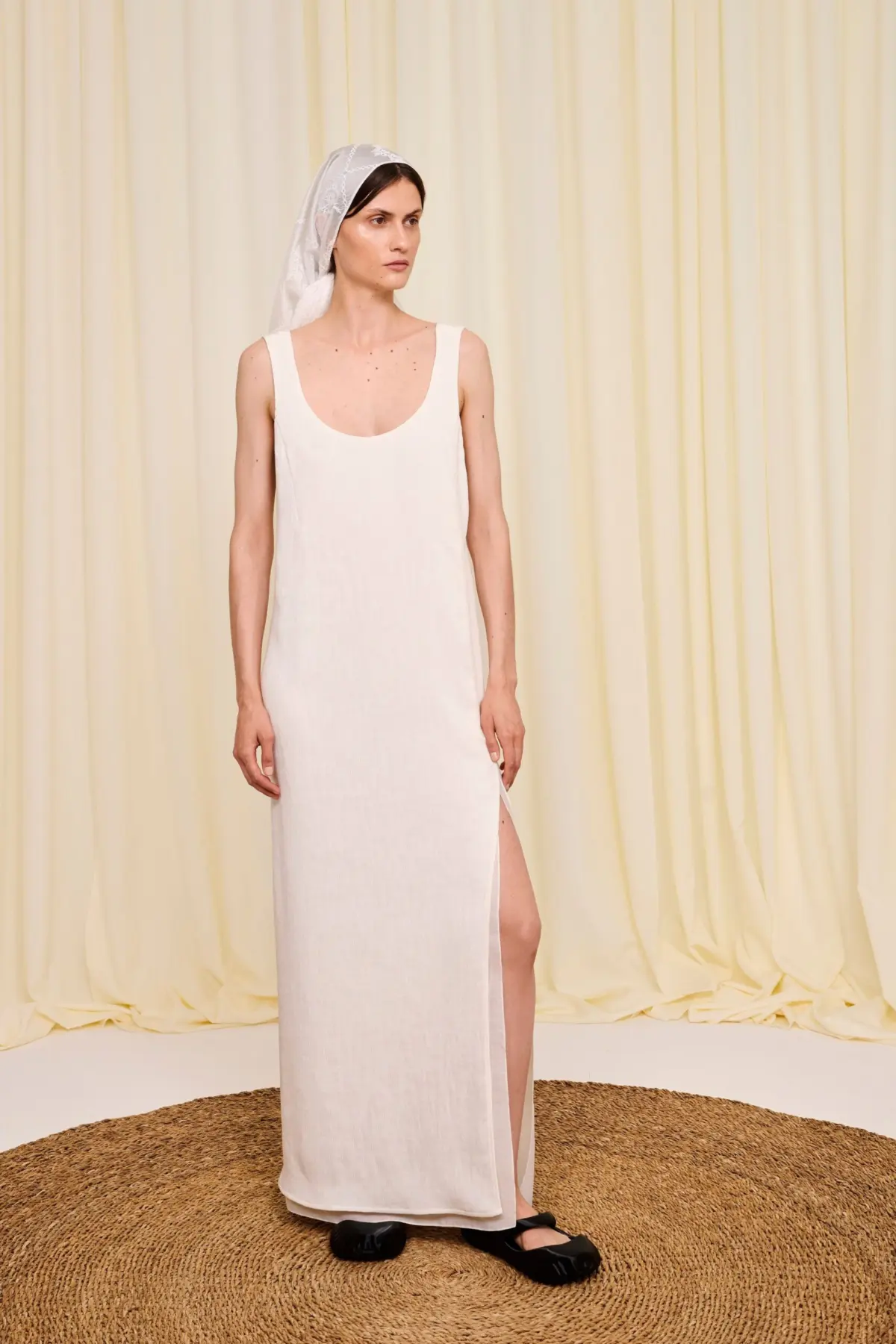
For the upcoming spring season, the creative team at Nehera, led by Ladislav Zdút, has continued their deep-dive into a thematic narrative that first emerged earlier this year. The brand’s latest collection serves as a conceptual bridge, linking the aesthetics introduced in their recent menswear line—inspired by the Hungarian vacation destination of Lake Balaton—with the balletic motifs that defined their previous fall ready-to-wear offerings. The result is a nuanced exploration of atmosphere, memory, and the friction between tranquility and underlying social anxiety.
At the heart of the collection lies a sophisticated, if somewhat paradoxical, philosophy. Zdút, acting as the brand’s CEO, describes the inspiration as a study of contrasts. On one side of the spectrum is the pervasive mood of the summer resort: the feeling of a slow, lazy, and heat-drenched afternoon. It is an atmosphere of total relaxation, intended to capture the essence of a holiday spent by the water. Yet, juxtaposed against this lethargic ease is a darker, more intellectual thread that references themes of rebirth, crisis, and historical instability.
The specific historical resonance that Zdút points to is perhaps the most striking element of the collection’s intellectual framework. He notes that during the era of communist regimes in Central and Eastern Europe, the broadcast of Tchaikovsky’s "Swan Lake" on television became a telltale sign of political uncertainty. Whenever the government felt its grip on power slipping or the regime faced a period of internal instability, the state would cycle the ballet as a way to occupy the airwaves and maintain a facade of calm. By weaving these references into the fabric of a spring collection, Nehera is engaging in a dialogue about how history, culture, and trauma linger in the collective consciousness, even when the immediate context—a summer vacation—suggests otherwise.
This darker, more complex mood is intentionally subtle, woven into the collection in a way that requires a discerning eye to fully appreciate. Despite the heavy historical weight of the inspiration, the clothes themselves remain remarkably wearable and light. The collection avoids the trap of becoming overly conceptual or avant-garde, opting instead for a tactile, soft approach that emphasizes comfort and ease. The tailoring is characteristically roomy, eschewing rigid structures in favor of fluid silhouettes that mirror the "airiness" that defines the brand’s vision for the spring season.
The garments themselves reflect this commitment to a relaxed lifestyle. A long, tank-style dress serves as a standout piece, evoking a distinct "out-of-office" vibe that fits perfectly with the resort-inspired narrative. These pieces feel designed for movement and warmth, utilizing cuts that drape away from the body to emphasize comfort in the heat. There is a sense of deliberate simplicity in the construction, allowing the fabric and the silhouette to do the heavy lifting rather than relying on ornate embellishments or aggressive styling.
However, the collection does not shy away from visual impact. Alongside the more muted, lounge-ready pieces, there are shorter, more vibrant styles that act as a focal point for the season. Among these is a dress rendered in a bold, eye-catching shade of red. This specific choice of color is a direct nod to the bright, plastic swim inflatables that once dotted the shores of Lake Balaton during the height of its popularity. It is a nostalgic touch that grounds the collection in the specific geography and visual language of the Hungarian landscape, bridging the gap between the memory of the resort and the reality of the present-day garment.
To further amplify the theme of airiness, many of the shorter dresses feature dangling streamers. These elements are not merely decorative; they serve to animate the clothing, catching the breeze and creating a sense of constant, gentle motion. This stylistic choice reinforces the seasonal focus on lightness, effectively balancing the collection’s deeper, more somber intellectual roots with the playful, ephemeral nature of spring fashion. The streamers act as a visual manifestation of the wind, the water, and the fleeting nature of both leisure and political stability.
The success of this collection lies in its ability to reconcile these two opposing forces. It is rare to find a fashion house that can seamlessly integrate the anxiety of political history with the sun-drenched ease of a summer holiday, yet Nehera manages to do so without creating a disjointed narrative. The "distress" that Zdút references is present not as a literal interpretation, but as a subtle undercurrent—a feeling of something significant happening just beneath the surface of a seemingly perfect, quiet day.
For the modern consumer, this approach offers more than just a seasonal wardrobe; it offers a narrative. By grounding their designs in the specific, localized history of Lake Balaton and the cultural shorthand of Tchaikovsky, the team at Nehera creates a garment that feels intentional. The wearer is invited to participate in this story of rebirth and crisis, moving through the world in clothing that is as much about the intellectual journey as it is about the physical comfort of a well-cut dress or tailored trouser.
As the industry continues to grapple with the role of storytelling in fashion, Nehera’s latest work stands as a testament to the power of context. The clothes do not need to shout to be heard. Instead, they whisper, allowing the wearer to discover the layers of meaning embedded within the seams and folds. The "slow, lazy, hot" atmosphere of the resort remains the primary experience for the observer, while the historical tension serves as an essential, quiet backbone that prevents the collection from feeling merely superficial.
In looking toward the spring, the brand has solidified its reputation for producing clothing that respects the intelligence of its audience. By refusing to simplify their inspirations, they have created a collection that is both beautiful in its simplicity and profound in its scope. The interplay between the vibrant red inflatables of the past and the somber echoes of "Swan Lake" provides a rich, multi-dimensional experience. It is a collection that encourages us to look closer at the world around us—to appreciate the quiet moments of peace, while acknowledging the complex, often turbulent history that has paved the way for our present reality.
Ultimately, the spring collection serves as a poignant reminder that fashion is a language, and Nehera is using that language to explore the duality of the human experience. Whether it is the weight of a memory or the lightness of a summer breeze, every element of the collection works in harmony to tell a story of resilience, change, and the persistent search for beauty in even the most uncertain of times. The result is a series of looks that feel entirely relevant, sophisticated, and deeply human, marking yet another significant step forward for the label’s ongoing creative evolution.