
Some losses in life refuse the tidy, cinematic narrative arc of adversity overcome. There is rarely a singular moment where pain simply evaporates, replaced by the polished veneer of "moving on." Instead, the human experience is often defined by the quiet, lingering question of how to keep moving forward without the pretense of having left those formative hardships behind. It was precisely this tension—the struggle to reconcile past wounds with a present reality—that informed the latest collection from Oude Waag designer Jingwei Yin. Drawing deeply from a difficult period in his own life, Yin sought to trace a gradual, non-linear shift from emotional armor toward a more open, accepting state of mind. The resulting collection, which debuted to critical interest, avoided the trap of solemnity, proving most persuasive when it allowed opposing impulses to play off one another rather than forcing them into a false sense of reconciliation.
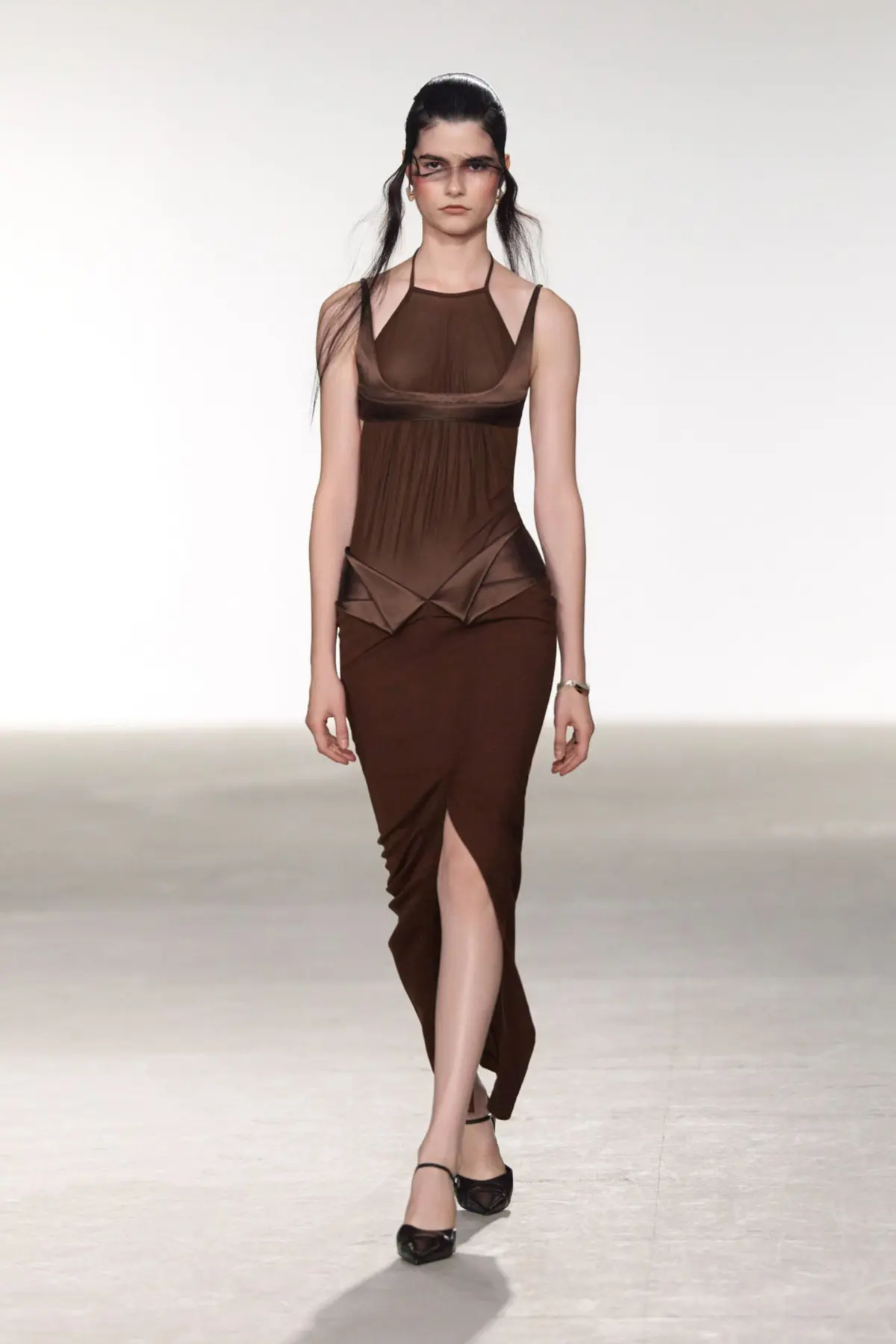
The collection functioned as a visual meditation on the fragility of the human spirit. On the runway, this was articulated through a dialogue between sharp, protective tailoring and the vulnerable, fluid nature of unencumbered fabric. Neat, structured contours—representative of the armor one builds to survive trauma—were placed in direct conversation with liquid draping, floating chiffon, and washed, timeworn surfaces. This contrast was not merely aesthetic; it lent the garments a palpable sensuality. When the construction gave substance to these softer elements, the effect was one of profound allure, suggesting that true strength lies not in rigidity, but in the capacity to remain open despite past fractures.
Jingwei Yin has long been regarded as a thoughtful and sophisticated voice in contemporary design, a reputation bolstered by his rigorous professional background. Having previously worked under the mentorship of Haider Ackermann, Yin clearly internalized a masterclass in the architecture of clothing. From Ackermann, he inherited a deep reverence for the precision of tailoring and the poetic possibilities of draping. Yet, Yin’s work is distinct for the way he synthesizes these Western techniques with a broader, more global perspective.
"I see a connection between draping and the flat-cutting techniques of Eastern and Japanese design, and I try to bring these approaches together in a modern way," Yin explained, reflecting on his creative process. "Draping is a form of drawing, even sculpture, requiring the eye, mind, and hands to work as one." This hands-on philosophy was evident in every garment that walked the runway. The clothes did not look as though they had been merely manufactured; they appeared to have been formed in real-time, with fabrics knotted, twisted, and gathered around the body in ways that felt both deliberate and organic.
The technical prowess on display was balanced by an embrace of chance. Yin incorporated ink-splash prints throughout the collection, a detail inspired by the pomo technique of traditional Chinese ink painting. In these paintings, the artist often cedes a degree of control to the medium, allowing the ink to bleed or settle in unexpected patterns. By introducing this element into an otherwise meticulously calibrated collection, Yin mirrored the unpredictability of the healing process. Just as grief does not follow a prescribed path, the prints disrupted the structural order of the tailoring, injecting a sense of spontaneity into the silhouette.
The color palette reinforced this narrative of gradual transformation. The show opened with a heavy focus on earthy browns and muted, weathered grays—colors that felt grounded, perhaps even somber, evoking the weight of experience. As the presentation progressed, these tones eventually gave way to a sudden, striking slash of crimson. It was not a grand, theatrical declaration of recovery or a triumphant "happy ending." Instead, the flash of red felt like a renewed appetite for life, a subtle signal that while the past remains, the present has regained its color.
This conceptual depth is what made the collection so compelling. It did not promise a cure for the difficulties Yin was exploring; rather, it offered an honest acknowledgment that life rarely proceeds in a straight, predictable line. The clothes were at their most convincing when they gave physical form to this idea, allowing for contradictions, loose ends, and unexpected turns without feeling the need to spell out a neat moral lesson for the audience.
Yin’s approach to fashion is inherently psychological. He views his work not just as a means of covering the body, but as a way to interpret the complexities of the human condition, specifically the female experience. "I love women’s complexities," Yin remarked after the show. "But above all, I’m drawn to their mystery." This focus on mystery explains the allure of his silhouettes; they do not reveal everything at once. They invite the viewer to look closer, to understand the tension between the structured exterior and the fluid, shifting interior.
In an industry that often demands constant reinvention and clear, marketable narratives, Jingwei Yin’s latest collection for Oude Waag stands out for its refusal to oversimplify. By weaving his personal history into the very seams of his garments, he created a collection that felt authentic, vulnerable, and deeply human. The interplay of fabric and form served as a reminder that resilience is not about becoming harder or tougher, but about finding a way to carry one’s history while remaining open to the world.
As the final looks were presented, the audience was left with the impression of a designer who is still evolving, both in his technical craft and in his ability to translate abstract emotion into tangible, wearable art. The success of this collection lies in its restraint. It respected the intelligence of the wearer, allowing the clothes to exist as a quiet testament to the idea that, even after the most difficult periods, there is beauty to be found in the ongoing, imperfect process of living.
Ultimately, Jingwei Yin has managed to capture the essence of a very specific, modern struggle. By blending the precision of high-level tailoring with the organic, unpredictable nature of ink-inspired textiles, he has created a visual language that speaks to the persistence of the human spirit. There was no need for a dramatic finale or an explicit explanation of his intent. The clothes themselves—with their knotted fabrics, their sudden splashes of color, and their delicate, floating chiffon—told the story of a man moving through the world, turning his experiences into something that, while perhaps marked by the past, is undeniably focused on the future. The collection serves as a powerful reminder that in fashion, as in life, the most beautiful moments are often those that arise from our willingness to embrace the mystery, the contradiction, and the fluid, non-linear path of our own experiences. Through this latest offering, Oude Waag has solidified its place as a house that prioritizes emotional resonance as much as technical excellence, ensuring that Jingwei Yin’s work continues to resonate with those who see their own complexities reflected in his sophisticated, mysterious, and deeply considered designs.