
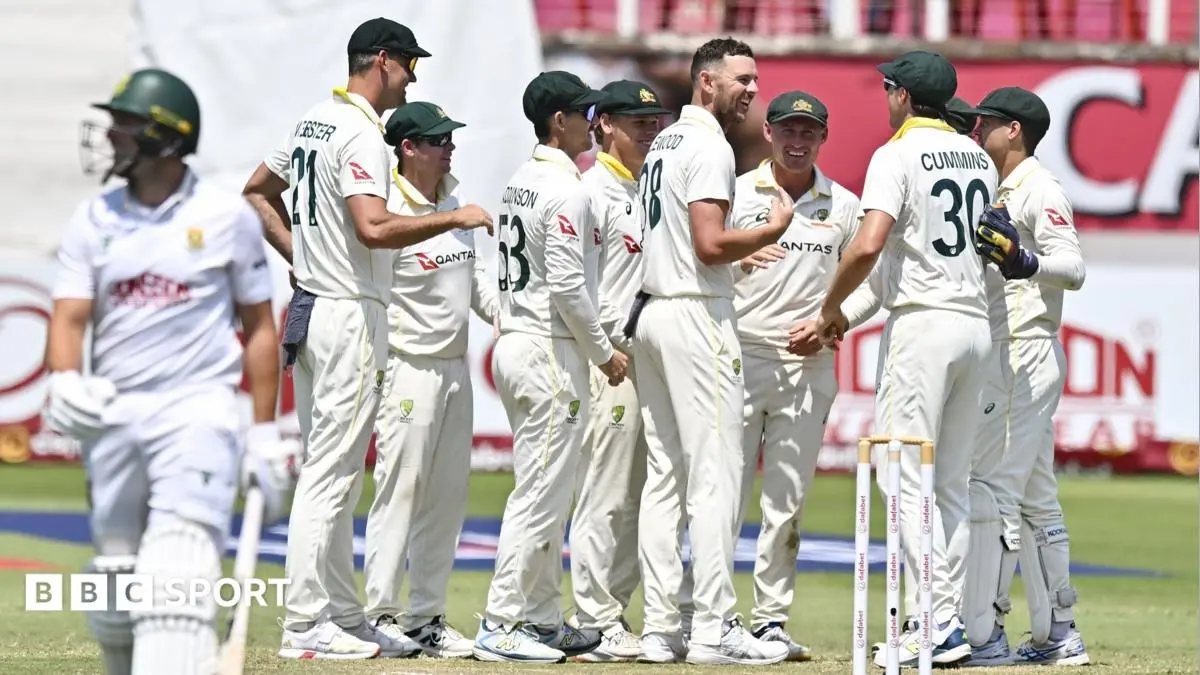
Australia 390 & 314-6 dec: Renshaw 82; Nortje 2-56, Maharaj 2-56
South Africa 284 & 206: Markram 75; Hazlewood 6-49
Australia won by 214 runs
South Africa’s formidable 12-match unbeaten run came to a shuddering and decisive stop with a comprehensive defeat against Australia in Durban. As the dust settles on the opening encounter of this three-match series, cricket analysts and team management alike are left confronting a pressing question: were the Proteas simply suffering from the inevitable rust of a long layoff, or is there a deeper, more alarming trend to read into a Test match where they were comprehensively outclassed across all five days?
The reigning world champions fought valiantly, holding out until roughly an hour into the afternoon session on a tense final day. Aiden Markram, showing immense grit and technical discipline, battled admirably for 237 deliveries. However, a relentless Australian attack—spearheaded by Josh Hazlewood, who delivered career-best Test figures of 6-49—eventually shattered any lingering resistance, sealing a 214-run victory and giving the tourists a vital 1-0 lead in the series.
"I would like to see more fight," admitted Proteas coach Shukri Conrad in the aftermath of the defeat. "I don’t know if it is alarming, [but] it is concerning."
With a demanding international schedule ahead, including a high-profile visit from England over the Christmas period, the burning question is whether South Africa should be genuinely worried as they embark on this eye-catching few months of red-ball cricket.
Much of the narrative surrounding South Africa in recent times has focused on their impressive run to the 2025 World Test Championship final at Lord’s. Yet that journey was achieved through a remarkably light diet of red-ball cricket. They played only 12 Tests during that cycle—fewer than any other team in the international arena—securing their qualification after a hard-fought home draw against India and a series defeat in New Zealand, interspersed with victories over the West Indies, Bangladesh, Sri Lanka, and Pakistan.
Mitigation for this latest Durban stumble can certainly be found in the fact that this was South Africa’s first Test match in nearly a year. Furthermore, the majority of their batting lineup had warmed up for the challenge with just a single domestic red-ball fixture. Context, however, cuts both ways. Australia recently emerged from an eight-month break of their own, a period that included a surprising home defeat against Bangladesh, a point that Shukri Conrad was quick to highlight in his post-match assessment. Moreover, South Africa’s memorable win over Australia last summer, alongside a brilliant 2-0 success in India, proves conclusively that this squad possesses the talent and capability to defeat the world’s premier teams.
Despite these encouraging historical markers, this particular Test match laid bare a deeply concerning and recurring vulnerability among South Africa’s top-order batters.
While players like Tristan Stubbs and Ryan Rickelton have established themselves as exceptional white-ball performers, their burgeoning Test careers have largely been built against lower-ranked oppositions. Stubbs’ two Test centuries, for instance, have come against Sri Lanka and Bangladesh, while Rickelton’s have been notched against Sri Lanka and Pakistan. Durban represented an obvious and steep step up in class and hostility.
The flaws were evident throughout the match. In the first innings, just two overs after Wiaan Mulder had been bounced out by the Australian attack, Stubbs top-edged an attempted pull shot down to fine leg. In the second innings, his stay was cut short when he played a loose, expansive drive on a score of just one. Opener Rickelton suffered a similar fate, driving and edging a wide delivery late on the second day, before nicking an attempted pull shot in only the fourth over of the fourth morning.
Wiaan Mulder has shown flashes of resilience, notably scoring 367 not out against Zimbabwe last year, but Bangladesh remains the only other nation against whom he holds a Test batting average above 30. His patient, 110-ball stay for 29 runs on the final day—before he was unfortunately strangled down the leg side—offered some encouragement, but consistency remains an issue.
Wicketkeeper Kyle Verreynne, by contrast, lasted a mere three balls in his first-innings outing before softly nudging part-time spinner Matt Renshaw to slip. Verreynne’s overall Test average of 30.14 dips significantly to 28 against Australia, and drops further to a concerning 15 against both England and India.
Reflecting on these recurring top-order struggles, Conrad did not mince his words. "A few of the guys need to step up," he stated plainly. "The real disappointment was the batting in the first dig on a really good wicket. Yes, you face a world-class attack, but quite a few guys were getting starts and simply not kicking on."
Amid the disappointments, there were flickers of individual brilliance and resilience. Aiden Markram’s defiant knock in the fourth innings stands out as a major positive for the Proteas. Bounding his way through an anchor innings, he batted for nearly six hours to accumulate 75 dogged runs before eventually edging Mitchell Starc through to wicketkeeper Alex Carey during the afternoon session.
David Bedingham also looked remarkably composed and comfortable after stepping into the crucial number three position, although he ultimately joined the list of batsmen guilty of failing to capitalize on a solid start after being dismissed for 49 and 46 respectively.
Crucially, this defeat cannot be blamed entirely on the batting unit. Temba Bavuma, experiencing defeat as South Africa’s Test captain for the very first time, allowed the game to drift significantly on the second day. During this period, Australia’s lower order was permitted to swell their first-innings total from a precarious 124-6 all the way to a commanding 390 all out.
Australia’s Matt Renshaw played a magnificent innings to anchor his side with 190 runs, but he was rarely challenged as he casually farmed the strike and meticulously protected Nathan Lyon during a match-defining ninth-wicket partnership of 134 runs.
While comparing any modern bowling lineup to Australia’s fearsome attack—arguably the most successful quartet Test cricket has ever witnessed—is inherently unfair, South Africa’s bowling unit lacked the relentless, suffocating pressure exerted by their counterparts.
There were, however, encouraging signs from the pace battery. Anrich Nortje was profoundly impressive, picking up four wickets in his first Test appearance since March 2023. Displaying trademark hostility, his final spell actually carried more pace than his opening burst, culminating in a fearsome bouncer that struck Steve Smith flush on the helmet on day four.
Yet support was lacking elsewhere. Mulder offered very little threat during his new-ball spells, while Marco Jansen faded into the background after removing Nic Maddinson and Steve Smith early on the opening day. The eventual return from injury of premier fast bowler Kagiso Rabada—who was spotted bowling with purpose during the lunch break on day five—cannot come soon enough for the hosts.
The spin department also faced scrutiny. Neither veteran Simon Harmer nor Keshav Maharaj managed to exert the control required to keep the Australian batsmen subdued. "Anrich’s return was phenomenal and really pleasing," Conrad noted. "If we were brutally honest, our spinners were not as sharp as they normally are."
With the second Test looming large and scheduled to begin in just five days’ time in Gqeberha, South Africa must urgently hope that this opening fixture successfully blew away the competitive cobwebs. The alternative takeaway—that this performance reflects deeper technical and structural limitations—would be far more concerning for the Proteas as they look to salvage the series.