

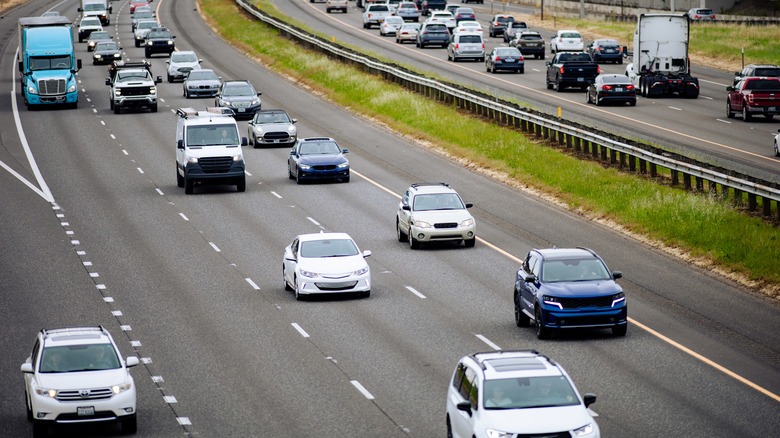
If you live in the United States, you may quickly notice the subjectivity of that first word, "united." The states are far from unified when it comes to the polarizing practice of left-lane camping—the habit of cruising slower than prevailing traffic in the leftmost highway lane and forcing faster drivers to navigate around or pass on the right. This behavior is not merely a source of immense frustration for everyday road users; in many jurisdictions, it is explicitly unlawful. Law enforcement agencies take the issue seriously in various parts of the country. In 2025 alone, for instance, Colorado issued 2,540 individual tickets to drivers for camping out in the left lane.
Yet, defining what actually constitutes illegal left-lane camping remains remarkably complicated, as the law changes dramatically depending on which state line you happen to cross. Even within the borders of a single state, the statutes can introduce a dizzying array of exceptions and confusing stipulations.
Take Colorado as a primary example. In that state, it is technically illegal to remain in the leftmost lane if you are not actively passing other vehicles on roadways posted with a speed limit of 65 miles per hour or higher. However, a major exception exists: if that specific left lane is designated as a high-occupancy-vehicle (HOV) lane, legally speaking, you are not considered a camper if you are traveling within it. This means that camping—at least in the legal sense, rather than the tent-and-campfire variety—becomes a heavily qualified condition depending entirely on lane designation.

Crossing the border from Colorado into Arizona shifts the legal framework entirely. According to Arizona state law, a left-lane camper is defined quite broadly as someone driving "at such a slow speed as to impede or block the normal and reasonable movement of traffic." Notably, this statute makes no explicit mention of the numerical speed limit; instead, the law is intentionally designed around traffic flow and keeping vehicles moving smoothly.
Data compiled by organizations like the American Automobile Association (AAA) indicates that most states enforce general rules requiring motorists to stay out of the left lane unless they are actively passing, merging, or preparing to exit. Beyond those specific maneuvers, continuous cruising in the left lane theoretically designates a driver as a camper. In practice, however, enforcement and statutory definitions vary wildly.
Let ’em merge
The confusion deepens when examining how different states handle specific highway maneuvers, such as accommodating entering traffic. In Washington State, Montana, and Pennsylvania, for example, it is entirely legal for a driver to move temporarily into the left lane to allow another vehicle to merge smoothly onto the highway from an on-ramp. While this policy makes practical sense for maintaining highway safety and flow, it is not universally codified across the country, according to comprehensive surveys of state transportation laws compiled by researchers at the Massachusetts Institute of Technology (MIT). Furthermore, Washington shares a legal nuance with Colorado, making a distinct exception for HOV lanes that separates them from standard passing-only left lanes.

What proves even more peculiar is that several states—including Alaska, Maryland, North Carolina, and Ohio—technically permit a degree of left-lane camping under specific statutory conditions. In Alaska, the law dictates that a driver must either maintain the maximum speed limit or move over to the right. Maryland law similarly instructs motorists to scooch to the right if they are chugging along at 10 miles per hour or more below the posted speed limit. North Carolina aligns closely with the Alaskan directive, requiring drivers to slide right if they are not pegged right at the maximum speed limit.
Then there is Ohio, whose legal approach stands out as particularly unusual. Ohio law permits left-hand cruising as long as the motorist is traveling at the prevailing speed limit. If they are traveling slower, however, they are legally required to give way when being overtaken, provided the faster vehicle gives an "audible signal"—presumably involving the trailing driver tapping on their horn before attempting a pass. North Carolina’s statutes similarly reference an audible signal, leaving many observers wondering why both state legislatures have seemingly overlooked the existence of standard automotive horns.
These conflicting regulations contribute significantly to driver tension, keeping left-lane camping firmly entrenched as one of the most widely cited bad habits guaranteed to annoy everyone else sharing the asphalt. While annoyed motorists often dream of ways to exact revenge on sluggish left-lane occupants, legally engaging in retaliatory driving maneuvers remains restricted to a very small handful of states.
Pass on the right — where it’s legal
For decades, standard driver’s education programs have drilled a singular rule into the minds of American motorists: never pass on the right. Yet, in states like Maryland, Minnesota, New York, New Hampshire, Utah, Wyoming, and Tennessee, passing on the right is explicitly legal under certain defined circumstances. These scenarios typically apply when there is a dedicated left-turning lane, but they also extend to situations where a roadway features two or more continuous lanes traveling in the same direction. These legal allowances often directly defy everything drivers were taught in basic training.
Consider the statutory language in New York State. Nothing in the state’s legislative text appears to prohibit a motorist from driving past a slower vehicle on the right while traveling on a multi-lane interstate highway, provided certain physical conditions are met. The law outlines specific parameters where right-lane passing is formally permitted, noting that it is allowed upon any street or highway with unobstructed pavement that is not occupied by parked vehicles and is of sufficient width to accommodate two or more lines of moving vehicles traveling in each direction.
Furthermore, the New York State Department of Motor Vehicles driver’s manual section on passing states quite plainly that motorists may indeed pass on the right, naturally while strictly abiding by the aforementioned state statute. Whether drivers choose to incorporate this maneuver into their regular driving habits to avoid traffic bottlenecks or bypass stubborn cruisers where right-lane passing is technically legal is another matter entirely. Drivers venturing into these maneuvers are generally left to navigate the unpredictable reactions of surrounding traffic on their own.