
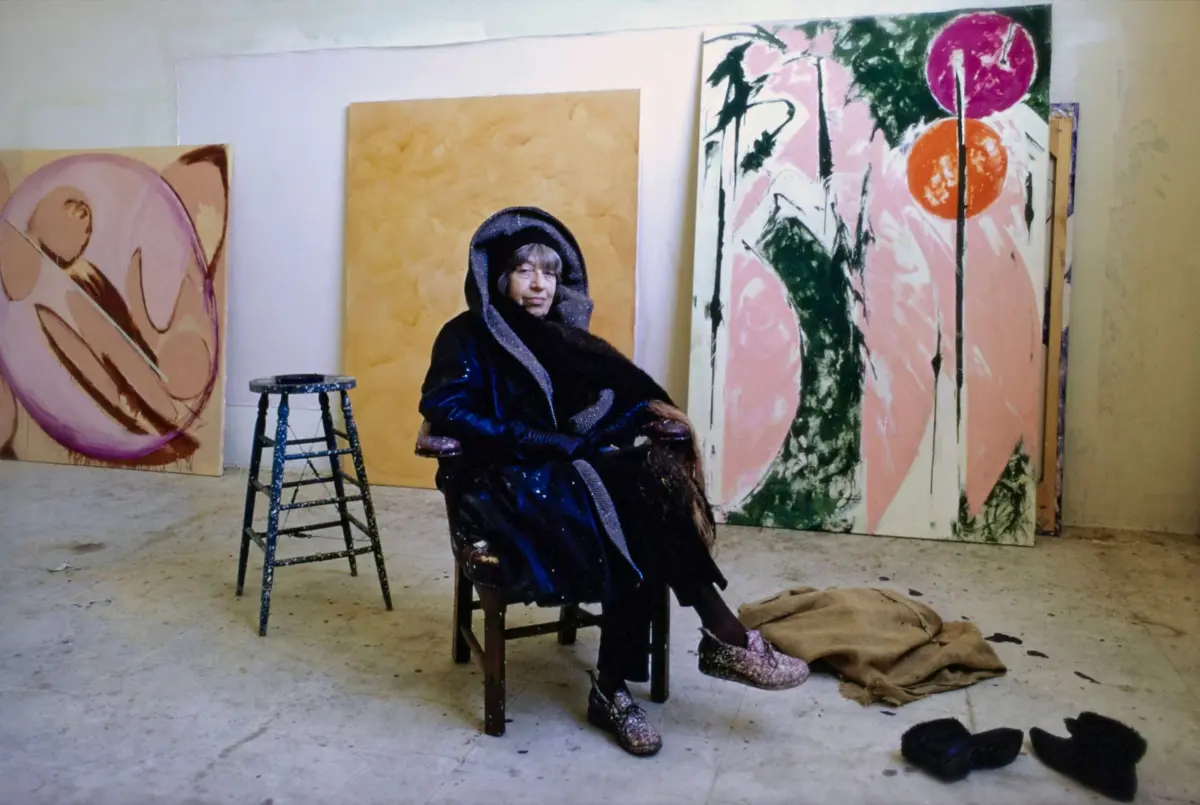
“American Great: Lee Krasner,” by Barbara Rose, was originally published in the June 1972 issue of Vogue.
At the center of the seismic artistic upheaval that transformed New York into the undisputed art capital of the world in the late 1940s and early 1950s stood two figures: Jackson Pollock and his wife, Lee Krasner. Krasner was an intense, forceful presence, defined by steady gray-blue eyes that mirrored her carefully guarded independence. Together, they helped forge the movement known as Abstract Expressionism, a style defined by revolutionary physical gestures, bold imagery, and rich, layered surfaces that effectively swept aside the prevailing European Cubist aesthetic. Just as Paris had once been the mecca for American writers in the 1920s, New York suddenly became the crucible for American painting in the postwar era. Yet, unlike many of her contemporaries—women often relegated to the sidelines of the art-and-literary world—Lee Krasner was, and remained, her own woman, an artist of significant merit.
While the art world has long been captivated by the formidable, often mythologized personality of the late Jackson Pollock, far less attention has been paid to Lee Krasner: the painter who fought the same battles, exhibited in the same galleries, and painted alongside her legendary husband. Today, art critics and historians are finally beginning to recognize what has long been true: Lee Krasner is one of the most important painters of the twentieth century, an artist whose contribution to the development of American modernism is only now being fully understood.
The erasure of her professional identity was perhaps best illustrated by a telling anecdote regarding the "Irascible Eighteen," the famous group of New York School artists who signed a 1950s petition protesting the lack of American art in the Metropolitan Museum of Art. When asked why she was not among them, Krasner offered a stark, sobering explanation: “I wasn’t asked to sign. Barney Newman called, and when I answered the phone, he asked for Jackson. He didn’t even bother to inform me of the protest.”
For years, this dynamic defined her public persona—she was "Mrs. Jackson Pollock" first and an artist second. But the reality of their marriage, often obscured by the media’s focus on Pollock’s "macho" cowboy persona, was far more complex. Pollock, a turbulent man, viewed Krasner as an equal and a serious professional. In their shared life, she was as much a comrade-in-art as she was a spouse. Indeed, Pollock was a notable exception among the patriarchal circle of Abstract Expressionists; he was one of the few major figures of that generation to be married to another practicing, avant-garde artist.
Unlike his peers, who frequently turned to Freudian analysis for inspiration, Pollock delved into Jungian archetypes. His work, which included explorations of feminine figures like The She-Wolf and Pasiphaë, sought to balance the masculine principle with the primal, earth-goddess-centered energy of the feminine. This willingness to embrace strong female archetypes was matched by his domestic life; he chose to marry a woman who was courageous, outspoken, and deeply educated. Krasner’s training—at Cooper Union and the National Academy School of Fine Arts—had introduced her to modernism in the 1930s, long before Pollock moved away from the provincial "American Scene" style of his teacher, Thomas Hart Benton. While some credit Krasner with steering Pollock toward the European modern masters, she remains reticent on the topic. "When I first met Pollock, we disagreed on many things," she recalls. "But as struck as I was by the revelation his paintings were to me, still I couldn’t believe he was discussing Benton that seriously. I can’t say if I affected Pollock’s views at all. I know that Pollock affected me enormously; I dare say I must have had some effect on him."

Living as an abstract painter during these decades required an immense inner strength. Krasner navigated a landscape filled with obstacles: the institutional indifference of museums, the casual sexism of fellow artists, and the crushing weight of personal tragedy following her husband’s death in 1956. Through depression, illness, and the exhausting legal battles surrounding the Pollock estate, she never stopped painting. Recently, she has entered a new, prolific phase of her career. Her studio is currently filled with canvases defined by pure, radiant color contrasted against expansive areas of bright white. While floral imagery often emerges, the swirling, rhythmic motifs connect these new works to the visceral energy of her earliest paintings.
"I have just given all the Pollock material to Eugene Thaw and Virginia Allen, who are preparing the definitive catalogue raisonné," she says, a visible sense of relief accompanying the statement. "Now I can once again concentrate on being Lee Krasner the painter."
Her journey has spanned the entire evolution of postwar American art: from her youth in the Bohemian enclave of Greenwich Village to her formative studies with Hans Hofmann, who brought European modernism to New York; from her work as one of the few women in the W.P.A.’s art section during the Great Depression to her life as a partner to an icon. Today, she divides her time between the Long Island house in Springs where she lived with Pollock and her light-filled apartment on Manhattan’s Upper East Side. Surrounded by the shells, rocks, and Art Nouveau objects that echo the organic forms in her paintings, she reflects on a career marked by both bitterness and triumph.
When asked about the difficulties of being a female artist in the 1930s, 1940s, and 1950s, Krasner is frank. "I never got any very positive responses to my work," she explains. "When I met Hans Hofmann, he said, ‘Zis is so good you would not know it was done by a woman’—meaning the highest compliment he could pay me. That was always there, maybe it will be for a long time. It’s as old as Judeo-Christianity. In Western thought, the God image is a male concept and there isn’t much room for the female. Those are facts not to be denied."
Despite the challenges, the fundamental question of whether she should be painting never arose. "I don’t know how I would have felt if he’d said, ‘I don’t want you to paint,’ or acted it out in any way. The issue, of course, never arose; but it’s inconceivable to me that I would have stopped painting if my husband hadn’t approved."
Krasner also bristles at the historical revisionism that turned Pollock into a "two-fisted cowboy." In reality, they shared a life of domestic partnership. "Jackson always did the baking. If he wanted apple pie, he baked it. I didn’t know how to bake. I usually cooked—but he cooked, too. He also did other necessary household chores. Perhaps if we’d had more money, we would have hired people to do things. But we didn’t, so we had to do everything ourselves, and we shared the work."

Looking back at the rise of the New York School, Krasner feels a mixture of awe and bewilderment at how quickly the art world shifted. "I feel what has happened is quite fantastic," she says. "In the fifties, there was still vitality and warmth in the art world—it was alive and meaningful. In the sixties, I don’t know what happened. It wasn’t that long ago that Arshile Gorky didn’t have a gallery, de Kooning didn’t have a gallery. Now overnight, young artists have whole museums. A mushroom can’t blow up that fast!"
She remains fiercely protective of the integrity of art, rejecting labels that she believes provincializes the creative process. When asked about the term "American-type painting," a phrase championed by critics like Clement Greenberg, she is dismissive. "It offends me. The minute you send up a slogan, you can put anything in the bag and the slogan carries it. That’s boring and provincial in thought and concept, and the antithesis of what I mean by art." Similarly, while she expresses sympathy for the goals of the modern feminist movement, she remains wary of labels. "I don’t know what’s meant by ‘feminine’ subject matter, any more than I understand what’s meant by ‘masculine’ subject matter. I’m sympathetic to the women’s movement, but I could never support anything called ‘American’ art."
Her influences were wide-ranging, but the most profound was, inevitably, Pollock. "After meeting Pollock, I gave up the model and still life. I began with a blank canvas and nothing in front of me," she remembers. "In Pollock, I felt a force that once more moved me as strongly as the impact of Matisse or Picasso."
Moving to Long Island in 1945 was a turning point for both of them. "We were so busy for about two years tearing off wallpaper and burning up the contents of the house that we didn’t have time to do much else," she recalls of the early days in Springs. "I began making the mosaic table you like because I couldn’t work." Even then, their professional boundaries remained. They would offer criticism only upon polite invitation. "The last time he came to my studio was just before I left for Europe in 1956," she says. "I had just finished a painting called Prophecy. He said, ‘Fine. Leave it alone. Except for this,’ and he pointed to one spot where I had scratched with the back of the brush in wet paint a form like an eye. He advised me to take it out. I thought it was all right and I left it in."
Today, many more American women are choosing a path similar to the one Krasner carved out decades ago. Yet, to be a pioneer required a singular kind of courage. While a breakthrough of recognition arrived in 1965 with a retrospective at London’s Whitechapel Gallery, America is only now truly beginning to acknowledge that Lee Krasner’s work possesses the same aesthetic depth, historical weight, and quality as her male colleagues. Because the painters of that era branded themselves as "heroic," and because society has historically been slower to honor its heroines than its heroes, this recognition has been unnecessarily delayed. But throughout the history of American art, there have been brave, self-reliant women who struck out on their own paths. Lee Krasner is undeniably one of them.