
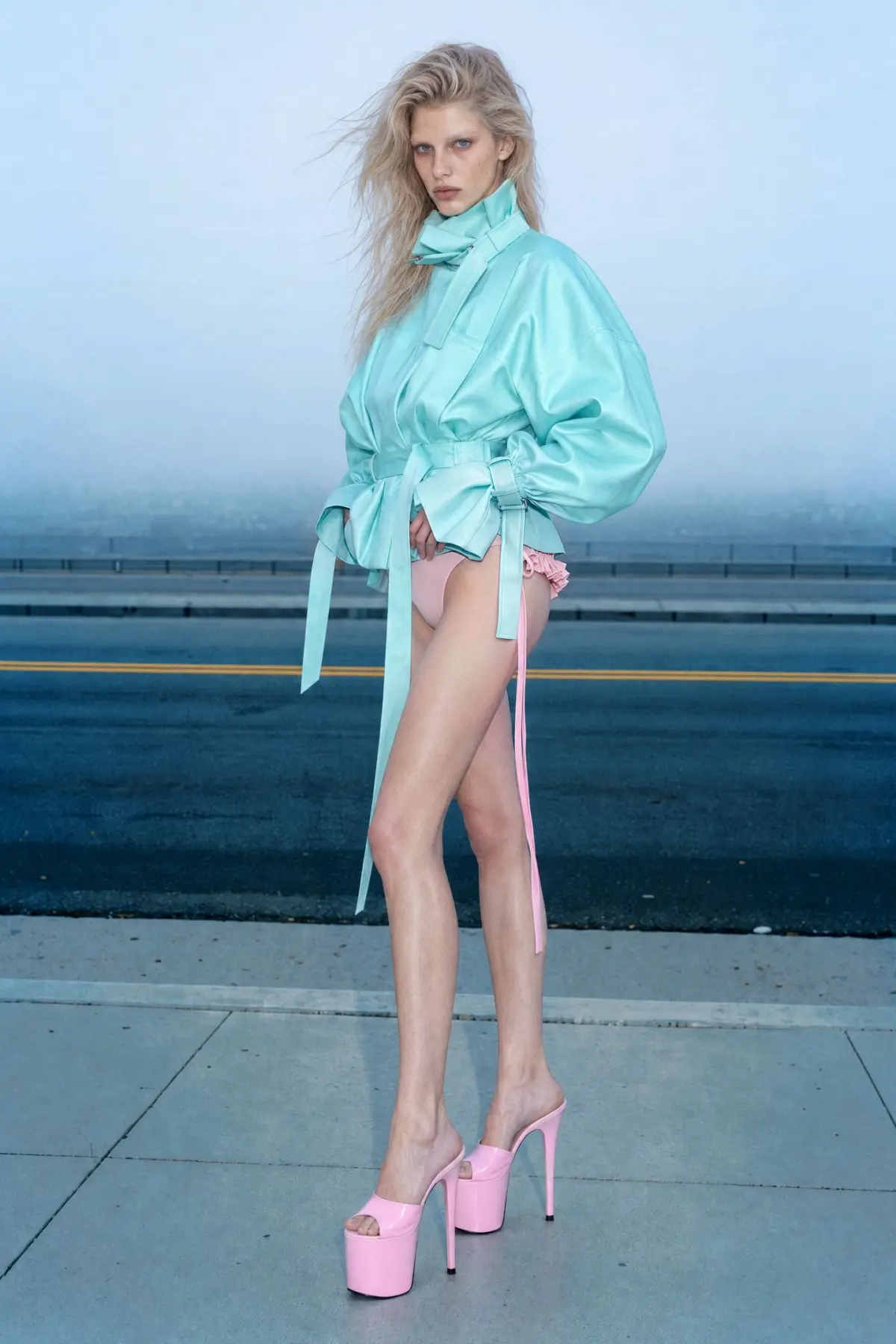
David Koma has long been celebrated for his mastery of the red carpet aesthetic—sculptural, sharp, and unapologetically glamorous. Yet, for his Spring 2027 collection, the designer chose to pivot away from the static, high-octane luxury of the gala circuit to explore a more kinetic, personal inspiration: the paradoxical world of competitive 1990s figure skating. It was a season born from a contemplation of “cool summers,” a contradiction that led Koma directly to the ice rink. In this arena, where the rigors of athletic discipline are hidden behind a facade of theatrical femininity, rhinestones, and effortless grace, Koma found the perfect metaphor for his latest creative evolution.
Central to this exploration was the figure of Tonya Harding. It is a bold, albeit complex, reference point, but Koma was quick to clarify that his interest lay not in the tabloid spectacle or the infamous narratives that defined her career in the public imagination. Instead, Koma was captivated by the sheer “determination and rawness” of her presence. He saw in her story a compelling friction between the grit required to compete at the highest level and the fragile, ornate performance expected of a skater. This tension provided the blueprint for the Spring 2027 collection, which navigated the fluid space between a skater’s utilitarian warm-up layers and the dramatic, sparkling reveal of a competitive performance. By grounding his work in these themes, Koma successfully integrated his signature sharp-edged tailoring and delicate feather embellishments into a narrative that felt both historical and forward-looking.
The color palette served as the primary storyteller for this journey. Koma moved through a spectrum that balanced the harsh, cold reality of the rink with the whimsical artificiality of the performance. Inky black and milky ivory provided a stark, sophisticated foundation, which was then aggressively punctuated by satiny, sugary shades. By allowing these contrasting tones to cut across one another, Koma ensured the collection avoided the trap of becoming overly saccharine. Among the standout pieces were a minty blue bomber jacket featuring a technical, athletic neckline and skirts that utilized fringe or gathering techniques reminiscent of a skater’s scrunchie. These were juxtaposed against candyfloss pink knickers, shimmering metallic column gowns, and sculpted, boned bodysuits that deliberately abbreviated the sport’s most iconic silhouettes.
One of the most intriguing aspects of the collection was Koma’s focus on the technical side of skating: specifically, the “compulsory figures.” These are the painstaking, precise circles and figure-eights that skaters are required to trace onto the ice, often with little fanfare, yet they remain the foundational metric upon which they are judged. Koma translated this geometry into high fashion with a striking black minidress. The garment featured concentric forms rendered in hand-beaded crystals, with mother-of-pearl centers meticulously inserted into the fabric like fine jewelry. This attention to detail echoed the discipline required of the athletes, grounding the collection in a sense of rigor that extended beyond mere aesthetic choices.
Geometric motifs appeared throughout the collection in various guises, often serving both a decorative and a structural purpose. In some instances, they manifested as hipbone cutouts that bloomed with cascading fringe, while in others, they acted as internal metal constructions. These hidden skeletons were designed to pull and gather the fabric tightly around the body, bolstering the “showtime” dynamism Koma sought to achieve. Even when the garments were stationary, they seemed to vibrate with potential energy. A series of gowns and skirts utilized internal boning to extend the silhouette away from the body, providing a rigid scaffold for layers of silk fringe and delicate feather plumes to dance upon.
“I like to animate the body and create this organic movement,” Koma explained, describing his process. For the designer, the challenge was to find an elegant way to translate the centrifugal force of a skater in motion into the medium of ready-to-wear. By focusing on how clothing reacts to the body, Koma managed to capture the essence of a sport defined by speed and rotation without losing the refined, architectural quality that has become synonymous with his brand.
Perhaps the most significant development in this collection was the broadening of the David Koma scope. While the high-glamour hallmarks—the boning, the crystals, the sharp silhouettes—remained central to his output, they were increasingly embedded into everyday categories. This season, the glamour was not reserved exclusively for the red carpet; it was woven into ready-to-wear separates, elevated knitwear, and functional layering pieces. Koma emphasized that he wants the wearer to experience his vision across a variety of categories and occasions, effectively deconstructing the notion that his designs are strictly for formal events.
This shift suggests a move toward versatility, inviting the “David Koma woman” to inhabit his world in her daily life rather than just on special occasions. When asked about this evolution, Koma reflected on the changing nature of his customer base. “It’s becoming harder to define the David Koma woman, and I think that’s important,” he noted. “To see how characters across the world translate my vision is key.”
For Koma, the core proposition remains that glamour is, in itself, a form of strength. By framing the discipline, raw intensity, and technical precision of 1990s figure skating through the lens of modern luxury, he has created a collection that feels both grounded and aspirational. He has managed to take the cold, rigid environment of the ice rink and imbue it with a sense of warmth and wearability, proving that the boundary between the athletic and the aesthetic is far more porous than it might seem.
As the collection concluded, it left a clear impression: the David Koma brand is moving toward a more multifaceted identity. By embracing the “raw determination” of his inspiration, Koma has stripped back some of the artifice associated with high fashion, replacing it with a nuanced exploration of character and movement. Whether through the concentric beaded patterns representing the technical rigor of compulsory figures or the soft, playful colors of a skater’s warm-up, the collection succeeded in animating the body, transforming the wearer into a performer of her own daily life.
Ultimately, this season represents a maturation of the Koma aesthetic. It is a collection that respects the past—the grit of the 90s, the history of the sport, and the brand’s own design heritage—while simultaneously pushing into new, more accessible territories. As the designer continues to refine his vision, the focus on movement, structural integrity, and the strength found in glamour remains the common thread that holds the disparate elements of his work together. In the quiet after the show, the resonance of the collection was clear: David Koma has successfully moved beyond the confines of the red carpet, inviting his audience to experience the discipline and the sparkle of his world in a more personal, everyday capacity.