
Russian forces continue to face tactical retreats in Ukraine’s eastern Donetsk region, according to battlefield reports and open-source intelligence assessments. The ongoing shift in momentum highlights the growing friction within Moscow’s military strategy, as Ukrainian counteroffensive operations systematically disrupt long-term Russian objectives in the sector.
According to posts from the Kremlin-aligned Telegram channel Rybar on October 7, Moscow’s forces have been steadily losing ground and villages situated directly south of Lyman. The strategic town of Lyman has long been a primary target for Russian forces, who intended to use it as a crucial springboard to launch a full-scale offensive against the vital "fortress belt" cities of Sloviansk and Kramatorsk.
However, a coordinated Ukrainian counteroffensive campaign designated "Operation Vivaldi" has successfully reclaimed 175 square kilometres (67 square miles) of previously occupied land surrounding Lyman this year.

"The enemy is using successes in the Lyman direction to develop attacks [east of Sloviansk], where Russian troops are forced to defend previously occupied positions and expend resources on restoring control, instead of launching their own offensive," Rybar noted in its assessment. "It is becoming increasingly clear that the possibility of storming the urban area [of Sloviansk] is receding into the more distant future."
As Ukrainian forces push forward, a critical battle appears to be developing around the village of Kryva Luka, located east of Sloviansk. Sitting prominently on high ground along the Russian-held right bank of the Siversky-Donets River, Kryva Luka could potentially serve as a strategic base for Ukrainian troops to launch further counterattacks deeper into the east. Ukrainian President Volodymyr Zelenskyy confirmed to the Reuters news agency that while Operation Vivaldi has achieved notable successes, the broader campaign remains ongoing and incomplete.
Russian military analysts and independent observers point out that Ukraine’s steady advancement to positions near Kryva Luka has been aided by communication flaws within the Russian military apparatus. Russian sources acknowledged that their side frequently published premature claims regarding the capture of settlements that had not actually been secured. This tactical reporting error inadvertently revealed operational plans and allowed Ukrainian defenders to accumulate vital reserves and stage localized counterattacks.
"Premature statements aided Ukraine," Rybar admitted. "Some villages were declared liberated even before Russian units arrived, which allowed the enemy to accumulate forces there and launch counterattacks."

Prior to launching Operation Vivaldi, the Ukrainian military methodically built up significant tactical reserves in the Lyman area—a preparation phase that is now paying measurable dividends. The Ukrainian Ministry of Defence reported that its broader campaign aimed at degrading the logistical flow of Russian ammunition and fuel lines to the front lines achieved a milestone in September, striking a record number of air defence assets and tactical targets situated more than 50 kilometres (30 miles) behind the lines.
These battlefield losses contrast sharply with public assertions from Moscow. Russian President Vladimir Putin claimed that Russian forces successfully captured 1,300 square kilometres (500 square miles) of Ukrainian territory in September, a narrative echoed by his senior generals. However, independent assessments by the Institute for the Study of War—which tracks territorial changes using geolocated, open-source data—indicate that Russian forces actually suffered a net territorial loss of approximately 80 square kilometres (30 square miles) over the course of that month.
Concurrently, the human cost of the protracted conflict continues to mount. According to figures released by the Ukrainian military, the Russian casualty rate reached a record high for 2026, totaling 46,230 casualties in September alone. Of that total, Ukrainian officials stated that 33,087—representing more than 70 percent—were confirmed fatalities. Robert Brovdi, the commander of Ukraine’s Unmanned Systems Forces, reported that enemy casualties surged by an additional 40 percent during the first five days of October compared to the same period in September. By October 7, the cumulative toll of Russian dead and wounded since the launch of the full-scale invasion in 2022 had reached 1,545,950, according to the Ukrainian military’s general count.
Putin’s Response
Faced with mounting territorial setbacks and unsustainable attrition rates, Moscow has intensified its aerial bombardment campaign against Ukrainian population centers and critical infrastructure, resulting in severe civilian casualties.

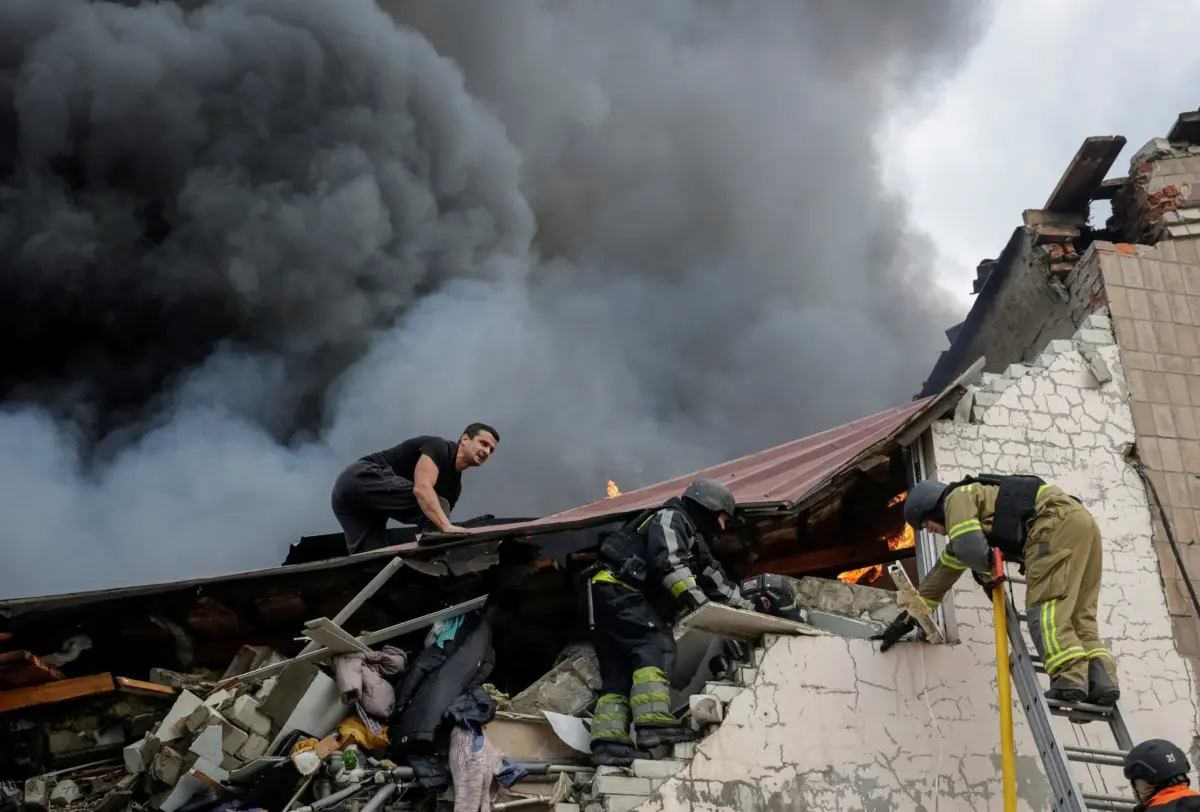
The human toll of these strikes was underscored on October 7—coinciding with Vladimir Putin’s birthday—when a Russian cruise missile struck the northern Chernihiv region, completely demolishing a five-storey apartment building in the city of Pryluky. The blast and subsequent collapse killed 22 people, including five children.
"Today, for Putin’s birthday, the Russian army ‘gifted’ the destruction of a residential building in Pryluky," President Zelenskyy remarked.
Data from the Ukrainian Air Force indicated that Russia unleashed a massive barrage that day, deploying 130 drones, 48 cruise missiles, and ballistic systems across 12 distinct regions. At least two more civilians were killed in Kyiv, and two others lost their lives in Oleksandria. The devastating campaign continued the following day in Kramatorsk, where at least 30 people were killed on October 8 when a Russian bomb struck two crowded city buses. Subsequent emergency footage revealed bodies strewn across a major avenue and a nearby public park.
Military analysts note that Russia’s increasingly frequent deployment of jet-powered drones, such as the Geran-4 and Geran-5 variants, strongly suggests that these strikes against non-military urban targets are deliberate rather than accidental. Ukrainian military intelligence revealed that these advanced munitions rely on a combination of satellite positioning, sophisticated inertial navigation systems, and onboard optical cameras that verify topographical landmarks against pre-loaded databases to ensure precise terminal guidance. These jet-powered systems travel at speeds exceeding 500 kilometres (310 miles) per hour, making them significantly harder to intercept than traditional propeller-driven Shahed drones.

To counter the evolving aerial threat, Ukraine has accelerated the integration of F-16 fighter jets provided by international allies, which have quickly established themselves as a frontline defensive shield. President Zelenskyy noted that F-16s are currently successfully intercepting and destroying between 50 and 60 percent of incoming drone attacks. Additionally, Ukraine is field-testing five new types of interceptor drones—with the most effective model showing a 30 percent success rate—alongside specialized small-scale missiles.
As a final layer of urban protection, Ukrainian defense planners have deployed a dozen AI-driven heavy machine-gun turrets around Kyiv, with dozens more scheduled for installation nationwide. Serhiy Beskrestnov, a senior adviser to the Ministry of Defence, explained that these units provide localized "facility-level" defense capable of safeguarding critical infrastructure such as warehouses, factories, bridges, and power substations.
Despite dense air defenses, Russian forces have increasingly targeted vital transit nodes, including bridges crossing the Dnipro River. Kyiv’s northern and southern bridges were struck seven times during the first four days of October alone. Previous strikes have also targeted government administrative buildings and energy grid facilities in an ongoing bid to induce widespread blackouts. Nevertheless, during the heavy October 7 aerial barrage, the Ukrainian Air Force reported successfully intercepting 80 percent of the jet-powered drones, 95 percent of the propeller-driven drones, and 80 percent of the incoming cruise missiles.
International diplomatic support has continued alongside these military developments. On October 7, German Chancellor Friedrich Merz traveled to Kyiv to announce a substantial 1.3-billion-euro ($1.46bn) military aid package. During the visit, Merz also signed bilateral agreements worth 8.5 billion euros ($9.5bn) aimed at jointly developing advanced drone defense systems and other critical armaments with Ukrainian defense manufacturers. The visit served as a significant political gesture following domestic electoral setbacks in Germany, where the pro-Russian Alternative for Germany (AfD) party recently outperformed Chancellor Merz’s governing Christian Democratic Union (CDU).

Meanwhile, Ukraine has maintained its strategic campaign of long-range strikes targeting critical industrial infrastructure deep within Russian territory. On October 2 and October 8, long-range drone strikes hit major oil refineries in Volgograd and Bashkortostan, respectively, as part of a systematic effort to starve the Russian economy and military machine of refined fuel.
"Over 51 percent of the enemy’s oil refining capacity has been disabled," the Ukrainian military stated.
Ukrainian forces also successfully struck the Samara linear production and dispatch station, described by the General Staff as a major hub for receiving, storing, and blending oil. According to military reports, the strike destroyed eleven 20,000-tonne storage tanks and three 50,000-tonne storage tanks at the facility. The installation is responsible for blending high- and low-sulfur crude oils from various fields to produce the internationally traded Urals export grade, which historically accounts for up to 50 percent of Russia’s total petroleum export volume.
Alongside economic targets, Ukrainian operations continue to hit military infrastructure. On October 7, a targeted strike hit the Astrakhan Gas Processing Plant, which extracts gaseous sulfur essential for the production of military explosives. Days earlier, on October 4, long-range operations destroyed a Sukhoi Su-35 multi-role fighter and a Sukhoi Su-34 fighter-bomber stationed at the Adygea airfield, while also striking the Seshcha airfield in Bryansk. Between July 6 and October 3, Ukraine’s ongoing mid-range strike campaign targeting regional electrical supply networks in occupied territories accumulated a total of 456 verified strikes.