
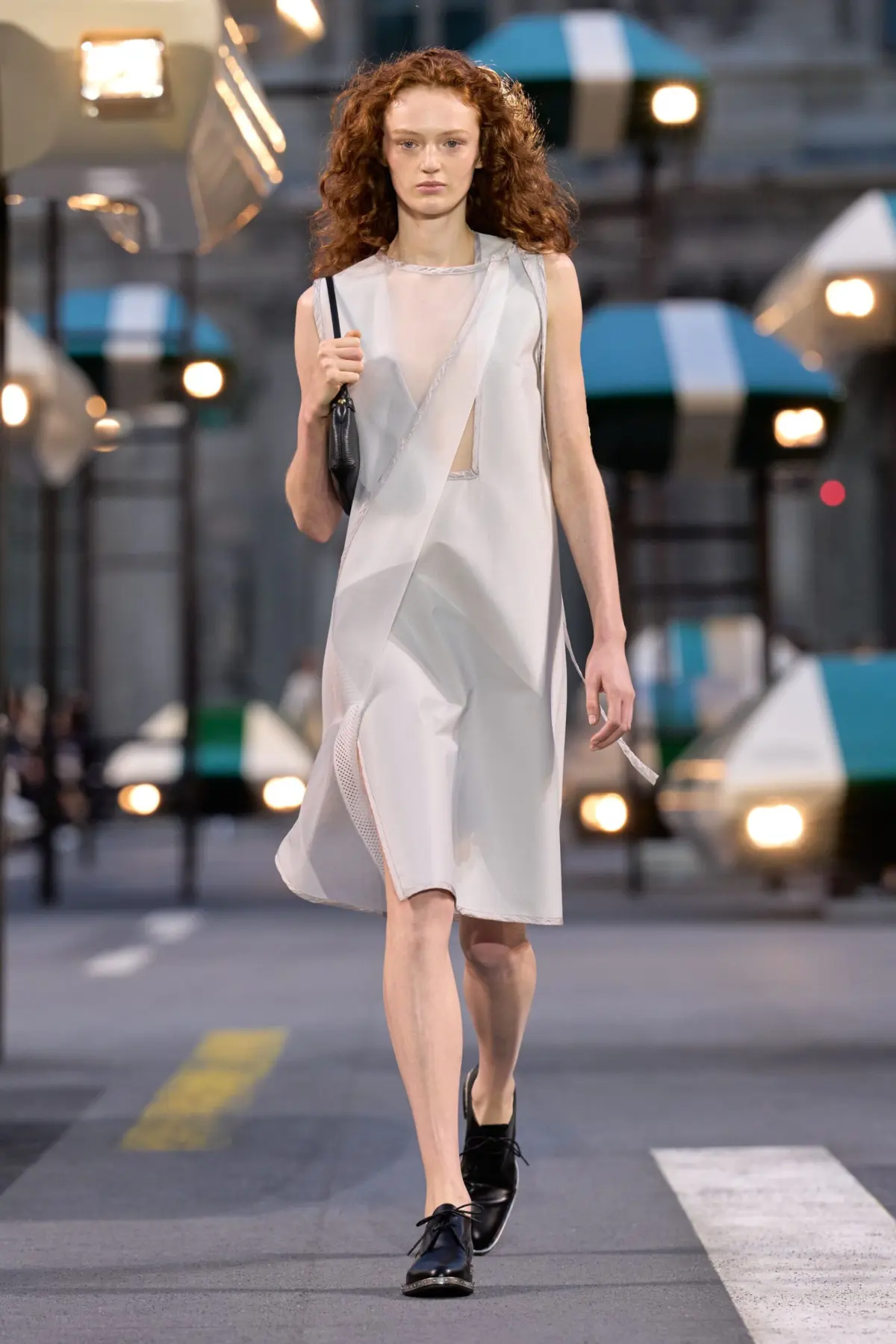
The Cour Carrée of the Louvre was transformed into an airfield plucked directly from the aesthetic of The Jetsons this week, serving as the surreal backdrop for Louis Vuitton’s Spring 2027 collection. Above the heads of the gathered fashion elite, flying cars—complete with glowing red tail lights and the iconic, house-signature Damier check paint jobs—hovered in a choreographed dance or descended onto the ersatz macadam of the makeshift runway. It was a spectacle of space-age ambition, yet beneath the futuristic artifice, the narrative Nicolas Ghesquière was weaving proved to be unexpectedly grounded.
Despite the sci-fi set design, the creative director was not interested in a nostalgic return to the future. It has been two decades since Ghesquière famously pioneered the "cyborg" aesthetic with his iconic C3PO leggings during his tenure at Balenciaga, a moment that remains a touchstone in fashion history. For Spring 2027, however, he pivoted away from the extraterrestrial and the speculative, opting instead for a philosophy that is profoundly human: an "ergonomic," body-first approach to design.
This shift marks a significant departure for the designer, who has spent recent seasons exploring the boundaries of volume and historical fantasy. The collection arrived in the wake of a personal milestone for Ghesquière, who was awarded the Legion d’Honneur by French President Emmanuel Macron just last week. The ceremony at the Élysée Palace underscored the designer’s long-standing relationship with the French political elite; Ghesquière has been a primary sartorial architect for First Lady Brigitte Macron since her husband’s first presidential campaign. During the ceremony, President Macron offered a lighthearted acknowledgment of this bond, joking to the crowd, "It just occurred to me that you were the second man in her life. I’m not quite sure how to take that," a comment that prompted laughter and highlighted the intimate, high-stakes intersection of Ghesquière’s public influence and his private craft.
Yet, on the runway, Ghesquière has been on a solitary, often monumental journey. Over the last few years, his collections have been characterized by larger-than-life silhouettes and an obsession with the out-of-time. From the rugged, traditional shepherd’s cloaks of his previous collection to the arid, Dune-inspired robes of his Resort 2023 presentation, he has consistently challenged the wearer to occupy a space between history and imagination. His work has frequently drawn from a vast reservoir of references, ranging from the frantic, neon-soaked energy of 1980s party-girl fashion to the rigid, architectural geometry of 18th-century panniered frocks. Given this history of maximalism and historical pastiche, the opening look of his latest show—a simple, sleeveless white shift paired with black men’s oxfords—felt like a jarring, deliberate reset.
When asked about the sudden shift toward such stark reduction, Ghesquière was clear about his intent. "I wanted to express a sensation of simplicity, a feeling of purity," he explained. He noted that the transition was not about a lack of effort, but rather a mastery of it. "It’s an impression of minimalism, but the work behind this construction, the simplification, making things extremely light, is really complex."
This pursuit of "purity" rippled through the entire collection. The subsequent looks maintained a level of restraint that felt both refreshing and deeply intentional. Collarless jackets and straight-leg trousers carried the unadorned, utilitarian efficiency of a uniform, stripped of unnecessary ornamentation. Summer dresses appeared in ethereal, lettuce-edged layers of chiffon that seemed to float as they moved, while checked pantsuits were engineered with such technical precision that they remained light enough to flow like flou fabric. It was a masterclass in modern construction, proving that Ghesquière’s penchant for complexity had not vanished; it had simply been channeled into the architecture of the garment itself.
The designer attributed these new instincts to the prevailing chaos of the world outside the atelier. In a time of global uncertainty, the desire for clothes that offer comfort and clarity seems to be a common thread among the industry’s elite. Fashion is currently undergoing a "great reset," with a new generation of creative directors ascending to top roles across major houses. Many of these designers are responding to the twin pressures of the contemporary marketplace and a growing consumer preference for clothes that feel grounded and unstudied. In this climate, the "relatable" collection has become the new frontier of luxury.
Observers might wonder if this broader industry trend is what finally centered Ghesquière. Whether the shift was a response to external pressures or a purely internal evolution, the result is a collection that feels undeniably wearable. During his tenure at Balenciaga, Ghesquière’s work was defined by a cult-like obsession among fashion insiders with his "perfect pants"—a garment that balanced form, function, and an elusive, cool-girl edge. For 2026 and heading into 2027, the notion of "wearable Ghesquière" has regained its resonance.
The standout pieces of the collection, particularly in the evening wear category, proved that he hasn’t lost his ability to create show-stopping silhouettes. Elongated tanks crafted from embellished, hammered satin, paired with fluid, sweeping trousers and extended trains, stood out as some of the most sophisticated designs of the season. They managed to balance the drama of high fashion with a lightness of spirit that felt entirely new for the designer.
As the show concluded and the flying cars remained suspended above the Cour Carrée, it became clear that Ghesquière is entering a new phase of his career. By stripping away the historical layers and the theatrical excess that have defined his recent work, he has managed to focus on the essential relationship between the fabric and the human form. If this collection is a preview of the path he intends to follow, it suggests a future where Ghesquière’s technical genius is applied not to escaping reality, but to enhancing it. For those who have long admired his ability to push the boundaries of what clothing can be, this pivot toward the ergonomic and the simple is a welcome, and perhaps necessary, evolution. It is a refinement of his vision, proving that sometimes, the most complex work is the kind that looks, at first glance, like it was hardly any work at all. It is a daring move to scale back when the world demands more, but in the hands of a designer as experienced as Ghesquière, the minimalism feels like a bold statement of confidence. The runway may have been filled with the trappings of a distant, flying future, but the clothes themselves were firmly rooted in the here and now, ready for the world to wear them.