
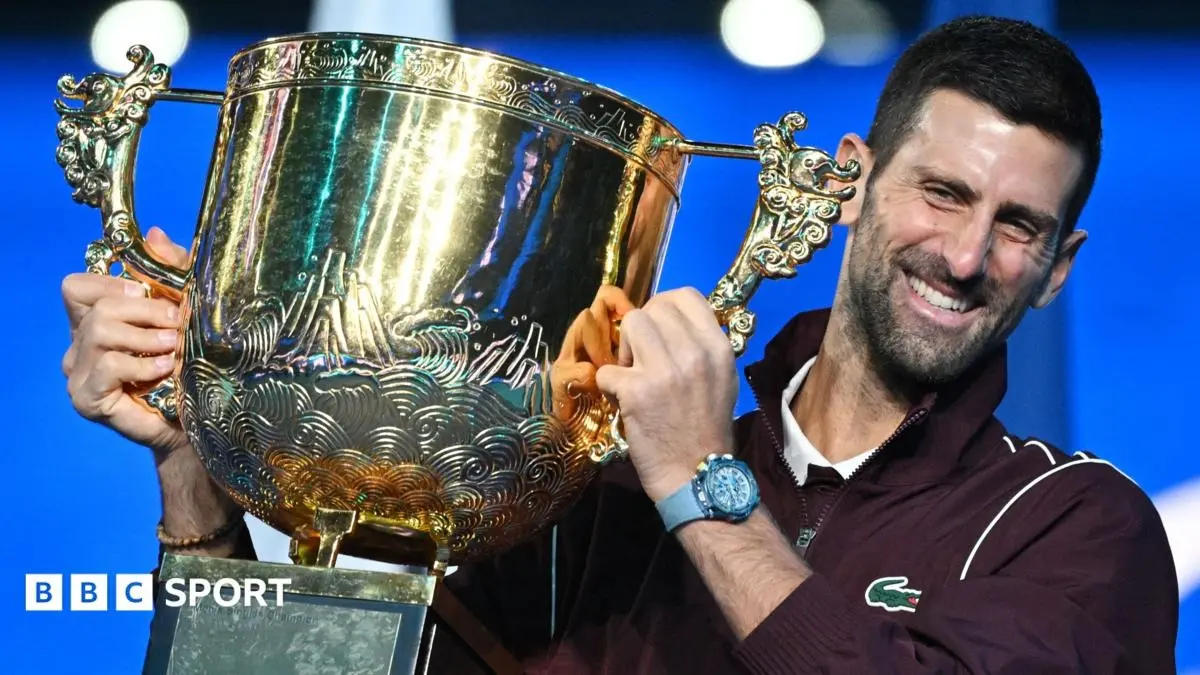
Novak Djokovic has captured his first title in just over a year, producing a vintage display of resilience and tactical brilliance to conquer the Beijing tournament. The historic victory marks a monumental milestone for the 24-time Grand Slam champion, who has carefully managed and limited his playing schedule in recent seasons to protect his body from the mounting physical toll of elite-level competition.
By lifting the trophy in the Chinese capital, Djokovic has etched his name deeper into the history books, becoming the oldest man to win an ATP Tour-level title since the legendary Ken Rosewall achieved the feat in Hong Kong back in 1877 at the age of 43. Beyond the historic statistical achievement, the triumph carries immediate practical significance for the Serbian superstar, guaranteeing his return to the upper echelons of men’s tennis as he climbs back inside the world’s top 10 rankings.
The journey to the Beijing final was a true test of endurance and mental fortitude for the veteran champion, who was competing in only his second tournament showpiece of the year. His early-season campaign had been highlighted by a deep run at the Australian Open in January, where he ultimately fell in a hard-fought title match to young Spanish star Carlos Alcaraz. Despite that disappointment, Djokovic’s path through the Beijing draw demonstrated that his competitive fire and technical mastery remain entirely intact.
Along the road to the final, Djokovic overcame a formidable challenge by defeating world number two Alexander Zverev. His semi-final encounter provided further drama when he found himself a set and a break up against third seed Daniil Medvedev before the Russian player was defaulted from the match. This sequence of high-stakes matches set the stage for a triumphant conclusion to a week that showcased the enduring brilliance of one of the greatest players in the history of the sport.
Reflecting on his remarkable journey back to the winner’s circle, Djokovic opened up about the immense hurdles he has had to overcome over the past twelve months. "This year has been quite challenging for me, lots of ups and downs and physical and health issues, so I was just trying to find a good feeling on the court," Djokovic admitted candidly following his victory. "I know that when I’m feeling well and striking the ball well I can still compete at the highest level. This week has been an evidence to that. I’m very proud."
Djokovic’s ability to compete at the absolute highest echelon of professional tennis has rarely been called into question by pundits or peers. Earlier in the season, he delivered a masterclass against world number one Jannik Sinner to reach the Australian Open final, and he memorably captured a set off Carlos Alcaraz during their championship showdown. However, the recurring narrative of his recent career has not been a lack of skill or tactical acumen, but rather the betrayals of his physical frame.
In recent years, his body has increasingly let him down at crucial moments during the tennis calendar. The physical strain boiled over at the US Open, where a visibly depleted Djokovic was left in tears following a gruelling, energy-sapping first-round defeat. In the aftermath of that early exit, he spoke openly with reporters about struggling with a "serious health condition" that sapped his stamina and particularly bothered him during oppressive, humid weather conditions.
The Grand Slam stage has brought mixed fortunes for the champion as he navigates this demanding phase of his career. At Wimbledon, he demonstrated his enduring prowess on grass courts by navigating a tough draw to reach the semi-finals, where he ultimately bowed out against the eventual champion, Jannik Sinner. Conversely, the clay-court season brought disappointment and unexpected hurdles, most notably a surprise third-round exit at the French Open at the hands of rising star Joao Fonseca, who capitalised on Djokovic’s physical vulnerabilities.
Faced with these persistent physical limitations, Djokovic and his coaching team made the strategic decision to drastically alter his approach to the tennis calendar. By selectively choosing his events and strictly limiting his schedule to protect his body from cumulative fatigue, the champion aimed to peak at the tournaments that mattered most. That cautious, measured approach has now yielded its most significant dividend yet, resulting in a prestigious title and a renewed sense of confidence as he proves that he can still outlast and outclass the younger generation when properly conditioned and injury-free.
The victory in Beijing serves as both a validation of his selective scheduling strategy and a warning to the rest of the men’s tour. With his ranking restored to the top 10 and his confidence bolstered by a flawless week of high-stakes tennis, Novak Djokovic has firmly re-established himself as a formidable force, proving that the final chapters of his legendary career are still waiting to be written.