
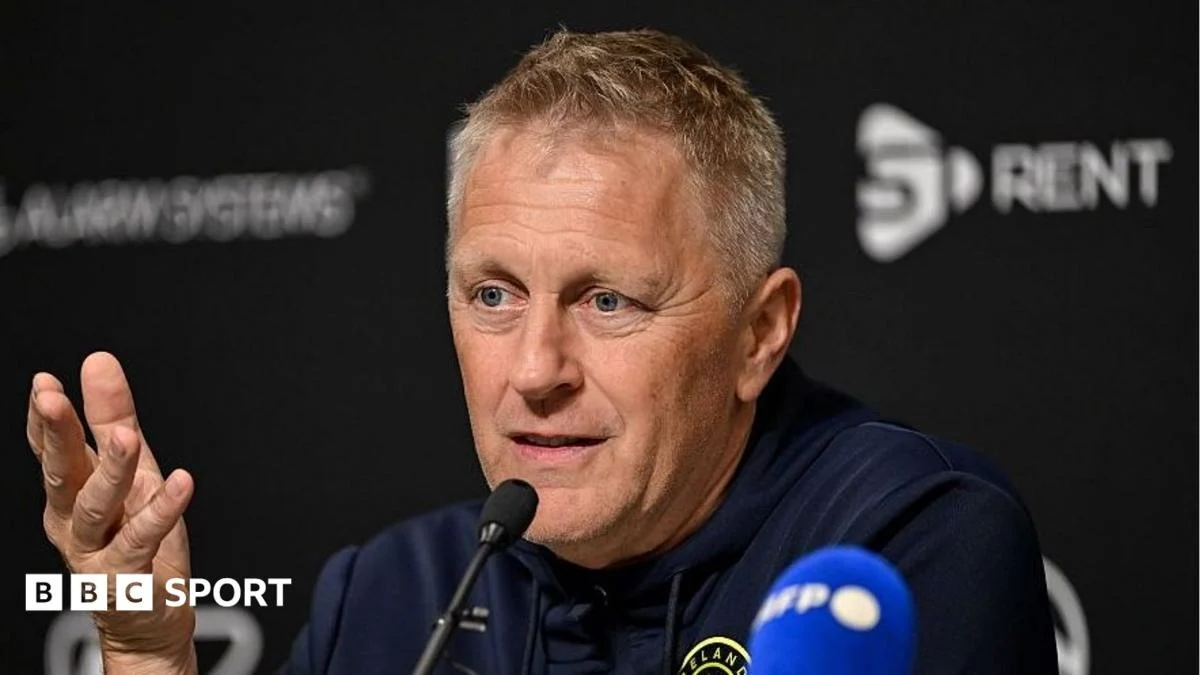
Republic of Ireland manager Heimir Hallgrimsson has admitted he is simply "delighted" that a grueling and deeply turbulent international window has finally come to an end, candidly stating that he hopes no other national team is ever forced to endure the extraordinary challenges his squad has faced over the past two weeks.
The conclusion of the international period came on Sunday following a hard-fought, behind-closed-doors 1-1 draw against Israel in the Serbian town of Backa Topola. That fixture brought down the curtain on a punishing fortnight that tested the physical, mental, and emotional resilience of the entire Irish camp. Over the course of just fourteen days, Hallgrimsson’s side played four demanding matches—with only a single game contested on home soil in Ireland—and accumulated approximately 5,000 miles of travel across borders.
Yet, the heavy travel schedule and demanding fixture congestion were only part of the story. The decision for the Republic of Ireland team to take the field against Israel this week, as well as during last week’s 3-0 victory in Debrecen, Hungary, placed the squad at the center of intense public scrutiny and political controversy. The pressure group Irish Sport for Palestine actively campaigned under the banner of the ‘Stop The Game’ initiative, calling for a comprehensive sporting boycott of the fixtures against Israel in light of the ongoing Israel-Gaza war.
The mounting external pressure reverberated directly within the squad prior to last Sunday’s victory in Hungary. Goalkeeper Gavin Bazunu made himself unavailable for the fixtures, concluding that he felt "it would be wrong to participate." Bazunu’s withdrawal set off a chaotic chain of events behind the scenes, culminating in a vote held among the remaining players to determine whether the squad should proceed with the matches against Israel.
The tension surrounding the camp only escalated as the fixtures progressed. On the eve of Sunday’s draw in Serbia, Hallgrimsson’s pre-match news conference was abruptly cut short following a heated exchange. An Israeli reporter made accusations that certain Irish players had directed racist comments toward their opponents during the victory in Debrecen. The Football Association of Ireland (FAI) strenuously denied the allegations, pointing out that the association had already launched its own official investigation into racist abuse directed toward Ireland’s own players by a section of Israel fans during that same match in Debrecen.
Appearing before the media one final time with visible fatigue etched across his face, Hallgrimsson acknowledged that he has "been fresher" after enduring such an arduous fortnight, though he reflected that he has "learnt a lot in these two weeks."
"I’m absolutely delighted this is finished," Hallgrimsson said following the Sunday draw, a result that left the Republic of Ireland campaign with a total of five points out of a possible 12.
"It has taken a toll on us all. The players have been absolutely amazing in tough times and I wish no national team to go through what we have gone through over the last two weeks."
While Gavin Bazunu’s absence was rooted in his personal conviction regarding the matches, midfielder Finn Azaz missed both fixtures against Israel for an entirely different and deeply complex set of reasons.
The 26-year-old midfielder holds family links to Israel on his mother’s side. For Hallgrimsson, this familial connection placed the player in a uniquely difficult and sensitive position, particularly given the squad’s collective decision to wear black armbands and bow their heads during the Israeli national anthem ahead of both matches.
Azaz had delivered an impressive, high-quality performance just days earlier during Thursday’s 2-2 draw at home against Austria. However, when evaluating the physical and emotional toll of the week, Hallgrimsson ultimately concluded that the player was not in the right space to feature against Israel.
"Finn played 90 minutes against Austria and got a little knock, but also, this has been tough on him mentally and I just didn’t feel he was ready for playing," Hallgrimsson explained.
"It is probably the most difficult situation for him of all of us. He deserves a lot of credit for being in the squad and showed desire to be a part of this team."
Elaborating on the specific challenges faced by the midfielder, the Irish manager detailed how the team’s planned gestures of solemnity weighed heavily upon him.
"It was tough for him that we were wearing black armbands and tough for him that we looked down when the [Israeli] national anthem was sung," Hallgrimsson continued. "It tested him more than all of us, so I felt it was better to leave him out today than play him."
Despite the profound difficulties and emotional strain navigated by Azaz over the past fortnight, Hallgrimsson expressed firm optimism when asked about the Southampton midfielder’s long-term international future with the Republic of Ireland. The manager stated that he could only "hope so" when questioned if Azaz would continue representing the national team moving forward.
"Nothing points to him quitting and just being here proves it to me that he wants to be with us and wants to be with us in the Euro finals in 2028," Hallgrimsson said.
"He’s shown his quality and worth on the pitch to us."