
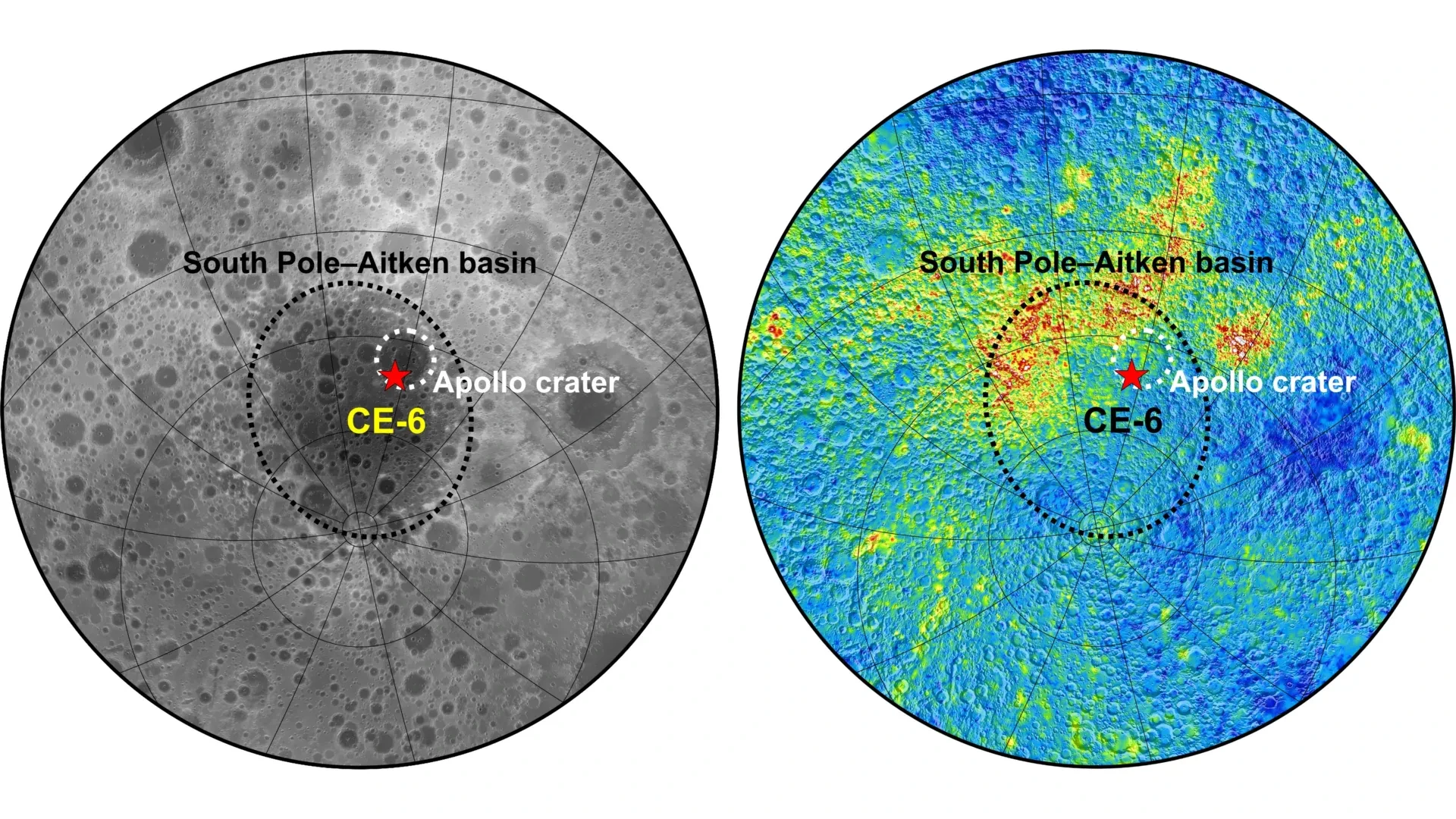
Although the Moon no longer generates a global magnetic field of its own, it retains a remarkable geological memory. Deep within lunar rocks and soil, microscopic traces of an ancient magnetism remain permanently locked away, acting as silent witnesses to a very different epoch in lunar history. By meticulously studying these preserved magnetic minerals embedded within the dusty regolith and rocky fragments brought back from the lunar surface, scientists are able to piece together how the Moon’s magnetic environment shifted, evolved, and eventually faded over billions of years.
Now, a team of researchers examining metallic iron trapped inside impact glass from the Chang’e-6 lunar soil has achieved a significant milestone, identifying face-centered cubic $gamma$-Fe for the very first time in natural lunar samples. This discovery opens an entirely new avenue for understanding planetary evolution and the ancient forces that once shaped our nearest celestial neighbor.
The groundbreaking study was led by Professor Haifeng Du from the High Magnetic Field Laboratory at the Hefei Institutes of Physical Science (HFIPS), operating under the umbrella of the Chinese Academy of Sciences (CAS). The details of their comprehensive analysis and subsequent findings were officially published to the global scientific community in the Proceedings of the National Academy of Sciences (PNAS) on September 16, marking a notable step forward in lunar science following the historic Chang’e-6 sample return mission.
Reflecting on the importance of the discovery, Dr. Long Li, a researcher at HFIPS and a key member of the investigative team, emphasized the broader implications of their work. "This tiny magnetic fossil may help us better understand the Moon’s ancient magnetic history," Dr. Li noted, pointing to the immense value hidden within nanoscale mineral structures that have largely remained shielded from the harsh conditions of the lunar surface for eons.
A Rare Iron Phase Hidden in Lunar Glass
To uncover these microscopic secrets, the research team employed a battery of advanced analytical techniques. They began with focused ion beam preparation to precisely isolate minute sections of the lunar material without damaging its delicate internal structure. Following this preparation, the scientists utilized high-resolution transmission electron microscopy and detailed chemical analysis to peer deep into the atomic architecture of the sample. These sophisticated methods ultimately revealed numerous nanoscale iron particles scattered widely throughout the glassy material.
Upon closer examination, the researchers made a striking observation: some of these minute particles did not consist of the standard iron configurations typically encountered in typical terrestrial or previously studied extraterrestrial environments. Instead, they were composed of face-centered cubic $gamma$-Fe, also known as gamma-iron or austenite. Remarkably, further quantitative evaluation showed that $gamma$-Fe was actually the dominant form of iron found within the two distinct impact-glass samples examined during the course of the study.
This revelation presented an immediate scientific puzzle. Under normal thermodynamic conditions, face-centered cubic $gamma$-Fe is stable exclusively at extremely high temperatures. As molten or heated material gradually cools down, $gamma$-Fe typically undergoes a structural phase transition, transforming completely into another, more stable form of iron known as body-centered cubic $alpha$-Fe, or alpha-iron.
Faced with this thermodynamic anomaly, the researchers began investigating how such a high-temperature phase of iron could possibly survive on the cold, exposed lunar surface. They successfully found compelling evidence suggesting that the extraordinarily violent and unusual conditions produced by high-velocity meteorite impacts on the Moon play a pivotal role. Specifically, the extreme heat, shock pressures, and subsequent rapid thermal shifts generated during impact events create a unique environment that allows $gamma$-Fe to bypass its usual transition and survive in the present day.
To explain how these fragile structures could persist over geological timescales, the team proposed that several compounding factors help stabilize the face-centered cubic lattice. These stabilizing mechanisms include the incorporation of small amounts of carbon and other trace chemical elements within the iron matrix, the extraordinarily rapid cooling rates of the molten silicates and metals created during an impact event, and the robust mechanical protection provided by the surrounding glassy matrix, which shields the reactive iron nanoparticles from oxidation and other forms of atmospheric or cosmic degradation.
Tiny Particles That Can Preserve Magnetism
Understanding the chemical composition and crystal structure of the iron nanoparticles was only the first step. To determine whether these particles could actually serve as reliable recorders of ancient magnetic fields, the research team needed to probe their physical magnetic properties down to the nanoscale.
To accomplish this, the scientists utilized off-axis electron holography, a cutting-edge microscopy technique that allows researchers to visualize and measure magnetic fields at the nanometer scale by analyzing shifts in electron waves as they pass through or near a magnetized sample. Through this method, the team was able to investigate the specific internal magnetic behavior of individual $gamma$-Fe nanoparticles.
The results of the holographic analysis revealed fascinating behavioral traits. The researchers discovered that relatively large $gamma$-Fe particles possessed the capacity to form a stable single-vortex magnetic state. Furthermore, these nanoparticles demonstrated a remarkable ability to retain a consistent and reliable magnetic response when they were exposed to an external magnetic field in a laboratory setting.
This structural and behavioral stability carries profound implications for planetary science. It strongly suggests that face-centered cubic $gamma$-Fe could act as a previously unrecognized, highly resilient recorder of magnetic information preserved within lunar materials. Because these particles are protected within glass and exhibit stable single-vortex states, they hold the potential to preserve pristine clues about the strength, direction, and fluctuations of the magnetic environments that existed during the ancient periods of the Moon’s history.
A New Window Into the Moon’s Magnetic Past
The unexpected identification of face-centered cubic $gamma$-Fe significantly broadens the known variety of magnetic minerals present in lunar samples returned by exploration missions. Because $gamma$-Fe and the more commonly found $alpha$-Fe form under distinctly different thermodynamic conditions and exhibit unique magnetic behaviors, each mineral possesses the capacity to record information from separate, specialized stages of lunar impact events and volcanic or dynamo-driven magnetic phases.
While this discovery establishes a solid foundation, the researchers note that much work remains to be done. Future scientific investigations will be required to determine precisely how much these unique mineral phases can reveal about the absolute strength and lifespan of the Moon’s ancient magnetic field, as well as the fundamental mechanisms by which that field evolved and eventually collapsed over geological time. As laboratories around the world continue to analyze the unprecedented bounty of material brought back by missions like Chang’e-6, these microscopic iron fossils promise to shed new light on the hidden magnetic biography of Earth’s closest cosmic companion.