
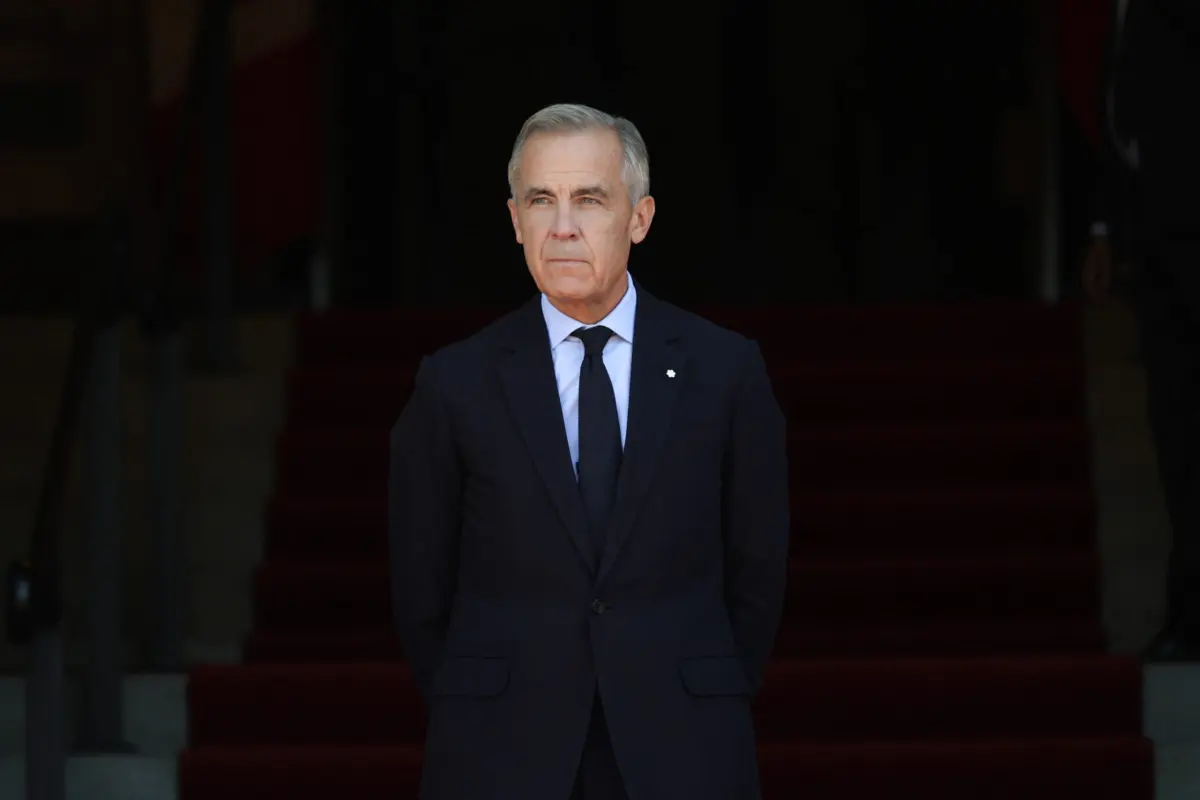
TORONTO, Canada — As Canadian Prime Minister Mark Carney races to make the country less dependent on the United States, attract billions of dollars in new foreign investment, and expedite the construction of major infrastructure projects, his sweeping economic overhaul is running into formidable resistance from a quarter that insists it shares many of the same overarching goals: organized labour.
The latest friction point, which centers squarely on the legally protected right to strike, follows months of mounting economic and political pressure on Ottawa from Washington, DC. Since taking office for a second term last year, United States President Donald Trump has imposed steep tariffs on a wide range of Canadian goods and weakened longstanding trade agreements. These developments carry perilous implications for Canada, which has historically relied on its southern neighbor as the destination for close to 80 percent of its total exports. President Trump has repeatedly piled on tariff threats with the explicit aim of pressuring Canada to become the 51st US state.
In response, Canada has levied retaliatory tariffs, while a broader, nationwide "Buy Canadian" movement has firmly taken hold across the provinces. The hockey-inspired national rallying cry of "elbows up"—signaling a collective, fierce readiness to defend the country against an aggressive opponent—has permeated public discourse.
However, with bilateral trade talks stalled since August, Prime Minister Carney has moved with palpable urgency to shore up the domestic economy and aggressively court new capital investments. Last month, his administration introduced Bill C-39, formally known as the Building Canada Strong Act. The legislation promises to bring unprecedented levels of "speed, certainty, and predictability" to investors looking at Canadian markets.
Alongside measures designed to drastically accelerate the regulatory approval process for major national projects, Bill C-39 would grant Ottawa clearer, more expansive legal powers to intervene directly in legal strikes and lockouts within federally regulated workplaces. This specific provision has immediately placed Prime Minister Carney on a direct collision course with the nation’s powerful labour unions.
Canada’s largest labour organizations have mobilized in unified opposition to the proposed legislative changes. The Canadian Union of Public Employees (CUPE), the nation’s largest union, saw its national executive take the extraordinary step of voting to formally defy the bill’s proposed limitations on the right to strike if the legislation passes through Parliament without substantial amendments.
CUPE National President Mark Hancock praised Prime Minister Carney’s overall handling of the turbulent relationship with President Trump, acknowledging that the union’s 800,000 members—who work in vital sectors ranging from hospitals and schools to municipal services—fundamentally want to be part of a unified "Team Canada" front.
"But at what cost?" Hancock asked during an interview with Al Jazeera.
A Fight Over the Right to Strike
The raging political controversy centers on Section 107 of the Canada Labour Code, a statutory provision that already grants the federal Labour Minister broad discretionary powers to step into active labour disputes if deemed necessary to maintain "industrial peace," bring an immediate end to work stoppages, and force disputing parties into binding arbitration.
Beginning in 2024, the federal government utilized this provision eight distinct times to intervene in high-stakes labour disputes involving commercial airlines, Canada’s two largest transcontinental railways, three major commercial ports, and Canada Post. Ottawa invoked the clause again during the Air Canada dispute in 2025, when flight attendants walked off the job on strike.
Throughout these conflicts, labour unions have actively challenged the use of the law in federal courts. They had entered the legislative drafting phase hoping that the new Bill C-39 would formally restrict, if not entirely repeal, the contentious clause, whereas business associations and corporate interests had vigorously lobbied for the provision to be strengthened.
Ultimately, the proposed bill does neither. Instead, it introduces two mandatory procedural conditions that the federal government must fulfill before it can legally turn to Section 107.
Before stepping in to halt a work stoppage, the government would be legally required to appoint a special mediator, wait for the submission of a public report, and formally consider whether an ongoing work stoppage is causing severe harm to the "national interest." Once a strike or a lockout is officially underway under these new rules, the minister could direct the Canada Industrial Relations Board to get operations running again and impose a binding dispute resolution process, such as arbitration.

Government officials maintain that these added steps establish clearer, more transparent guardrails around an executive power that already exists within the legal framework. Prime Minister Carney has asserted publicly, according to the Canadian Broadcasting Corporation, that the legislation "absolutely reinforces the right to strike."
Unions have decisively rejected this official defense. Labour representatives point out that the ultimate definition of what constitutes the "national interest" would still be decided entirely by the government minister of the day. Furthermore, they argue that the constant prospect of government intervention is bound to fundamentally alter power dynamics at the bargaining table before negotiations even reach an impasse.
"The political lesson that employers will draw from it is simple," Larry Savage, a professor of labour studies at Brock University, told Al Jazeera. "Hold out long enough, emphasize the economic damage, and then Ottawa will remove the union’s leverage for you."
Savage emphasized that disruption is precisely the mechanism that gives a strike its necessary power. "Every effective strike is disruptive," he noted.
Labour organizations report that they are already witnessing employers lean heavily into the expectation of federal intervention. Teamsters Canada alleges that the Canadian National Railway (CN) and the Canadian Pacific Kansas City (CPKC) railroad corporations were explicitly counting on Ottawa to step in when the companies locked out thousands of workers in 2024. True to that prediction, Section 107 was invoked within hours of the stoppage.
"Companies have gotten used to the idea that if there is a labour dispute, they can just wait for the government to intervene," Christopher Monette, Teamsters Canada’s director of public affairs, told Al Jazeera.
CUPE reported observing a nearly identical dynamic during the Air Canada dispute in August 2025. Hancock stated that collective bargaining completely stalled after more than 10,000 Air Canada flight attendants voted overwhelmingly to authorize a strike, because management was "expecting the government of Canada to step in and end the strike"—an account that the airline has formally disputed.
Less than 12 hours after workers walked off the job, Ottawa invoked Section 107. Air Canada CEO Michael Rousseau later acknowledged to BNN Bloomberg that the corporate leadership had indeed expected the statutory provision to be enforced and had not anticipated managing a protracted strike.
"That was why they didn’t have a strategy on how to deal with the strike," Hancock said.
Building Canada Faster
The fierce battle over the right to strike is emblematic of a much larger, highly polarized debate taking shape around Prime Minister Carney’s broader economic agenda: specifically, who gets a meaningful voice in deciding how Canada should transform itself, and at what speed, in the urgent name of reducing its vulnerability to the United States.
Critics have accused the Prime Minister of leveraging the acute economic threats posed by Washington to ram through sweeping domestic changes that reach far beyond responding to Trump’s ongoing trade war.
New Democratic Party leader Avi Lewis has openly accused Carney of utilizing the prevailing "fear and disorientation around the trade war to push through a series of unpopular measures that he did not run on, has no mandate for and would never get away with under normal circumstances."
That underlying tension was starkly on display in Toronto just one week before Bill C-39 was formally introduced in Parliament. Inside Canada’s inaugural national investment summit, hundreds of global investors gathered alongside government officials and corporate executives as Prime Minister Carney pitched a transformed country ready to build rapidly.

Outside the venue, however, hundreds of demonstrators marched through downtown streets toward the summit’s opening gala under the banner "The Many vs The Money." The protest rally brought together an eclectic coalition of labour unions, Indigenous communities, environmental organizations, and migrant-rights groups, carrying signs and delivering speeches targeting everything from fossil fuel extraction and military procurement projects to artificial intelligence and the use of public funds to incentivize private corporate investment.
For the nation’s unions, Bill C-39 has sharply crystallized that debate, pitting the federal government’s core promise of economic certainty for corporate investors directly against the fundamental ability of workers to exert economic pressure through the withdrawal of their labor.
However, Jim Stanford, an economist and the director of the Vancouver-based Centre for Future Work, has questioned the empirical validity of claims that strikes pose a severe threat to the national economy.
While work stoppages can undoubtedly prove costly for individual corporate entities, Stanford explained, "It is very, very rare that you would see a noticeable and sustained impact on GDP, employment or incomes."
Production schedules and transportation logistics are typically delayed rather than permanently lost, he added, with businesses catching up on backlogs once normal operations resume.
Stanford also challenged the persistent narrative that strikes actively drive away foreign and domestic investment, pointing out that more than 95 percent of all collective bargaining agreements in Canada conclude successfully without a single work stoppage. He asserted that there is "no empirical evidence whatsoever" demonstrating that labour strikes have a depressing effect on capital investment.
"This is more of the government giving some icing on the cake for business. It’s not that this has to happen or else our investment won’t work," Stanford said.
Furthermore, Stanford argued that there is a distinct economic cost associated with weakening the legal right to strike. Workers require genuine bargaining power to secure fair wage increases, which in turn sustain domestic consumer spending, economic productivity, and worker retention.
"It may seem like labour peace is a good thing, but if it means that a worker’s share of the pie shrinks, then this actually hurts the economy," he noted.
For prominent labour leaders, that is precisely the juncture where Prime Minister Carney’s aggressive economic push crosses a dangerous line.
"Canada’s unions are part of Team Canada. We have our elbows up," Canadian Labour Congress President Bea Bruske said in a public statement. "But we can’t have our elbows up against Trump with our hands tied at the bargaining table."
Professor Savage warned that the government’s frequent invocation of "Team Canada" rhetoric risks treating the legitimate bargaining power of workers as a burdensome national liability rather than a pillar of a healthy society.
"I don’t think Canada becomes stronger by telling workers in ports or railways or airlines that their rights have to be surrendered whenever employers invoke competitiveness or the national interest," he concluded.