
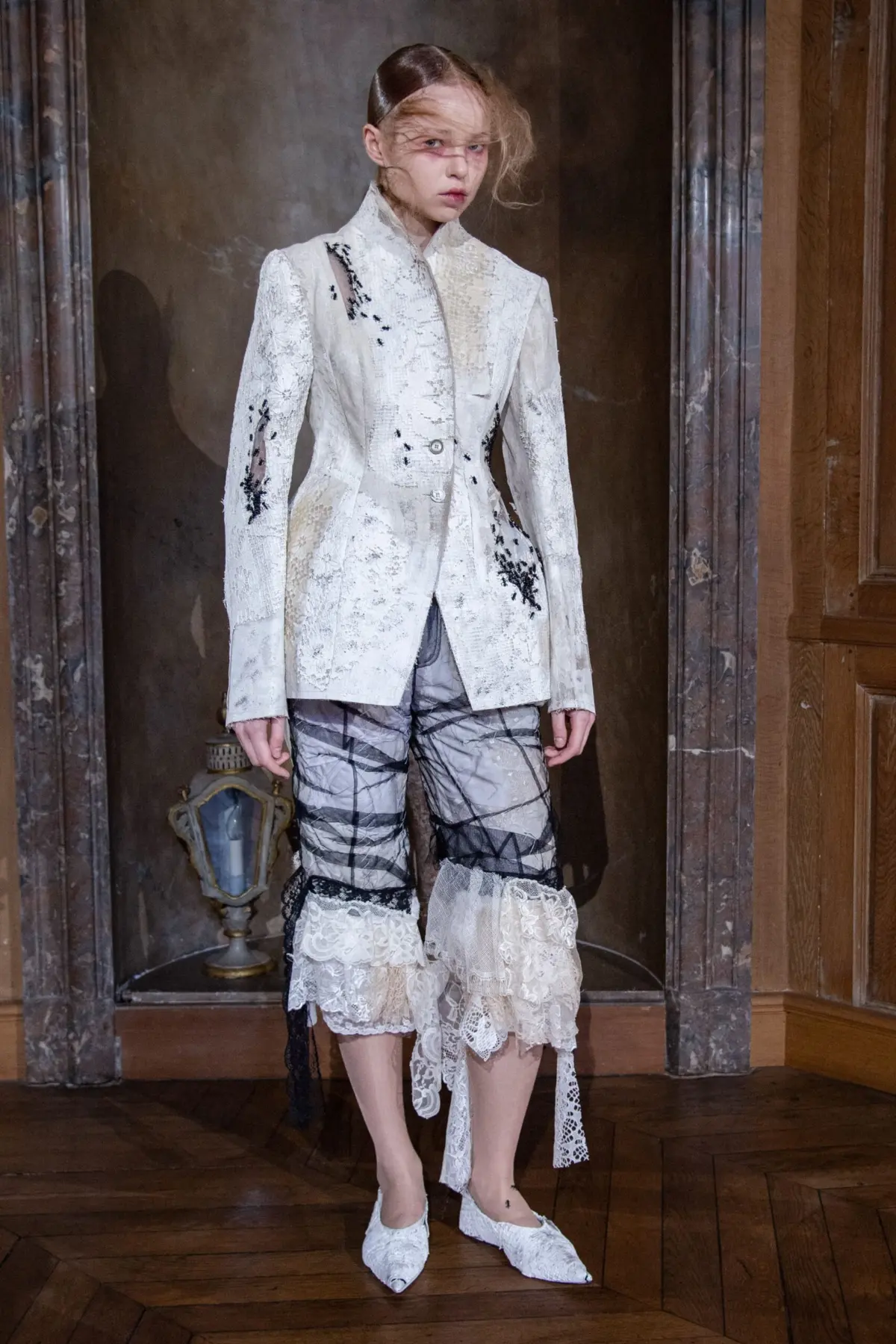
In an era where the concept of the “fairy tale” often feels like a relic of a simpler, more optimistic past, designer Caroline Hu has chosen to confront that difficulty head-on. Her latest collection, presented within the decaying, evocative walls of an old hôtel particulier, was not merely a runway show; it was a curated experience of tableaux vivants. Models moved through the space like spectral protagonists of a half-forgotten story, pausing amidst an environment filled with bears, crumbling plaster, crawling insects, and scattered love letters. Yet, despite the inherent gloom of such imagery, the atmosphere was far from gothic. Hu’s ambition was anchored in a profound sense of hope, asking a fundamental question: In a world that is increasingly resistant to romanticization, how can we salvage the remnants of the past to build something new?
The narrative arc of the presentation followed the familiar contours of a classic fairy tale. It traced the journey of a lonely protagonist who ventures beyond the familiar, passing through hidden passages and magical mirrors into a surreal landscape suspended somewhere between memory, desire, and the unchecked reaches of the imagination. For Hu, whose work has historically been characterized by an intensely inward-looking perspective, this fantasy served as a sophisticated vehicle for addressing modern reality without the need for literal reproduction.
“There is so much ugliness and cruelty,” Hu remarked, reflecting on the thematic underpinnings of her design process, “but I try to build something romantic and beautiful around it.” It is a sentiment that, in less capable hands, might have drifted into the saccharine territory of a greeting card. Instead, the clothes themselves provided the necessary weight to ground the concept, transforming an abstract philosophical inquiry into a tangible, wearable reality.
The tension within the collection—the friction between the pristine and the broken—is what made the presentation so compelling. Hu’s romance is inherently dualistic; it acknowledges the sweetness of childhood innocence through the use of delicate lace, soft roses, and pale, ethereal surfaces, but it refuses to let that innocence remain unchallenged. The collection was marked by the persistent, subtle evidence of time and wear. Interspersed throughout the garments were embroidered love letters—some bearing messages of personal encouragement addressed to the designer herself—rendered in stark black and red thread.
This sense of survival and reconstruction was echoed in the very construction of the pieces. Patchworked fabrics appeared as if they had been salvaged from disparate lives, forced into a harmonious, albeit complex, coexistence. A striking black coat, assembled from a collage of various textiles, stood as a testament to this philosophy. Similarly, an evening dress constructed from deconstructed lace and floral motifs, alongside a rigid jacket adorned with tiny, meticulously beaded ants, suggested objects that had been shattered and painstakingly reassembled. The result was not the archetype of the “perfect princess,” but rather a portrait of a princess navigating the aftermath of a difficult childhood—a figure defined by resilience rather than perfection.
This is precisely where Hu’s unique point of view crystallizes. She possesses a clear affinity for beauty, yet she seems to harbor a healthy, intellectual distrust of beauty when it is easily won or superficial. Her brand of romanticism requires a certain degree of friction—a fraying around the edges that acknowledges the complexity of the wearer. The construction of her garments is precise and intricate, yet it is simultaneously and deliberately fractured. This approach makes the fantasy convincing because it provides the collection with physical consequences. These are not mere costumes intended to illustrate a whimsical story; they are garments designed for a world where the fairy tale has already suffered a few cracks.
By imbuing the clothes with these structural imperfections, Hu challenges the viewer to reconsider the value of the damaged. She avoids the trap of succumbing to melancholy by ensuring that her focus remains on the active process of transformation. Fragility, in Hu’s vision, is not a passive state to be mourned; it is an active, evolving condition. Whether a garment is torn, aged, unfinished, or seemingly broken, it retains the capacity to be beautiful. It is an argument for the beauty of process over the finality of a finished product.
“I’m trying to build a new world,” Hu explained, emphasizing the underlying message of her work. “It’s positive. And hopeful.”
It is an eccentric, deeply personal way of asserting that romance is not a retreat from reality, but a method for engaging with it. By integrating lace, intimate correspondence, and the startling image of insects crawling over the furniture, Hu has created a space where the contradictions of life can exist side-by-side. The ants, which might typically evoke a sense of decay, are transformed here into a part of the landscape of her new world—a detail that emphasizes the inevitability of change and the persistence of nature even within our most carefully constructed environments.
Ultimately, the collection serves as a powerful reminder that we are all, in some capacity, involved in the business of rebuilding. As the models navigated the hôtel particulier, they acted as conduits for a narrative that prioritizes the act of restoration. Hu’s work suggests that if we are to find beauty in a difficult world, we must be willing to accept the broken pieces as part of the architecture. Her ability to synthesize these disparate elements—the delicate and the rough, the personal and the public, the broken and the repaired—solidifies her position as a designer who does not merely create clothing, but who actively constructs a framework for how we might view the world around us. In this latest showcase, Caroline Hu has proven that even in the face of ugliness, there is always room to stitch together a new, romantic reality, one thread of memory at a time. The fairy tale she has authored is one of perseverance, insisting that the most beautiful things we possess are often those that have survived the most.