
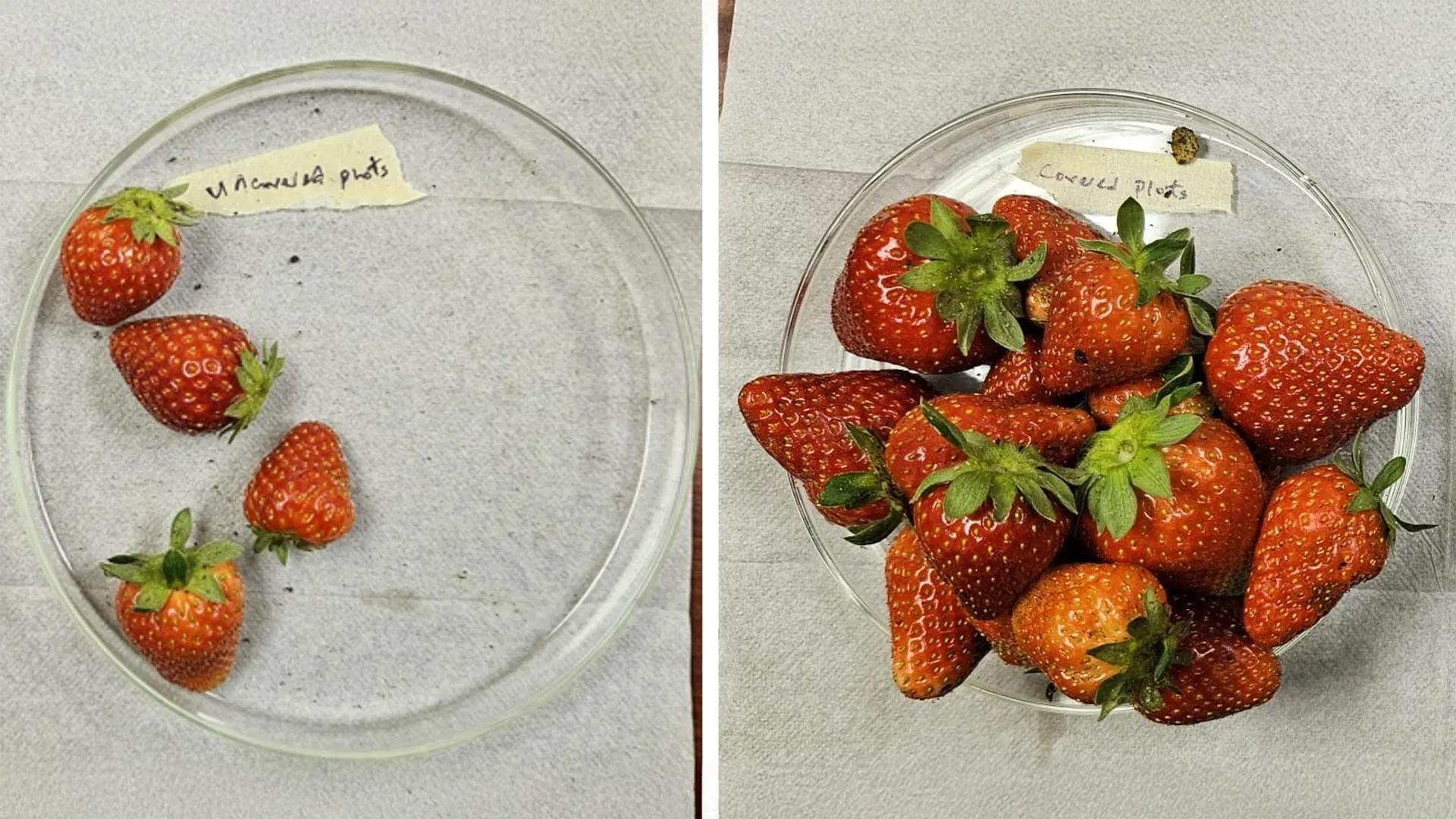
A newly developed textile covering has helped strawberry plants produce more than three times as much fruit in rigorous tunnel field trials, all while demonstrating no harmful effects on overall plant health. Agricultural and textile researchers who engineered the technology say that this innovative material could soon offer a reliable, sustainable way to dramatically reduce water consumption and minimize reliance on chemical pesticides in commercial strawberry production worldwide.
The specialized fabric, designated as Plant Armor, is engineered to be draped directly over rows of growing strawberry plants. Its sophisticated three-dimensional structure creates a robust physical barrier that effectively blocks insects and other pests from reaching and damaging the crops. At the same time, the intricately layered material maintains high breathability and permeability, allowing vital sunlight, natural rainfall, and fresh air to pass through seamlessly to the canopy below.
During recent tunnel field tests conducted across multiple growing seasons, strawberries protected by the Plant Armor system yielded as much as 3.56 times more fruit than unprotected control plants growing in the same environment. Crucially, detailed environmental monitoring revealed that the fabric did not restrict light availability or introduce any detrimental alterations to relative humidity levels within the microclimate.
A Fabric That Protects Without Blocking Sunlight
In agriculture, shading is a common hurdle when applying protective covers to crops. Many traditional materials block a significant portion of incoming solar radiation, which can unintentionally harm productivity.
"To produce fruit, plants need sunlight," said Gabriel Olawuyi, a graduate research assistant at North Carolina State University and lead author of the research paper detailing Plant Armor. "We expected that Plant Armor’s seemingly opaque fabric would lead to an increase in vegetative biomass at the expense of fruiting—because reduced sunlight would trigger a ‘shade-avoidance’ response, making the plant divert energy toward stem and leaf growth rather than fruit production. However, we found the fabric did not impede access to light at all, and fruit production increased significantly."
Beyond maintaining optimal light transmission, researchers observed that Plant Armor played a pivotal role in thermal regulation. The material consistently created a steady warming effect throughout the three growing seasons evaluated in the study. According to Olawuyi, this localized extra warmth helped the covered plants reach their critical reproductive and fruiting stages significantly earlier than plants grown without the textile protection.
"Plants require a certain amount of accumulated heat, calculated as ‘growing degree-days,’ to progress through developmental stages including fruiting. Our plant cover has proven to enhance these," Olawuyi explained. "The plants were in a condition whereby the warmth they need to go through each phenological stage to their production was given to them optimally, and they produced far more than the uncovered plants."
Because the Plant Armor fabric physically intercepts insects, acting as an impenetrable wall against feeding pests, Olawuyi noted that the technology holds immense promise for sustainable farming. By preventing pest infestations mechanically rather than chemically, the innovation could substantially cut down the volume of conventional pesticides required in agricultural fields, reducing chemical run-off and lowering production costs for growers.
From Military Textiles to Strawberry Fields
Interestingly, the conceptual origins of Plant Armor have very little to do with traditional agriculture or farming innovation. The underlying technology actually emerged from targeted research focused on improving the performance of military uniforms. Specifically, initial scientific efforts were aimed at making military gear more resistant to persistent mosquito bites while simultaneously enhancing comfort, breathability, and ergonomics for soldiers who must wear heavy protective body armor in harsh operational environments.
This unexpected, highly beneficial pivot from military clothing research to modern agricultural science underscores the profound value of interdisciplinary collaboration and cross-pollination across diverse scientific fields, noted co-author R. Michael Roe, the William Neal Reynolds Distinguished Professor at NC State University.
"The path to Plant Armor started with trying to make a cloth to go on a soldier’s chest to make body armor more comfortable," reflected Roe, looking back at the trajectory of the project. "Then, through trial and error, we arrive at a product which could triple the output of strawberry farms here in North Carolina."
Roe emphasized that the breakthrough was a testament to persistent scientific inquiry and teamwork, noting that such practical applications are frequently impossible to foresee at the outset of basic research. "We couldn’t have predicted that when we started. Without all these people here doing research and following the science, we wouldn’t have arrived at this product."
Study Details and Support
The comprehensive findings of the research team have been officially documented in a published study titled "Knitted 3-D, Porous Textile Cover to Enhance Strawberry Fruit Production and Prevent Insect Feeding," which appears in the scientific journal Agriculture. Alongside lead author Gabriel Olawuyi and senior researcher R. Michael Roe, the project’s co-authors include James Clothier, Matthew Bertone, Grayson Cave, Reuben Garshong, Andre West, Loganathan Ponnusamy, and Clyde Sorenson, all representing North Carolina State University.
The development and testing of Plant Armor received vital financial backing and logistical support from a specialized grant provided by the North Carolina Agricultural Foundation, registered under grant number AG00463770. Additional foundational support was delivered through the Research Capacity Fund (HATCH) via project award number 02853, issued by the United States Department of Agriculture’s National Institute of Food and Agriculture.
Furthermore, the specific iteration of the technology evaluated in the recent study—designated as Plant Armor Gen 2 fabric—has been formally patented by North Carolina State University under US Patent No. 11,582,968 B2, issued on February 21, 2023. The university currently holds the intellectual property rights and has licensed the technology for broader commercial development. This milestone achievement represents a successful, multi-disciplinary collaboration spanning NC State’s College of Natural Resources, the Wilson College of Textiles, and the College of Agriculture and Life Sciences.