
For decades, astronomers navigating the deep mysteries of the cosmos have relied on brief, fleeting bursts of gamma rays to identify some of the most violent events in the universe: the head-on collisions of neutron stars. These intense flashes of high-energy light are notoriously ephemeral, often vanishing into the dark expanse of space in less than two seconds. However, groundbreaking new research indicates that this narrow view of stellar cataclysms may only be part of the story. A series of recent observations suggests that at least some neutron star mergers unleash powerful, extended X-ray flashes that remain brightly visible for several minutes, fundamentally challenging our understanding of how these cosmic events unfold.
A comprehensive study recently published in the scientific journal Science Bulletin presents robust, compelling evidence for this connection. The findings open up an exciting possibility that could solve a long-standing astronomical puzzle: many mysterious cosmic flashes detected across the universe, whose elusive sources have baffled researchers for years, may actually originate from the cataclysmic merging of binary neutron stars.
Since the advanced Einstein Probe satellite officially commenced its mission following its launch in January 2024, astronomers around the globe have detected hundreds of remarkably bright X-ray flashes emanating from distant galaxies. Designated as fast X-ray transients, these sudden and energetic events have multiple potential origins. While scientists have previously linked some of these occurrences to the catastrophic deaths and core collapses of massive stars, a significant portion of them have remained entirely unexplained, leaving astrophysicists searching for missing pieces of the cosmic puzzle.
Pinpointing the exact cause of these fast X-ray transients has historically presented a formidable challenge. Determining their true nature is often difficult because astronomers frequently lack crucial baseline data, such as the precise distance to the events or the total magnitude of energy they release into the surrounding space. Without knowing how far the light has traveled, calculating the intrinsic power and physical mechanisms driving the explosions remains an uphill battle.
A Possible Magnetar Birth
A dedicated team of researchers working within Professor Eleonora Troja’s research group—supported generously by a European Research Council (ERC) Consolidator grant—has managed to break through these observational barriers. By orchestrating a swift and coordinated response, the team successfully identified the physical source behind one particularly intriguing X-ray transient.
The sequence of events was set into motion when the Einstein Probe satellite issued an automated alert signaling the detection of a high-energy transient. Recognizing the potential significance of the signal, Professor Troja’s team rapidly mobilized a suite of powerful follow-up instruments. Their coordinated campaign utilized some of the world’s premier astronomical facilities, including the European Southern Observatory’s flagship Very Large Telescope (VLT) located in Chile, alongside the high-resolution capabilities of the Very Large Array.
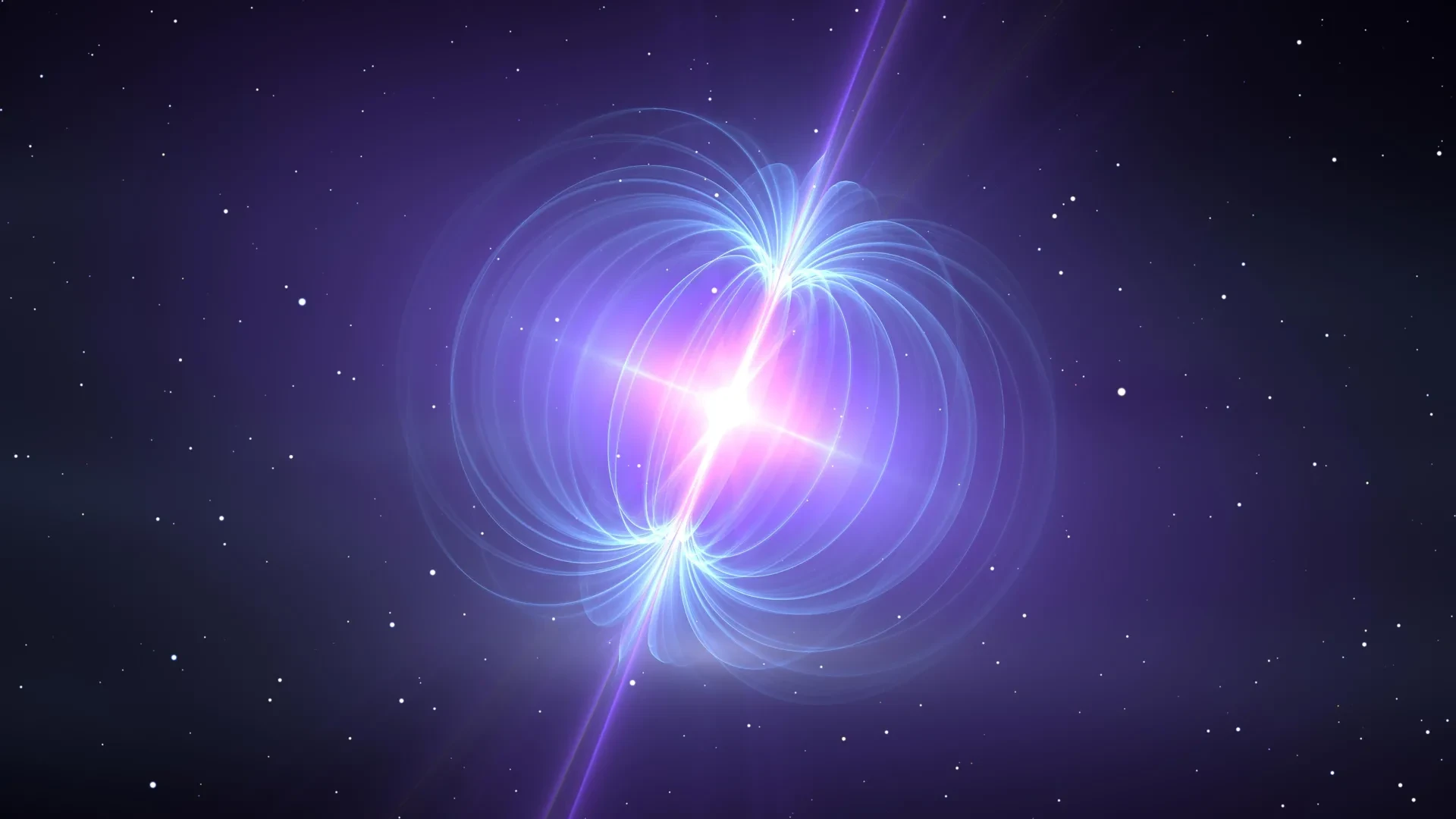
By carefully studying the fading afterglow and the lingering remnants left behind in the immediate wake of the cosmic explosion, the researchers arrived at a profound conclusion. They realized they may have witnessed the very moment of birth for a magnetar—an exotic, highly magnetized neutron star—forged directly from the fiery collision and subsequent merger of two pre-existing neutron stars.
Neutron stars themselves are among the most extreme objects in the universe. They represent the unimaginably dense stellar remnants left behind when massive, evolved stars exhaust their nuclear fuel and reach the dramatic ends of their lives. Crushed under their own immense gravity, a teaspoon of neutron star material would weigh billions of tons on Earth. When two of these dense remnants spiral inward and ultimately merge, the collision generates gravitational waves—ripples in the fabric of spacetime itself—that travel outward across the cosmos. Simultaneously, the brilliant light and radiation produced during these dynamic interactions provide astronomers with vital clues, helping them decipher what kind of exotic object survives the initial impact.
Historically, short gamma-ray bursts have served as the primary electromagnetic signature associated with neutron star mergers. These brief flashes of high-energy radiation mark the moment of collision, but they typically fade almost as quickly as they appear.
"However, if the remnant of the collision is a magnetar, it could keep bursting for longer," explained Professor Troja, who serves as a key member of the Einstein Probe European collaboration and is a co-corresponding author of the published research paper. Elaborating on the physics of these objects, she noted, "Magnetars are rapidly spinning neutron stars with huge magnetic fields. When they damp their magnetic power into the surroundings, they can make any explosion brighter and longer-lasting. When I saw the X-ray data from this new event, I realized something was up."
A Record X-Ray Flash
The remarkable event that unlocked these new insights has been cataloged under the designation EP250704a/GRB 250704B. It was initially captured on July 4, 2025, through the collaborative monitoring efforts of the SVOM, Insight-HXMT, and Einstein Probe satellites, which together provide a comprehensive watch over the high-energy sky.
True to the traditional behavior of neutron star collisions, the accompanying gamma-ray burst associated with this event lasted for only about half a second. However, what happened next shattered previous expectations. The Einstein Probe recorded continuous, bright X-ray emission streaming from the source for nearly ten full minutes, setting a brand-new benchmark in observational astronomy.
"This is the longest lasting prompt X-ray flash ever observed from a neutron star merger," stated Niccolò Passaleva, a graduate student researcher who spearheaded the complex follow-up observations using the VLT in South America. Emphasizing the rare opportunity presented to the scientific community, Passaleva added, "It is an opportunity to have a front-row seat to the most extreme forces of the Universe and discover more of its secrets."
For several years leading up to this discovery, researchers had actively searched for a definitive, undeniable connection between fast X-ray transients and binary neutron star mergers. Previous candidates identified in archival data had invariably faded away far too quickly, leaving astronomers with tantalizing hints but insufficient evidence to confirm their origins.
This time, however, rapid human intervention made all the difference. Responding to the satellite alert within minutes, Passaleva initiated the observation sequence while the cosmic beacon was still blazing brightly enough in the sky for instruments to study in comprehensive detail.
Reflecting on the tense moments surrounding the sudden discovery, Passaleva recalled, "I was traveling home by train, and all of a sudden I was rushing against time to commandeer one of the largest telescopes in the world from my laptop."
Measuring a Flash From More Than 6 Billion Years Away
Once the VLT was successfully directed toward the coordinates of the transient, Passaleva and his colleagues utilized the telescope’s sophisticated X-Shooter instrument. This device is capable of splitting the incoming light of the explosion into its individual spectral components, creating a detailed chemical fingerprint. Through this spectral analysis, the team identified distinct absorption patterns that allowed them to precisely measure the event’s redshift—a standard astrophysical metric that reveals how much the universe has expanded since the light was emitted, thereby indicating how far away the source is located.
The team successfully calculated a redshift of $z=0.6610$. This numerical value proved that the cosmic explosion occurred long before our Sun and its surrounding planets even formed. In fact, the energetic photons captured by the telescopes had been traveling across the vast, expanding universe for more than six billion years before finally washing over the mirrors of Earth-based observatories.
Having established the immense distance to the source, the researchers immediately set out to uncover another vital piece of the puzzle to confirm their hypothesis.
Using deep, highly sensitive observations gathered through the FORS2 instrument mounted on the VLT, the team scanned the region for any sign of a bright supernova. Under standard astrophysical models, a long-lasting X-ray flash of this nature would normally be expected to accompany the violent core-collapse of a massive star, which invariably leaves behind a luminous supernova signature as it dies.
To the researchers’ anticipation, no supernova appeared in the deep-field images.
When taken together, the precisely measured cosmological distance, the complete absence of a surrounding supernova, and the unique, prolonged properties of the X-ray burst provided overwhelming, airtight evidence that the event originated from a neutron star merger rather than the death of a single massive star.
A New Way To Find Neutron Star Mergers
The identification of this unique event opens up a promising new observational avenue for the global astronomical community. If researchers are able to detect and catalog additional events sharing these specific characteristics, astronomers may finally be able to quantify how frequently neutron star mergers successfully give rise to stable or temporary magnetars rather than collapsing directly into black holes.
"Finding more of these X-ray flashes could help reveal how often neutron star mergers create magnetars," concluded Passaleva, looking forward to the future of the field. "I am really excited for the next run of gravitational wave observations, when we could finally pair one of these X-ray flashes with a burst of gravitational waves from the same source."
The landmark research was executed through a wide-reaching international collaboration of astronomers uniting institutions across the globe. The study’s lead authors include An Li from Beijing Normal University, Chen-Wei Wang from the Chinese Academy of Sciences, Niccolò Passaleva from the University of Rome Tor Vergata, and Jie An from the Chinese Academy of Sciences.
The corresponding authors guiding the publication are Binbin Zhang of Nanjing University, Eleonora Troja of the University of Rome Tor Vergata, Yi-Han Iris Yin of The University of Hong Kong, along with Jing-Wei Hu and Hua-Li Li, both representing the Chinese Academy of Sciences.
The critical VLT observations that underpinned the success of the study were conducted under the auspices of large program 114.27LW, with Professor Eleonora Troja serving as the Principal Investigator for the research initiative titled "QUEENB: a QUEst for Elusive Neutron star and Black hole mergers."