
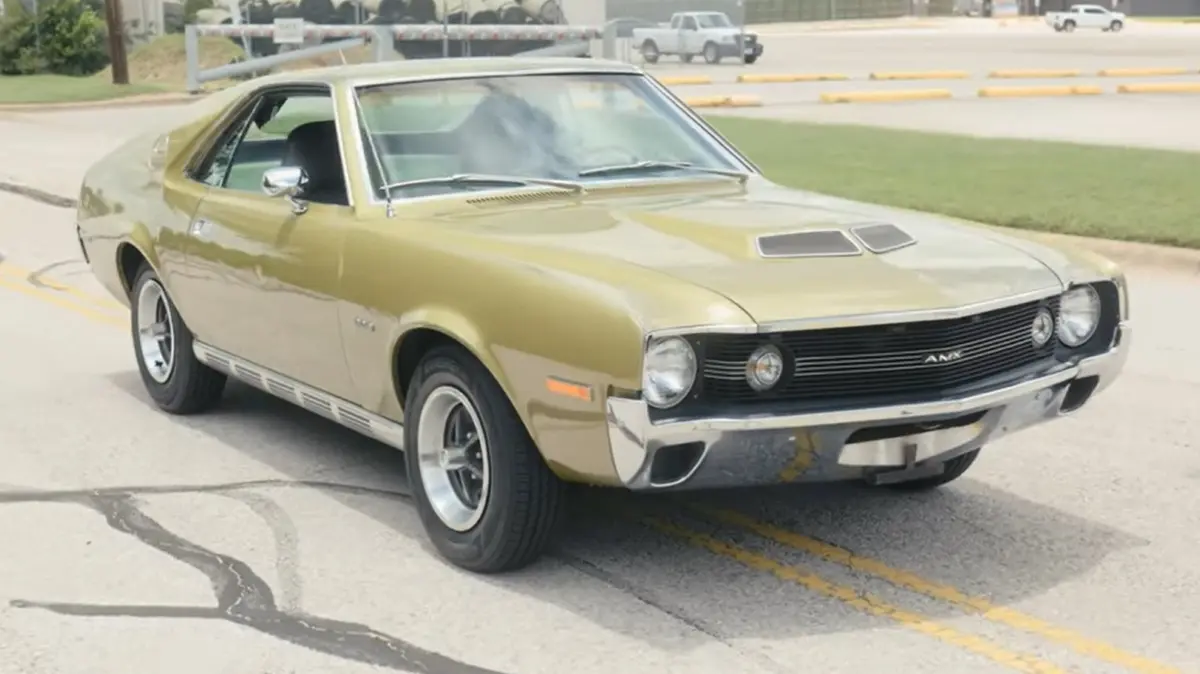
It is not often that modern automotive enthusiasts stumble upon a true survivor vehicle from 1970 bearing fewer than 15,000 miles on its odometer. Finding any vehicle from that era in such preserved condition is a notable event, but discovering an authentic 1970 American Motors Corporation AMX with so little road time is exceptionally rare. This piece of automotive history hails from the same turbulent year that the legendary rock band The Beatles announced their breakup and Apollo 13 ground crews listened anxiously to the crew’s famous distress call from deep space.
Located just a short drive from the home of Formula 1 in the United States, an Austin-based dealership named Motors Corner USA has placed a remarkable 1970 AMC AMX up for sale. Equipped with a burly 360-cubic-inch V8 engine and a responsive manual transmission, this muscle car survivor presents a compelling option for collectors. Better yet, it sits at that ideal intersection of originality and manageable wear, making it imperfect enough that a new owner will not feel guilty about adding serious mileage to the odometer—something this neglected classic desperately needs.
For those unfamiliar with the historical footprint of the AMX, the vehicle represented the American Motors Corporation’s daring, two-seater competitive entry into the fierce American muscle-car market of the late 1960s and early 1970s. During its production run, the AMX went toe-to-toe against formidable segment rivals such as the Ford Mustang and the Chevrolet Corvette.
Alas, AMC’s short-wheelbase creation, marketed as a genuine sports car for the price of a sporty car, did not achieve massive commercial success during its final standalone production year in 1970. Historical production figures show that AMC manufactured just 4,116 units of the AMX for the 1970 model year. That output represented roughly half the production volume of the previous year and accounted for a mere tenth of the total volume of Mach 1 Mustangs that Ford managed to push out of showrooms during the exact same period.
What do those low production numbers mean for modern classic car buyers? Simply put, tracking down a clean, well-preserved AMX is far easier said than done. While this particular model might not be the sort of pristine garage queen you would expect to see parked on the manicured lawn of an exclusive concours d’elegance where attendees wear monocles and sip overpriced champagne, its potential as a robust, enjoyable driver is remarkably high. When evaluating current market trends and the overall package, this vintage muscle car might actually represent a genuine bargain for enthusiasts who do not mind tackling a minor project or two.
This 56-Year-Old AMC AMX is a Manual, V8-Powered Survivor
American Motors Corporation produced the standalone AMX model from the 1968 through the 1970 model years. Following this initial three-year run, the AMX designation shifted for the 1971 model year, becoming a high-performance trim and appearance package that buyers could select when purchasing an AMC Javelin. Because of this corporate pivot, a solid, unmolested 1970 AMC AMX holds significant appeal as a collectible muscle car, acting essentially as the dramatic punctuation mark at the end of the AMX’s independent model story.
Adding to its appeal, this particular example pairs eight cylinders with a traditional manual gearbox. Under the hood, the car packs a robust 360-cubic-inch V8 engine, which was factory-rated at an impressive 290 horsepower and 395 pound-feet of torque when it originally rolled off the assembly line. That figure represented a healthy 65-horsepower bump over the smaller V8 offered in the 1969 model, though automotive enthusiasts can reasonably expect that a few of those original horses may have wandered away from the stable over the course of more than five decades.
While the 1970 AMX could be specified with a Shift Command automatic transmission, this specific car pairs its 360 V8 with an all-synchromesh four-speed manual transmission operated via a classic Hurst floor shifter. Stepping inside the cabin reveals an interior that remains remarkably true to its factory roots, though it naturally displays authentic signs of age, use, and patina.
The original factory instrumentation remains intact on the dashboard, while the period-correct leather upholstery and wood-grain trim accents have somehow managed to survive the decades largely intact. Furthermore, the vehicle comes accompanied by its original factory documentation, including the vintage operating record booklet and the physical owner’s manual provided to the first retail buyer.
For enthusiasts interested in acquiring the vehicle, the Texas-based muscle car is currently listed on AutoTrader with an asking price of $34,900. While that figure might sound like a significant sum of money at first glance, it is actually quite reasonable when compared against the typical market values commanded by 1970 AMC AMXs today.
According to tracking data from Classic.com, the average sale price for a comparable vehicle in the current collector market hovers around $68,091, though final transaction prices fluctuate wildly depending heavily on factors such as overall mechanical condition, precise mileage, and geographical location. While bargain hunters can certainly locate cheaper entry points—such as an AMC AMX project car requiring extensive restoration for around $20,000—this running, driving survivor is arguably a much smarter buy for anyone who simply wants to turn a key and hit the open road.
Somebody Please Drive This Thing Unapologetically
For a vehicle that is now 56 years old, this AMX is in remarkably solid cosmetic and mechanical shape. Motors Corner USA reports that the car’s 360-cubic-inch V8 engine fires up quickly and without excessive hesitation, a testament to a recently completed round of comprehensive mechanical servicing.
That recent maintenance work included a thorough rebuild of the original equipment manufacturer four-barrel carburetor, a complete brake fluid bleed to ensure firm pedal response, and the installation of a fresh set of spark plugs. Admittedly, this is not a pristine, concours-condition show car that has been meticulously trailer-queen polished for decades. Instead, viewed as a rolling time capsule—an artifact that has somehow endured for more than half a century without undergoing a obsessive, nut-and-bolt total restoration—it is difficult to find any structural faults or major mechanical grievances.
A closer inspection reveals a few minor imperfections scattered across the car’s original paint, including small yet noticeable cosmetic dents on the trunk lid, some interior trim pieces that are beginning to show signs of age-related disintegration, and subtle dimpling on the passenger-side door panel. More observant onlookers will likely spot what appears to be surface rust beginning to form behind the right rear wheel well. But perfection is rarely found in unrestored vintage machinery.
The car clearly requires a modest amount of bodywork, likely involving some minor metal repair, body filler, and localized paint touch-ups, but above all else, it needs a dedicated driver. After all, how many authentic AMC AMXs are still cruising public roadways with fewer than 15,000 miles registered on their odometers? The answer is precious few. The automotive community should simply be relieved that this particular survivor managed to escape the tragic fate of becoming just another forgotten classic left to rot in a field.