
Driving for a living is an inherently demanding and stressful vocation. The constant vigilance required when operating heavy machinery at high speeds, while sharing the road with human drivers and unpredictable traffic, can take a serious psychological and physical toll on any individual. However, for the specialized class of commercial drivers tasked with transporting enormous wind turbine blades up treacherous, winding, and narrow mountain roads, a single day at work can feel like it ages a person by years. The stakes are extraordinarily high, the margins for error are razor-thin, and the environmental conditions can change in an instant, turning a routine transport run into a high-stakes battle against gravity and geography.
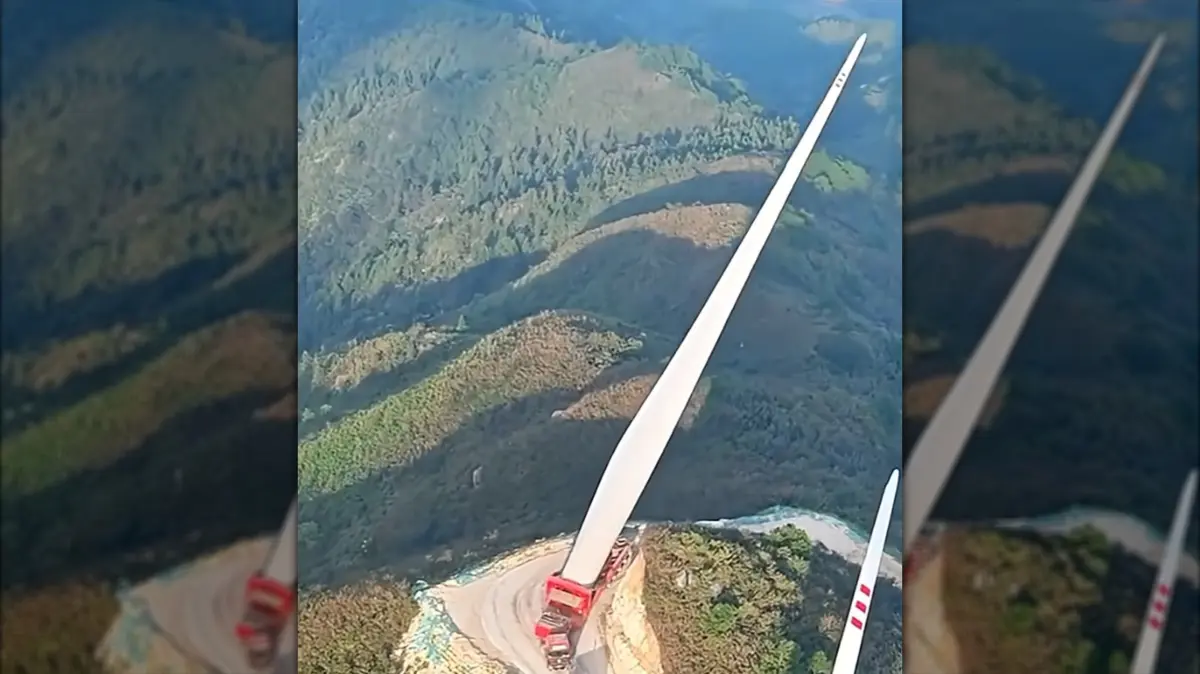
A captivating video recently released by CGTN Europe brings global attention to the extreme lengths—and literal heights—that modern logistics workers in China are willing to go to in order to make renewable energy infrastructure a reality. The footage documents a treacherous, nerve-wracking drive through the rugged Nanling Mountain Range in Hunan Province, China, an undertaking that resembles attempting to thread a needle amidst a high-altitude windstorm. In the footage, a skilled professional truck driver can be seen deftly maneuvering an astronomical 80-tonne, 172-foot-long windmill blade up the soaring, 1,312-foot-high Baoding Mountain.
Navigating some of the world’s most remote, winding, and narrow mountain infrastructure requires a specific, highly specialized tier of concentration and extraordinary driving skill. A momentary lapse in focus or a slight miscalculation can yield catastrophic consequences, potentially sending a multi-million-dollar cargo and a massive semi-truck plunging over a several-story sheer drop beyond the region’s largely non-existent guardrails. This specialized truck driver is easily a compelling contender for holding one of the most high-stress, high-danger jobs in the entire world. For the uninitiated observer, witnessing such a feat naturally provokes a sense of profound disbelief, raising the fundamental logistical question of how a conventional-looking truck can possibly accommodate, let alone transport, a structure of such monumental proportions.
Slow, tall and steady
To successfully transport an object as massive and unwieldy as a modern wind turbine blade, standard commercial vehicles simply will not suffice. Instead, highly specialized trucks and custom-built trailers are engineered precisely to the exact specifications and structural needs of the cargo. According to insights from Trucker Culture on YouTube, these specialized trailers and heavy haulers are equipped with an ingenious mechanical innovation known as a blade lifter system. The root, or the heavy base end of the wind turbine blade, is securely mounted directly to a specialized frame on the transport carrier, which is outfitted with powerful hydraulic lifters.
These hydraulic lifters serve as the critical mechanism that enables what appears to be a relatively compact truck to negotiate impossibly narrow mountain paths, tight switchbacks, and densely constrained rural routes. Along the way, the convoy must successfully bypass residential homes, dense forests, low-hanging power lines, fragile bridges, and virtually any other physical obstruction that crosses the path.
The hydraulic lifter mechanism is capable of raising the massive fiberglass blade upwards of 60 degrees from its resting position, though under certain specialized conditions or in specific operational scenarios, some systems can elevate the cargo even closer to a nearly vertical 90-degree angle. This vertical articulation proves exceptionally valuable when navigating tight, multi-point turns and severe hairpin switchbacks carved into the sides of mountains. By lifting the blade high into the air, the driver can effectively lessen the overall physical footprint that the truck and its trailer make on the roadway. Without this vertical maneuverability, the extreme length of the blade would cause it to swing wide, running a severe risk of hanging off the precipitous edge of the mountain pass, plunging both the vehicle and the multi-ton cargo into the abyss below.
Compounding the difficulty of the journey, the primary semi-truck is rarely traveling alone. The transport vehicles captured in the footage are accompanied by a dedicated team of escort vehicles and support crews. These support teams are tasked with far more than mere traffic control; they actively survey the route ahead, remove sudden physical obstacles, and help guide the primary driver through exceptionally precarious situations. In many instances, this intricate guidance is coordinated directly via radio communications, particularly when precise, millimeter-level movements are required to navigate narrow stretches where the truck and its elevated blade have literally just a few feet of clearance from sheer rock faces or canyon walls.
Furthermore, changing weather conditions can exponentially increase the threat level of an already precarious transport operation. Wind turbine blades are aerodynamically engineered by design to catch and harness the wind, an operational attribute that unfortunately does not cease just because the blade is strapped horizontally or vertically to the back of a specialized highway carrier. Encountering a sudden, powerful gust of wind at the exposed summit of a mountain like Baoding Mountain can instantly transform a routine transport day into a harrowing ordeal for everyone involved. When severe weather strikes, Mother Nature ultimately dictates the schedule, frequently bringing the entire transport caravan to a complete standstill until atmospheric conditions stabilize and clear. Attempting to push forward against severe mountain gales risks the wrath of the elements, potentially resulting in an unintentional, and drastically faster, unauthorized return trip straight down the side of the mountain.