
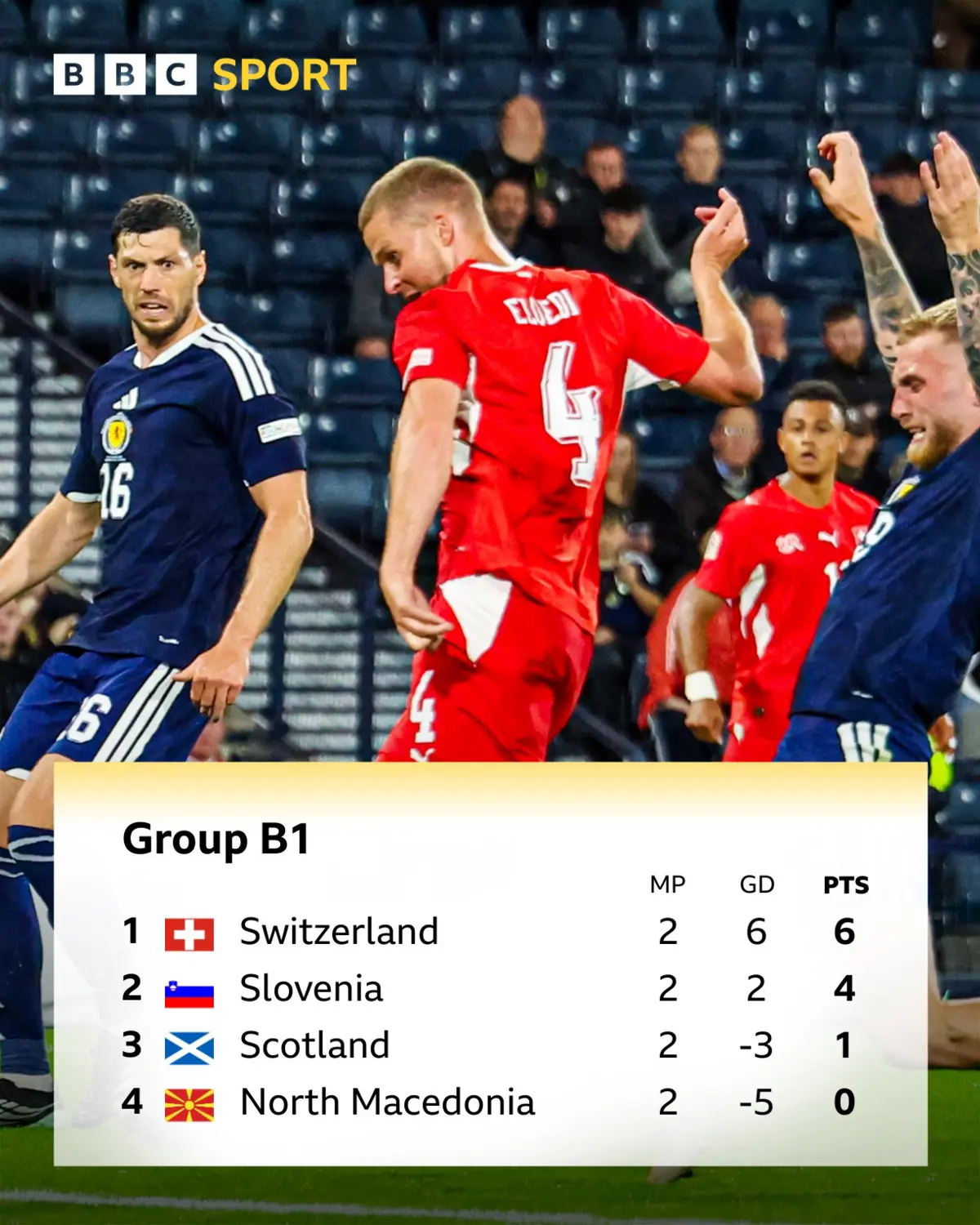
Scotland fans arrived at Hampden Park on Tuesday evening with a collective sense of optimism, eager to welcome a new chapter under manager Sebastien Pocognoli. Instead, they departed the historic stadium carrying the heavy, familiar weight of old woes, having watched their team suffer a comprehensive 3-3—correction, 3-0—defeat at the hands of a ruthless Switzerland side.
What was supposed to be the dawn of a fresh era quickly devolved into a familiar script of calamitous early defending, a self-inflicted wound that completely altered the trajectory of the game, and another frustrating match without finding the back of the net. Scotland’s goal drought now stretches to four consecutive matches, a worrying statistic that threatens to overshadow Pocognoli’s opening weeks in charge.
The unraveling began in the opening minutes. When Jack Hendry received a straight red card for a desperate last-man challenge, the atmosphere inside Hampden instantly transported fans back to past defensive meltdowns. Much like previous heavy defeats where Scotland gifted goals through sheer panic and defensive disarray, the team made an already difficult assignment against a tier-one European opponent an impossible one through slapstick errors at the back.
Switzerland are not an opponent that offers many gifts. They are a side with immense tactical nous, physical strength, and unshakeable belief. Argentina had a grueling battle to see them off in extra-time at the World Cup, and Germany only narrowly overcame them 4-3 in an international friendly thanks to an 85th-minute winner.
Under coach Murat Yakin, the Swiss possess the calm authority of a management team that knows with absolute certainty how a match will unfold. Once the opening goal hit the back of the net, Yakin turned around in his technical area with a half-smile already playing across his face. For the visitors, the job was effectively done.
There was, in truth, little Scotland could do about the brilliant, incisive passing sequence that initially cut them open to send Dan Ndoye racing clear in the game’s opening moments. However, there was plenty that Jack Hendry could have done—or rather, should not have done—when he found himself caught in a foot-race and physical mismatch against the lively forward. Watching the sequence unfold from the stands was a painful experience for the Tartan Army.
Ndoye was always favored to win the foot-race, a reality that an experienced international defender like Hendry should have recognized immediately. He should have known that any desperate, ill-fated attempt to halt Ndoye from that position could only end in disaster. With no cover and no position to make a legitimate challenge, Hendry needed to accept his fate and place his trust in his goalkeeper to bail him out.
Instead, of all the unpleasant options available, he chose the one he simply could not afford to take. Reaching out to grab Ndoye was a fatal, game-defining act.
Speaking after the match, Scotland captain Andy Robertson attempted to shed light on the psychological battle playing out in his teammate’s head. Robertson noted that allowing an opposition striker a clean shot on goal goes against every instinct a defender possesses; every fiber of their being demands that they do something to stop it.
Hindsight is wonderful, Robertson acknowledged, adding that football is ultimately a game dictated by split-second decisions. Yet, the brutal reality remained: "The red card killed us."
Off trudged Hendry down the tunnel, and up stepped Switzerland to convert the resulting free-kick. In a matter of minutes, Scotland found themselves a goal down and a man short against the 14th-ranked team in the world.
Whether Angus Gunn could have done better with Ricardo Rodriguez’s ensuing effort remains a subject for debate; the ball flew past the wall on the goalkeeper’s side, and Gunn failed to lay a glove on it. It was a truly nightmarish beginning to the evening.
Hendry’s night was over before it had properly begun, and Kieron Bowie suffered a similar fate. The young striker was sacrificed and substituted almost immediately in the wake of the red card, becoming an innocent tactical victim of a dreadful defensive error.
To their credit, the remaining Scotland players worked like dervishes in the aftermath. They fought, scraped, and battled for every loose ball. John McGinn diligently bought a series of crucial fouls to relieve pressure, while Oli McBurnie battled isolated in what McGinn later described as a "thankless task." There were fleeting moments when the Hampden crowd managed to re-energize themselves, allowing brief sparks of hope—or perhaps sheer delusion—to take hold.
Pocognoli’s underdogs tried desperately to stay in the contest, but an air of inevitability hung over the pitch. Switzerland handled Scotland’s energetic bursts with consummate professionalism, biding their time before landing the knockout blows later in the match.

The second and third goals did not flatter the visitors in the least. Taking on Switzerland was always going to be a monumental task with eleven men on the pitch; reducing the contest to a ten-versus-eleven mismatch after just eleven minutes effectively ended the contest as a competitive spectacle.
That is the most galling aspect for the coaching staff and supporters alike. Perhaps the match would have ended in the exact same defeat even if the red card had never happened, but the unfortunate truth is that the team never got the opportunity to find out.
Is North Macedonia Now Must-Win?
Sebastien Pocognoli remarked prior to kick-off that everyone within the squad was exceptionally excited to write the opening page of a new book at home, but that opening chapter quickly mutated into a horror story.
The narrative must pivot rapidly, with the next chapter scheduled in Skopje on Saturday. While it feels premature to slap the label of a "must-win" on a fixture occurring so early in Pocognoli’s managerial reign, for general morale and feel-good factor, it undeniably is.
North Macedonia present a vastly different challenge from Switzerland. They are certainly not of the same caliber as the Swiss, who comfortably dispatched them 3-0 the previous weekend, nor are they currently at Slovenia’s level following a 2-0 defeat earlier in the week.
North Macedonia enter the fixture winless in their last ten international matches, having scored a meager two goals during that barren run while shipping four against Turkey, four against Denmark, and seven against Wales.
Saturday represents a golden, necessary opportunity for Scotland to finally draw a line under their ongoing goal drought and bring their frustrating winless run to an abrupt and decisive conclusion.
How Pocognoli chooses to configure his starting lineup and formation in Skopje will undoubtedly spark intense debate among pundits and supporters, largely because the ninety minutes against Switzerland provided virtually no tactical insight. Almost nothing could be reliably gleaned from a match rendered a foregone conclusion so early on.
There were, however, isolated positives. Luis Binks defended admirably on his international debut, and Stephen Welsh slotted in seamlessly after the red card, performing with great composure. These represent rare plus-marks on an otherwise write-off of a night.
Bowie was cruelly robbed of his opportunity to shine against Switzerland and will surely be handed a proper chance to prove himself in Skopje. The proposed McBurnie-Bowie attacking partnership deserves an opportunity to demonstrate its potential after being broken up so prematurely at Hampden.
With the team desperately requiring goals, pace, and an element of unpredictability, the manager may also view this fixture as an ideal time to unleash Ben Gannon-Doak. While integrating the explosive youngster into a disciplined system can be challenging, his raw speed makes him well worth the tactical effort required to harness it.
The logic behind leaving Gannon-Doak out of a wing-back role against the highly accomplished Swiss was understandable, but no such defensive threat exists against North Macedonia.
Failing to score against Slovenia was certainly annoying; failing to score against Switzerland under those extenuating circumstances was entirely understandable; however, failing to score and failing to win in Skopje would constitute a genuinely horrible outcome for the national team.
It is time for Scotland to cut loose—or at least to find whatever constitutes cutting loose for a side that has seemingly misplaced its scoring touch. Memories of Scott McTominay’s acrobatic overhead kick, Kieran Tierney’s wonder goals, and Kenny McLean’s long-range heroics now feel like a lifetime ago.
At this stage, supporters would happily welcome an ugly deflection, a fortunate own goal, or a scrappy effort that ricochets in off McGinn’s backside or the back of McBurnie’s head. Anything will do to secure a goal and a victory. Absolutely anything.