
If you scroll down far enough on the list of “Carbon Majors”—the 178 corporate producers collectively responsible for the vast majority of the world’s historical fossil fuel emissions—you will eventually encounter Continental Resources. Ranked roughly 150th on the index, far behind international giants like Saudi Aramco and ExxonMobil, the firm has nonetheless generated nearly 600 million tons of carbon dioxide since 2005 alone. That total is equivalent to the combined carbon footprint of roughly two million everyday Americans over the same timeframe. The driving force behind this enterprise is Harold Hamm, an oil executive who cuts a classic figure in American corporate lore. Growing up in severe poverty in Oklahoma before working his way into the staggering wealth of the hydraulic fracturing boom, Hamm still retains a distinct Southern drawl. Today, he utilizes his immense fortune to shape the American political landscape, raising millions of dollars for Republican candidates and aggressively bankrolling opposition to green energy initiatives.
For audiences squinting at the screen, the protagonist of Alejandro G. Iñárritu’s new film, Digger, could easily pass for Hamm, or at least for the archetype of the oil billionaire that has firmly embedded itself in the modern American psyche. The movie centers on an unyielding energy executive named Digger Rockwell, a Texas-accented plutocrat who has expanded his late father’s wildcatting business into a massive global enterprise featuring offshore drilling operations in places like Greenland and Alaska. As portrayed by Tom Cruise, the character embodies a specific type of Southern businessman-ideologue. He travels in style on a private jet equipped with monogrammed seats, breaks into booming rants about his own anatomy, and appears to harbor only two primary interests in life: generating immense corporate profits and maintaining the health of his white cat, Maggie, whom he desperately attempts to keep alive against veterinary advice even as the animal decays in his arms.
Digger sets out to examine two fundamental questions. First, how much personal and moral responsibility does such an individual bear for the deaths, economic disruptions, and displacements triggered by global climate change? Second, what is the most effective or appropriate way for an artist to grapple with that question? For viewers who believe they already know the answers, this cinematic project may be aimed directly at them, though that does not guarantee an enjoyable viewing experience. In attempting to craft a sweeping fable about the unchecked hubris of petroleum titans in the vein of Hamm, Iñárritu has instead delivered a film that struggles to articulate much beyond what a politically engaged audience already understands. The director appears acutely aware that heavy-handed political parables about corporate greed carry limited artistic utility, yet he remains trapped within the very confines of the parable format. The resulting product is a chaotic storm of shouting and vitriol that threatens to exhaust even the most climate-conscious moviegoers.
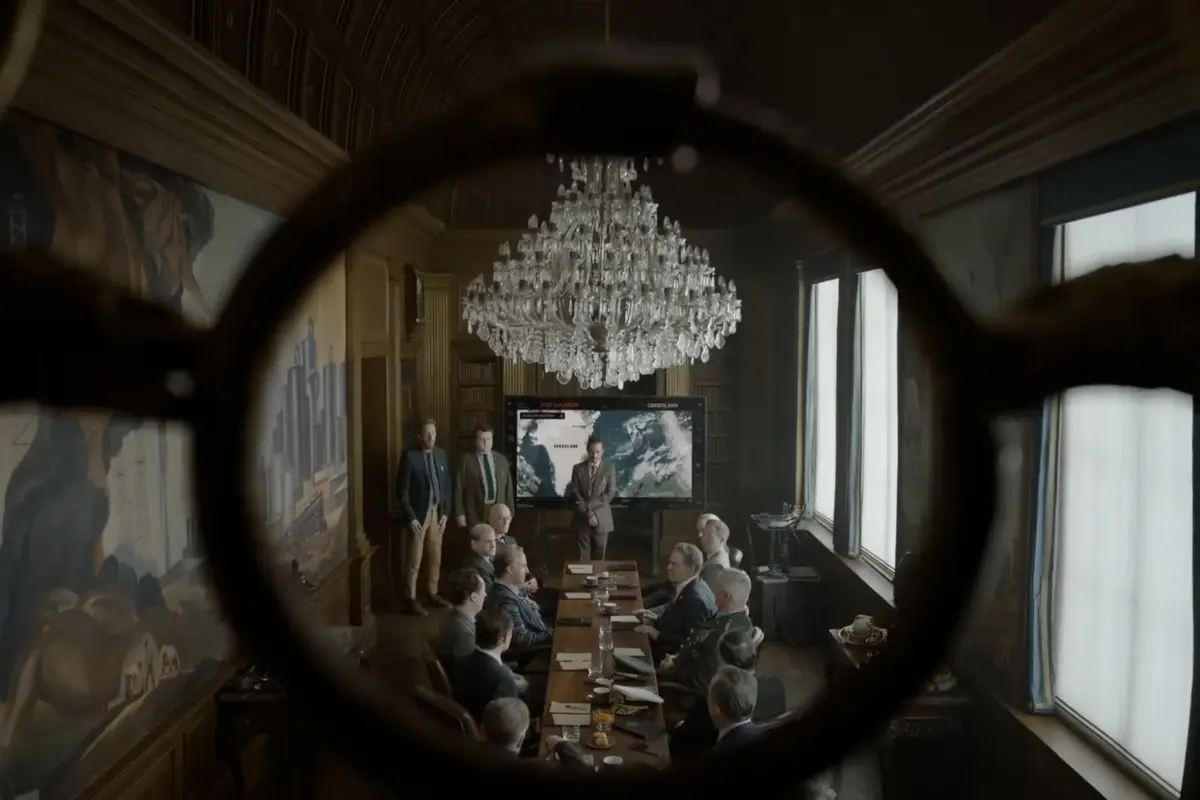
Following an opening sequence designed to let audiences marvel at Cruise’s extensive physical transformation into a sedentary, jowled oil executive, the plot barrels forward with the subtlety of a blaring tornado siren. A frightened technician aboard one of Digger’s offshore drilling platforms in Greenland calls his boss to report that a massive methane leak has triggered a deep geological crack, threatening the stability of the region’s immense ice sheet. Before Digger can even conclude a dismissive monologue explaining why he refuses to shut down a billion-dollar platform over a minor structural fracture, a delegation of corporate officers arrives to deliver worse news: the rig has suffered a catastrophic blowout, and the Greenland ice sheet has completely disintegrated. Consequently, a gargantuan iceberg is now hurtling directly toward Europe, carrying the catastrophic potential to flood the continent and cause hundreds of thousands of fatalities. Digger immediately confers with the U.S. president, played by John Goodman, to map out a response, and the pair quickly decide that the drilling must continue unabated.
This opening act establishes a tone of heavy-handedness that far surpasses Adam McKay’s 2021 climate satire Don’t Look Up, which famously used an approaching comet as an allegorical stand-in for global warming. Digger’s proposed solution to the unfolding planetary catastrophe involves deploying a proprietary digital censorship tool known as the “firewall,” designed to scrub all online mentions of the words “methane,” “iceberg,” and “climate change” from the internet. Meanwhile, the president and his conservative allies offer predictable reactionary proposals, such as attempting to bomb the massive floating glacier or simply praying for divine intervention. Whereas McKay favored a slick, cable-news-inspired realism, Iñárritu opts for a distinct aesthetic hybrid that borrows visual cues from Wes Anderson and regionalist painter Thomas Hart Benton. Digger’s corporate boardroom is lavishly decorated with Art Deco murals glorifying historic oil discoveries, while a literal sculpture of an ouroboros—a snake consuming its own tail—hangs conspicuously above the conference table.
The dialogue is densely packed with inside jokes and pointed references about climate science that will likely resonate deeply with the small minority of viewers who spend their daily lives immersed in environmental policy debates. The script touches upon the extreme global warming potential of methane, references a disastrous fictional “COP30 fiasco” where the United States supposedly alienated its international partners by abandoning the Paris Agreement, and even nods to the accelerating thaw of Arctic permafrost. The primary vehicles for these exposition-heavy exchanges are conversations between Digger and his resident corporate scientist, Ganesh, played by Riz Ahmed. Their debates routinely devolve into clashes over familiar culture-war battlegrounds. In one scene, Ganesh rejects an offering of expensive sashimi because the bluefin tuna population has plummeted by 97 percent, protesting that the current administration refuses to officially designate the species as endangered—only to taste the fish moments later and confess that he loves it.

Whether or not this satirical approach offers an accurate reflection of the global economy, it rarely translates into pleasurable cinema. Well over half of the runtime is consumed by characters shouting at the top of their lungs about greenhouse gas emissions or quarterly stock market valuations. This reaches a narrative peak during an excruciating sequence in which Digger berates the European Parliament, loudly accusing the assembled delegates of rank hypocrisy for consuming petroleum products while simultaneously condemning his company’s operational methods. Danish and German lawmakers howl in outrage from the legislative benches, branding him a genocidal actor for allowing the catastrophic iceberg to threaten their homes, while Digger screams back that the modern world entirely depends on his crude extraction. “You want me to keep producing,” he yells across the chamber. “You demand, and I supply!” For anyone who has ever worked professionally in environmental advocacy, participated in climate politics, or engaged in contentious online debates about global warming, the entire exchange feels distressingly familiar.
For a viewer without professional obligations to review the picture, walking out after the European Parliament confrontation would be a tempting proposition—not necessarily due to the ideological stance being argued, but because the cinematic experience is abrasive, loud, and fundamentally unpleasant. Regardless of whether a viewer sympathizes more with Digger or with the outraged European politicians, sitting through unrelenting shouting matches proves wearing. In a twist worthy of Cruise’s cinematic history, arguably the most relaxing moment in the entire film occurs when the U.S. Air Force scrambles a squadron of fighter jets to carpet-bomb the oncoming iceberg simply because it is the rare instance where everyone onscreen stops talking.
As the narrative progresses, the film introduces a late narrative twist intended to elevate Iñárritu’s project above the straightforward messaging of McKay’s earlier work. Without spoiling too many plot specifics, the film shifts from being a direct parable about climate change to a meta-parable examining the very nature of telling parables about climate change. The apparent goal of this narrative layer is to interrogate what artists hope to achieve by subjecting an audience to such heavy-handed metaphors in the first place.
McKay’s evident hope when releasing Don’t Look Up was that cultural fables might successfully goad the public into political action, a strategy whose ultimate efficacy can be measured against subsequent political developments, such as the continued political success of climate skeptics and a broader global cultural retreat from open discussions about global warming. Watching a feature film about a tyrannical fossil fuel executive is unlikely to prompt a consumer to purchase an electric vehicle any more than reading a corporate emissions ledger would.
Yet the creative impulse persists. Iñárritu appears determined to argue for the inherent value of documenting our current historical reality, even when that documentation inevitably warps into caricature. A handful of individuals have indeed amassed staggering fortunes by marketing a commodity that has supercharged modern human welfare while simultaneously destabilizing the climatic foundations of that very welfare. Those individuals are inherently far more motivated to continue selling their product than to halt operations. Is there not some intrinsic worth in preserving that unflattering truth for future generations? During one pivotal scene, a character succinctly summarizes this sentiment: “It’s ridiculous, and it’s scary, and it’s funny, and it’s stupid. It makes no goddamn sense, but it’s what happened.”
Even so, a feature film requires a narrative heart, and Digger ultimately lacks one just as completely as its titular protagonist. Despite lingering close-ups of Cruise staring longingly at his decomposing pet cat or gazing out at an oil-rig sunset, the picture fails to achieve the baseline emotional resonance of a standard blockbuster. It possesses roughly the warmth of a contentious social media thread regarding regulatory permitting reform, and its concluding suggestion that storytelling can offer solace during planetary crises feels like an instance of an artist merely telling the audience what to feel rather than dramatizing it.
If Iñárritu’s primary objective was to demonstrate via metaphor that corporate greed has actively facilitated the climate crisis, he has arguably succeeded all too well. If his secondary point was to illustrate that this exact style of cinematic metaphor is inherently simplistic and of questionable political utility, he has proven that as well. Viewers searching for engaging cinematic critiques of big business practices might ultimately wish they had invested their time and money elsewhere. At the very least, watching theatrical revivals offers the simple comfort of enjoying destruction without requiring an exhaustive ideological lecture beforehand.