
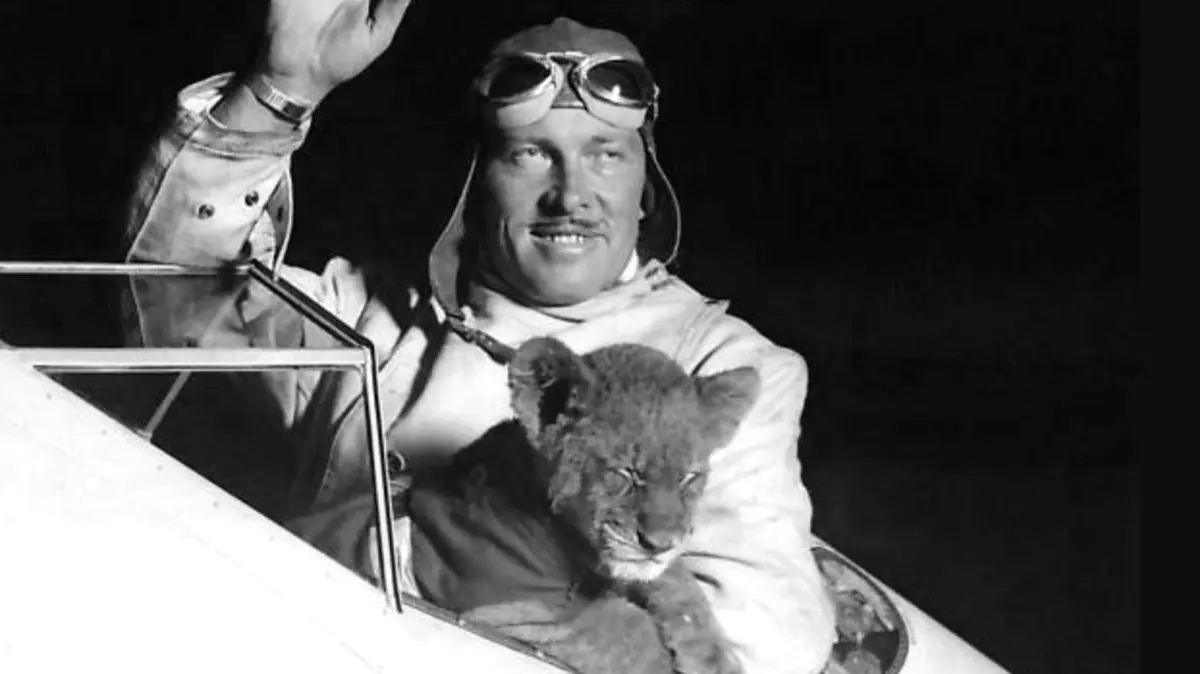
Celebrity in the 1930s operated under an entirely different set of rules compared to the modern era, thriving on sheer spectacle, daring personal branding, and high-stakes public stunts. In early 1930, legendary celebrity pilot Roscoe Turner and Gilmore Oil teamed up to shatter the transcontinental flight record aboard a Lockheed Express, blazing through the sky from New York to Los Angeles in a staggering 18 hours and 42 minutes. At the time, Gilmore Gasoline was heavily marketed under the brand name "red lion," a clever campaign designed to convince drivers that pumping the fuel into their cars would give the engine more "roar." Always the flamboyant showman with a penchant for theatricality, Turner approached the owner of a local lion farm and successfully convinced him to donate a young cub for the ambitious record-setting attempt. The tiny, three-week-old cub—whom Turner promptly christened Gilmore the Flying Lion—would go on to accompany the aviator through a series of high-profile stunts, including intense speed trials and the globally famous Cleveland National Air Races.
Turner himself was a seasoned air racer and aerobatics ace who was widely recognized for his flair for the dramatic. Having initially learned how to fly for the U.S. Army during World War I, Turner rapidly transitioned into a nationally renowned barnstormer, thrilling massive crowds by performing death-defying wing-walking stunts and artfully choreographed parachute jumps. His early aviation career was not without turbulence, however; in 1922, he served a brief stint in prison after purchasing a Curtiss JN-4 biplane that ultimately turned out to be stolen government property. Undeterred by the setback, Turner later established the Roscoe Turner Flying Circus before shifting gears to coordinate and execute flying stunts for Hollywood films and launching his own commercial airline. When the devastating economic realities of the Great Depression ultimately killed his entrepreneurial ambitions in commercial aviation, Turner eagerly jumped back into the cockpit of high-speed racing planes and secured a lucrative, career-defining sponsorship with Gilmore Oil.
For much of 1930, specifically between April and December, Turner and his unconventional co-pilot achieved international acclaim for their breathtaking airborne stunts. As the cub inevitably grew too large to safely continue flying inside the cockpit, Turner’s own fame and public notoriety continued to blossom across the United States. He secured his first major victory in the prestigious Bendix Trophy race in 1933, followed swiftly by a triumph in the Thompson Trophy air race in 1934. These monumental racing achievements were made possible after Turner teamed up with fellow aviation pioneers Jimmy Wedell and Harry Williams to meticulously develop a brand-new low-wing speed plane. The custom-built monoplane was remarkably Spartan, consisting of little more than a pilot’s seat, a tiller for steering, and a roaring Pratt & Whitney nine-cylinder radial engine that pushed the boundaries of aviation engineering at the time.
What of the lion?
Among Turner’s contemporaries was legendary pilot Jimmy Doolittle, who competed fiercely against Turner on the air-racing circuit before achieving his own immortal flying fame during World War II. Doolittle held a deep appreciation for Turner’s outsized personality and theatrical presentation, leaving behind a vivid description of the aviator that captured the spirit of the era.
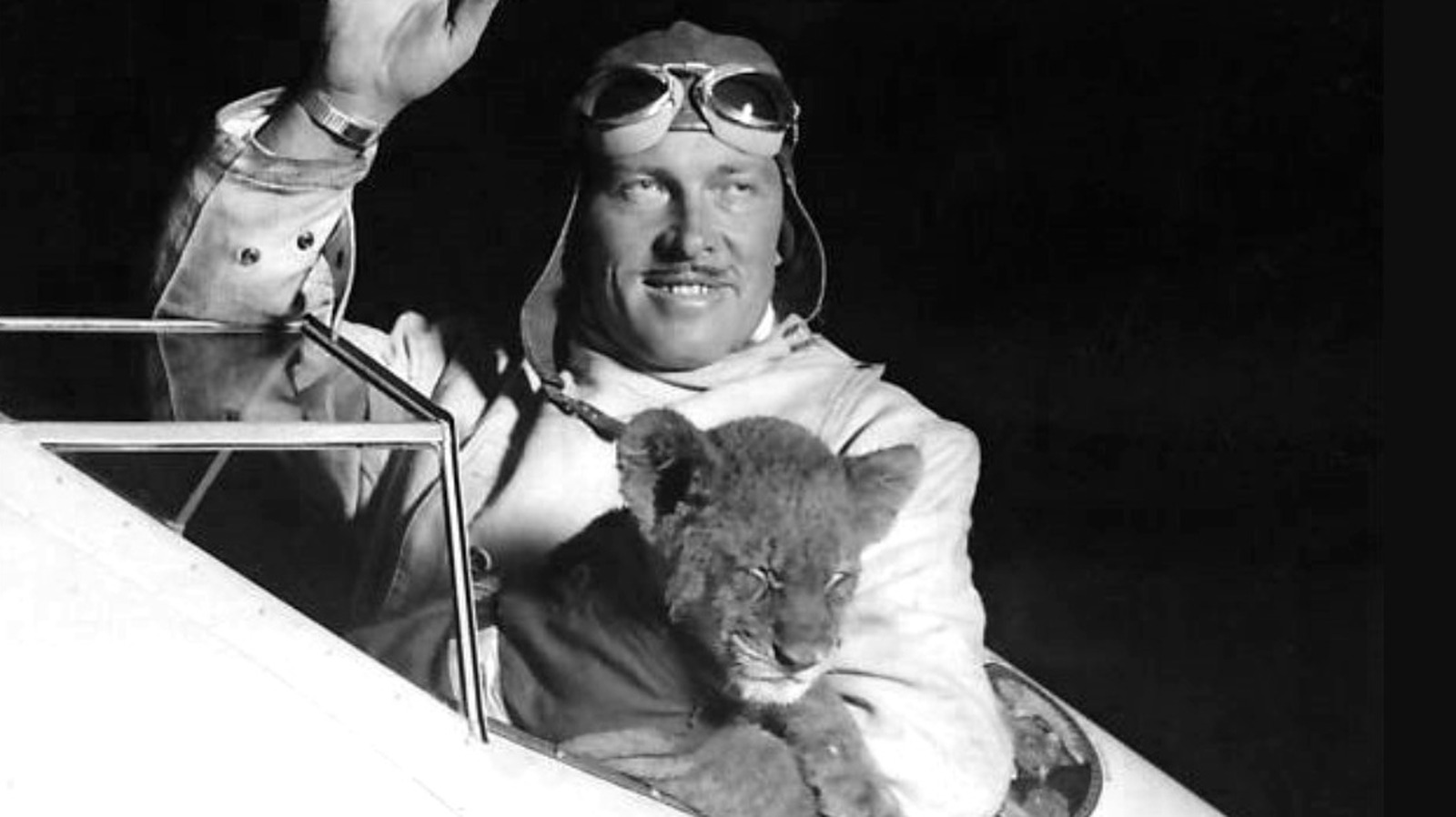
"You always knew when Roscoe was around. His broad smile topped with a broad waxed mustache was the first thing you noticed," Doolittle recalled, as recounted in historical accounts. "Then you saw his uniform — highly polished boots, riding breeches, powder blue military jacket with diamond studded wings, sometimes a Sam Browne belt or a silver buckle, gold-and-crimson helmet and goggles. Then you heard him joshing with everyone, anxious to meet anybody he hadn’t known before. You couldn’t help but like him."
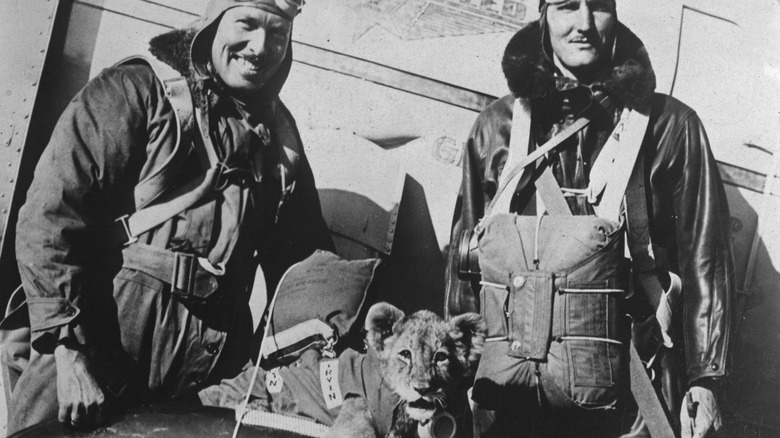
Despite the widespread public adoration, Turner’s unorthodox choice of co-pilot eventually drew unwanted scrutiny, landing him in trouble with the Humane Society once the organization caught wind of a wild animal flying regularly in an airplane. To appease the organization’s stern complaints and satisfy animal welfare concerns, Turner thoughtfully outfitted the 17-pound cub with a specially designed static-line parachute. For several ensuing months, Turner continued to attempt ambitious point-to-point aviation speed records—including a grueling run from Vancouver, Canada, all the way down to Aguascalientes, Mexico—with the lion faithfully in tow, all expenses generously covered by Gilmore Oil, a company entirely unrelated to the modern Gilmore Car Museum.
Gilmore the lion functioned as far more than a simple airplane passenger; he served as a living, breathing ambassador for the petrochemical company, for Turner’s burgeoning racing career, and for the broader advancement of aviation during a time when the industry was striving to capture the public imagination. The charismatic cub would routinely turn up wherever Turner traveled, making surprise appearances at crowded air shows, high-profile Hollywood movie premieres, and glamorous evenings out on the town. However, the realities of biology soon caught up with the partnership. By the time the lion reached 10 months of age, he tipped the scales at a hefty 150 pounds, signaling to Turner that it was finally time to part ways with his beloved co-pilot. Over the course of his unique career, Gilmore had impressively logged over 25,000 miles in the air as the official spokeslion for an oil company.
Gilmore the Lion remains an indelible and fascinating part of American marketing history, serving as a textbook example of the immense power of outside-the-box thinking and corporate sponsorship. Although the Gilmore Oil Company itself is long gone, having been absorbed decades ago into the corporate lineage that ultimately evolved into Mobil, its ultimate legacy remains rooted in a brand of creative, daring marketing that permanently captivated the imagination of a nation navigating difficult economic times.
What happened to Gilmore?
Despite his relatively brief career as an actual flying co-pilot, Gilmore rose to the status of a genuine cultural institution nearly a century ago, with his legendary name recognized and celebrated in households across the country. Following his retirement from the aviation circuit, Gilmore spent nearly a decade living out his days in captivity, initially housed within a secure enclosure at the Burbank airport in Southern California before being relocated to a different cage situated directly at a Gilmore gas station located in affluent Beverly Hills. Once a celebrated, dynamic symbol of raw power, speed, and adventure with a flamboyant best friend soaring through the clouds above, Gilmore had gradually transitioned into little more than a static public display, his powerful feet firmly planted on terra firma. Even so, throughout the remainder of the 1930s, Gilmore continued to make periodic, highly anticipated publicity appearances directly at Turner’s side, though he was never permitted to take to the skies in an airplane again.
By 1940, Gilmore was officially returned to the very facility where his extraordinary life had begun: the Louis Goebel Lion Farm situated in Agoura, California. He peacefully inhabited the spacious grounds of the farm for another full decade before passing away, with Turner maintaining a loyal connection by occasionally visiting his former co-pilot and continuously sending financial support to ensure the animal was properly cared for throughout his twilight years. Gilmore finally passed away on December 17, 1950, reaching the remarkably ripe old age of 20.
Following his death, Gilmore’s remains were carefully sent to a professional taxidermist to be mounted, after which the preserved animal was moved directly to Turner’s personal home in Indianapolis, Indiana. When Turner himself passed away in 1970, the stuffed remains of Gilmore the lion were officially entered into the permanent collection of the newly opened Roscoe Turner Museum that same year. When that museum ultimately closed its doors in 1972, Gilmore was transferred once more, finding a permanent home within the prestigious collection of the National Air and Space Museum. According to curatorial records from the museum, the fully mounted Gilmore now weighs a substantial 328 pounds, standing as a permanent physical testament to one of the most eccentric and memorable marketing partnerships in the history of American aviation.