
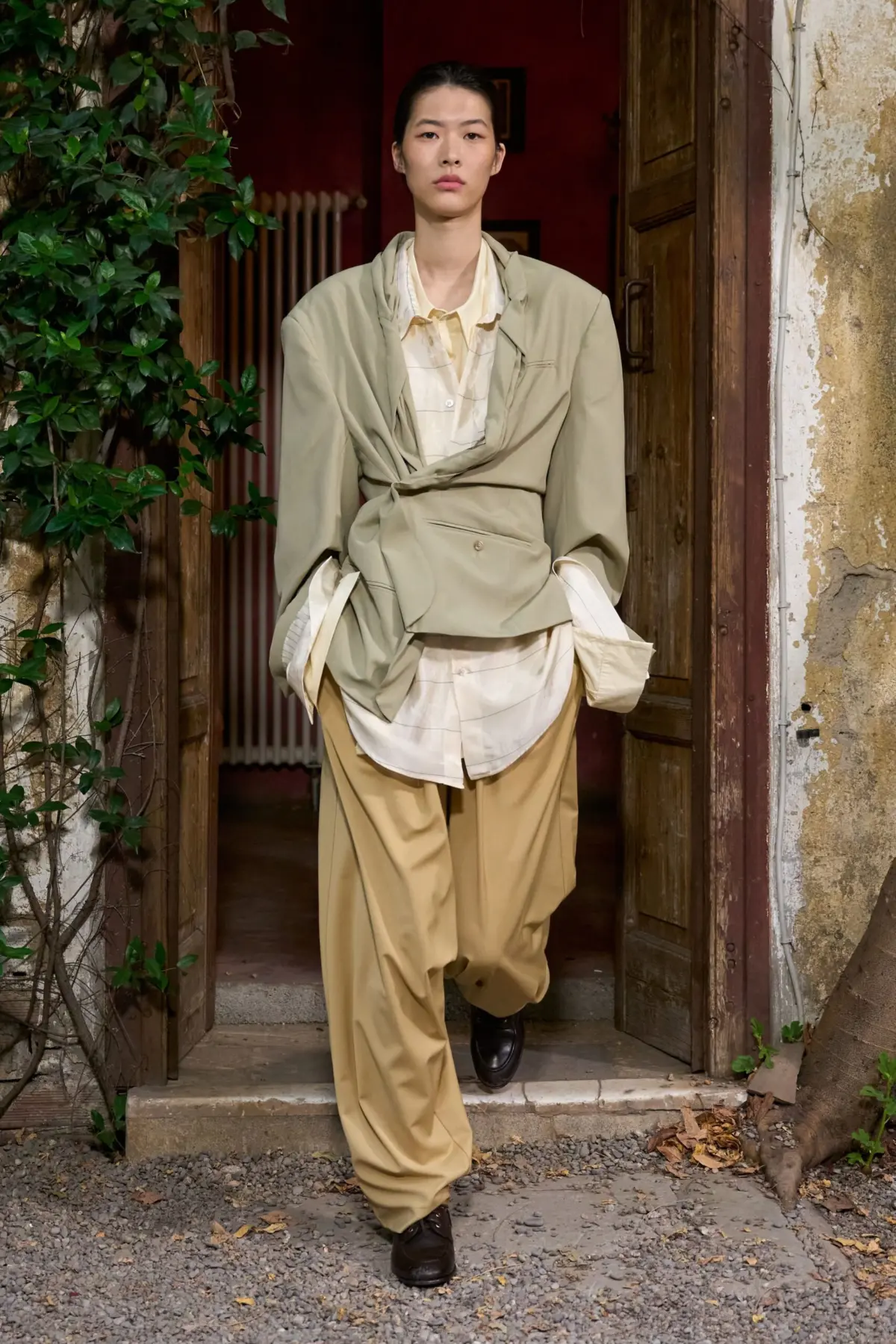
In a hidden, verdant garden tucked away behind a bustling Milanese courtyard, designer Luca Lin recently presented a collection that served as a quiet, compelling argument for the enduring pleasure of everyday clothes. The setting was intentionally serene; lush plants and soft, filtered light engaged in a quiet dialogue with the garments on display, as if the pieces themselves had been invited outdoors to reconsider their relationship with the human form. Rather than the frenetic energy often associated with the Milanese runway circuit, Lin opted for an atmosphere of contemplation, allowing the intricate craftsmanship of his work to speak for itself.
Lin’s approach to design begins with the prosaic cast of the standard wardrobe—the fundamental shirts, trousers, and jackets that populate the lives of most people. However, he proceeds to give each of these archetypes a slight, deliberate nudge. His background in patternmaking serves as the engine of his process, transforming basic silhouettes into objects of quiet intrigue. The garments appeared to have been deconstructed and reconstructed, folded and unfolded, until they achieved a distinctive presence, possessing a logic that felt both familiar and subtly, refreshingly different from the conventional mass-market output.
"At a moment when there is so much product out there," Lin noted, reflecting on the oversaturated state of the global fashion market, "I wanted to create something that could stand apart." His answer to the perennial designer’s problem of establishing a signature is notably devoid of the gimmicks that currently permeate the industry. Rather than inventing one instantly identifiable, logo-driven trick, Lin has opted to plant small, granular signatures throughout the collection. These details are designed to be discovered rather than advertised. For instance, the buttons on his shirts feature irregular, mismatched colors salvaged from the surplus stock of larger industrial productions. While the fastening remains functionally symmetrical, the result is that no two shirts are ever quite the same, providing a unique provenance to every piece. Similarly, the lapels of his blazers are tightly rolled to mimic the delicate structure of twisted ribbons, a small but deliberate flourish that elevates the garment from the mundane to the artisanal.
Adaptability remains a cornerstone of Lin’s construction philosophy. He has built versatility into the very architecture of his clothing. Multiple precise folds at the waists of trousers and the silhouettes of balloon skirts allow the garments to adjust fluidly to the wearer’s body, accommodating shifts in posture and preference. The functionality extends to his outerwear, where a jacket might feature two detachable sleeves, enabling it to transition seamlessly from a structured vest to a capelike outer layer depending on the wearer’s mood or the requirements of the climate. In Lin’s hands, deconstruction is never an abstract or overly intellectual exercise performed on the fabric; rather, it is a highly imaginative and pragmatic way of granting garments multiple lives and greater longevity.
Color, too, provides another essential layer of distinction. Lin’s palette is not defined by bold, declarative blocks that sit heavily on the fabric. Instead, he works through multiple nuanced shades of the same hues across varying materials, allowing colors to accumulate naturally through the layers of an outfit. The effect is one of delicate intensity, a visual depth that gives the collection a particular, shimmering quality of light. By avoiding the heavy-handed application of color, Lin ensures that the focus remains on the texture and the drape of the materials.
Sustainability is woven into the DNA of the collection, though it is never presented with the didactic or sermonizing tone that has become common in contemporary fashion discourse. Approximately 80% of the pieces were crafted from deadstock fabrics, an approach that aligns perfectly with Lin’s broader design philosophy: the desire to create less, rather than adding indiscriminately to an already crowded global wardrobe. For Lin, the argument for sustainability is made most effectively through the quality of the clothes themselves. By taking existing, discarded materials and making them feel new, and by taking familiar, staple garments and making them feel slightly strange or re-imagined, he achieves individuality through details small enough to be noticed rather than announced. It is a quiet form of advocacy that prioritizes the intrinsic value of the object.
Lin, who was born in Reggio Emilia to Chinese parents, has been steadily refining this unique design language over several seasons. His recent selection as a semifinalist for this year’s prestigious LVMH Prize serves as a significant marker of that evolution. For observers of his work, what is most encouraging is not the appearance of a sudden, drastic reinvention of his style, but rather the opposite: a growing, undeniable confidence in his own creative grammar.
The collection felt sophisticated in its technical construction yet remained remarkably fluid and poetic in its overall spirit. It managed to be distinctive without ever insisting on its own cleverness—a rare feat in an era that often prizes loud, performative design. Lin appears deeply interested in a much harder proposition: achieving a clarity of purpose through the sheer coherence of his thinking. His goal is to reach a point where authorship is something the wearer registers intuitively, rather than something that needs to be declared through branding or excess.
By focusing on the subtle interplay between the body and the garment, Lin is carving out a niche that favors longevity and thoughtful production over the fleeting cycles of trend-based fashion. In the quiet of that Milanese garden, the garments served as a testament to the idea that true style does not need to shout to be understood. As Lin continues to evolve, his work stands as a reminder that the most radical thing a designer can do today might simply be to make the everyday feel extraordinary, one folded lapel and one surplus button at a time. The collection successfully navigated the delicate balance between practical utility and artistic expression, offering a vision of the future that is grounded in the reality of how we actually live, move, and dress. Through this refined lens, Luca Lin has solidified his position as a designer who understands that the most meaningful narratives in fashion are often the ones told in whispers, articulated through the quiet, steady mastery of craft and the persistent pursuit of a coherent, individual vision.