
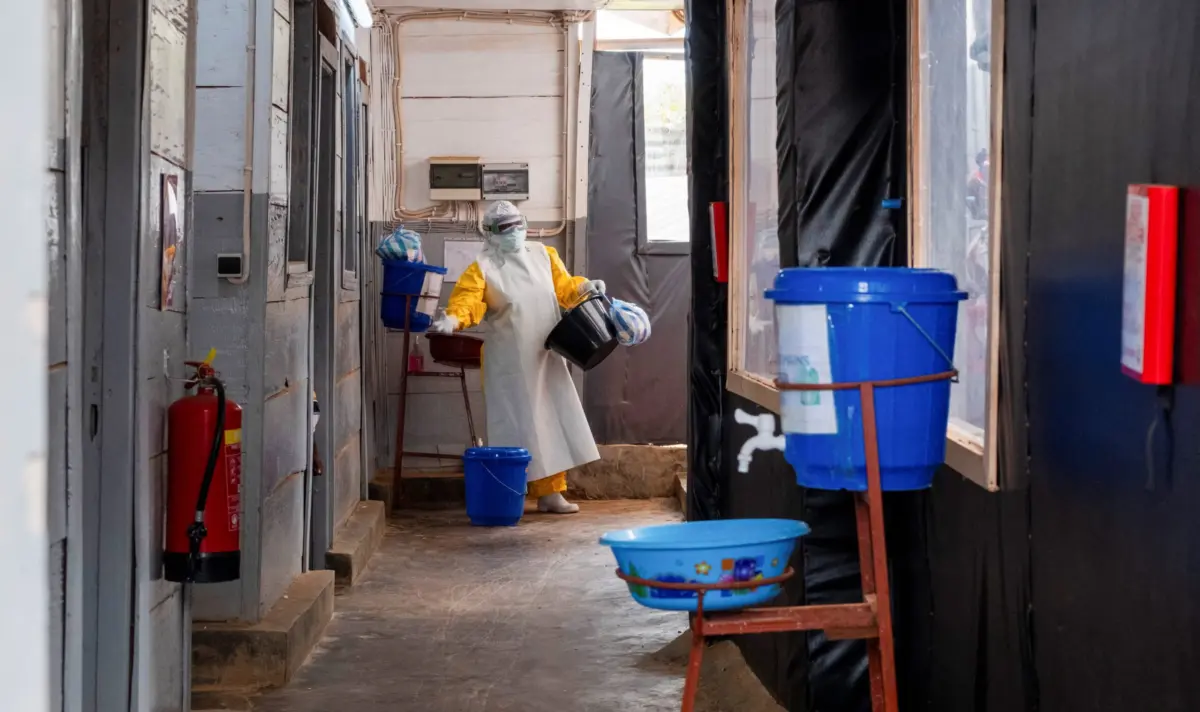
The health crisis in the Democratic Republic of the Congo (DRC) has deepened significantly as the Ebola virus, driven by the rare and challenging Bundibugyo strain, has spread to two additional health zones in remote border provinces. According to announcements made by the World Health Organization (WHO), the virus has now crossed into Bulu, located within the South Ubangi governorate along the border with the Central African Republic, and Dungu in the Haut-Uele province bordering South Sudan.
These newly identified infections expand the geographical footprint of an epidemic that health authorities are finding increasingly difficult to contain. The outbreak has now reached 63 distinct health zones distributed across seven provinces. The widening distribution underscores the severe logistical and operational obstacles confronting medical personnel on the ground, who are striving to halt the transmission chains in highly volatile and geographically isolated regions.
As of September 23, the cumulative toll of the epidemic has climbed to 7,890 confirmed cases, accompanied by 3,799 deaths. These figures highlight a grim mortality rate of nearly 50 percent, meaning that roughly half of all individuals who contract the infection ultimately succumb to the disease. The relentless climb in fatalities and infections has alarmed international health agencies, which warn that the trajectory of the outbreak remains precarious.
WHO Director-General Tedros Adhanom Ghebreyesus addressed the escalating crisis, emphasizing that ongoing regional conflicts and widespread population displacement are severely compounding the difficulties faced by medical response teams. These security and logistical hurdles prevent health workers from securely accessing vulnerable communities and carrying out vital contact-tracing procedures to intercept transmission paths.
“It’s very difficult to see Ebola in isolation because even our response to Ebola is affected by the conflict, because there is displacement and there is an access problem to some areas,” Tedros explained during a briefing on the situation.
Compounding the crisis is the nature of the pathogen itself. The Bundibugyo strain presents unique clinical and pharmacological challenges because there are currently no approved vaccines specifically tailored to combat it. In response to this therapeutic gap, the WHO has stated that it is actively accelerating clinical trials for experimental vaccines and specialized treatments to improve patient outcomes and protect frontline workers.
Contact Tracing Falling Short
Amid these widening operational hurdles, health workers tasked with identifying and monitoring individuals who may have been exposed to the Bundibugyo strain are falling dangerously short of their strategic targets. Robust contact tracing is widely considered the cornerstone of any successful epidemic response, but the current metrics reveal a profound shortfall in containment capacity.
Dr. Jean Kaseya, the director-general of the Africa Centres for Disease Control and Prevention (Africa CDC), detailed the alarming disparity during a recent assessment of the outbreak. Based on the cumulative total of more than 7,000 confirmed cases, epidemiological models suggest that health teams should realistically be monitoring approximately 420,000 individual contacts.
However, the reality on the ground paints a vastly different picture. “Currently, we have just 30,000 people in the contact list,” Kaseya revealed, highlighting a massive gap in surveillance and tracking. Without a comprehensive grasp of who has been exposed, containment remains an elusive goal. “When the outbreak is at community level, we cannot talk about control,” he added plainly.
The epicentre of the epidemic remains firmly rooted in Ituri province in the northeastern part of the DRC. Since the epidemic began in May, Ituri has accounted for a staggering 6,032 confirmed cases. The province continues to experience active transmission, registering 868 new confirmed cases within the space of just 21 days.
North Kivu province stands as the second most heavily impacted region in the country, recording 1,480 new cases overall, which includes 567 cases reported over the same recent 21-day window. According to a WHO situation report released on Sunday, North Kivu currently accounts for roughly a third of all newly confirmed infections and associated deaths nationwide.
Furthermore, data from North Kivu reveals a fatality rate of nearly 60 percent among diagnosed individuals—a figure significantly higher than the national average of 48 percent. Medical staff operating within the province attribute this elevated mortality rate to deep-seated community fears and delays in seeking professional medical care.
Community Fear and Medical Distrust
On the front lines of the healthcare response, doctors and nurses report a persistent and dangerous reluctance among local populations to visit established medical facilities. Many patients delay seeking help until the disease has progressed to an advanced, highly critical stage, drastically diminishing their chances of survival.
“Patients think that if they arrive at the hospital, they will be immediately sent to the treatment centre to die,” said Dr. Michel Paluku Mukuloli, a physician working at a hospital in Butembo, located within North Kivu. This pervasive fatalism and fear severely complicate the medical community’s ability to identify early cases, isolate patients promptly, and initiate life-saving interventions before the virus reaches its most dangerous and destructive stages.
North Kivu is no stranger to public health emergencies, having served as the epicentre of three previous Ebola outbreaks. This history includes the 2018–2020 epidemic, which stood as the DRC’s largest and deadliest outbreak until the current crisis surpassed previous benchmarks. However, those prior outbreaks were driven by a different variant of the virus known as the Zaire strain, for which established vaccines and specialized therapeutics were eventually deployed with notable success.
In contrast, medical responders note that significantly less scientific and clinical data is available regarding the Bundibugyo strain. Compounding the diagnostic challenge, patients infected with this specific strain often exhibit milder symptoms during the initial phases of the illness. These early signs are frequently difficult to distinguish from, and are easily mistaken for, far more common endemic ailments such as malaria and typhoid fever, further delaying proper diagnosis and containment measures.