
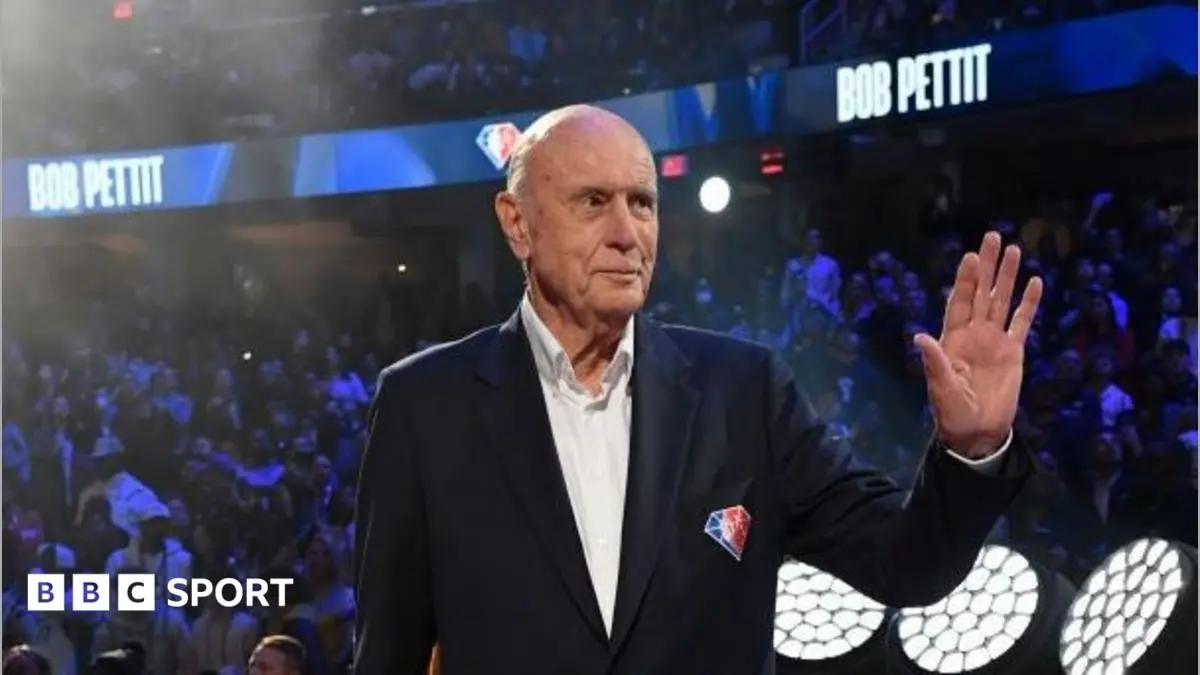
Pettit’s passing marks the loss of one of the foundational superstars of professional basketball, a towering figure whose career bridged the era of the league’s infancy and its growing national prominence. Throughout an illustrious 11-year career spent entirely with the Hawks franchise in Milwaukee and St. Louis, Pettit established himself as an unstoppable offensive force and a fierce rebounder, setting standards of excellence that paved the way for generations of future basketball legends. The Basketball Hall of Fame paid tribute to the iconic player, remembering him as "a true giant of the game." No cause of death was given in the announcement.
Born in Baton Rouge, Louisiana, Pettit emerged as a collegiate star at Louisiana State University, where his exceptional scoring ability and relentless work ethic first captured the attention of professional scouts. His transition to the professional ranks came in 1954, when he was selected by the Milwaukee Hawks in the NBA draft. The franchise subsequently relocated to St. Louis ahead of the 1955-56 season, and it was in St. Louis that Pettit would cement his legacy, remaining loyal to the organization for the entirety of his decorated career.
It was during that landmark 1955-56 campaign, his second year in the league following an impressive rookie season, that Pettit achieved a historic milestone. In the inaugural year of the NBA’s Most Valuable Player award, Pettit was voted by his peers as the league’s top performer. Not content with simply claiming the first-ever MVP trophy, Pettit dominated the competition by topping the league’s scoring charts that same season, showcasing a lethal combination of jump shooting, driving ability, and tenacity under the boards that confounded opposing defenses across the league.
Pettit would repeat this remarkable feat three years later during the 1958-59 season, once again capturing the NBA MVP award while simultaneously leading the league in scoring for the second time in his career. His scoring prowess and consistency were virtually unmatched during an era when physical play dominated the paint and scoring efficiency was much harder to come by.
Beyond his individual accolades, Pettit proved to be a quintessential winner who elevated the performance of everyone around him. The pinnacle of his team success came in 1958, when he led the St. Louis Hawks to the NBA championship. In a fiercely contested series against the powerhouse Boston Celtics, Pettit delivered one of the greatest individual performances in finals history. In the decisive Game 6, Pettit scored a staggering 50 points, carrying the Hawks to a championship-clinching victory that momentarily halted the dominant Celtics dynasty and brought the title to St. Louis.
Pettit would return to the grand stage of the NBA Finals on two additional occasions, leading the Hawks back to the championship series in 1960 and 1961, though they fell short against Boston both times. Despite those series losses, Pettit’s reputation as a supreme playoff performer was thoroughly secured, as he consistently raised his level of play when the stakes were highest.
Throughout his 11-year professional tenure, excellence became the baseline expectation for Pettit rather than the exception. Remarkably, he was named an NBA All-Star in every single season of his career, a testament to his remarkable durability, sustained high-level play, and enduring popularity among fans and media alike. He was also named to the All-NBA First Team ten times and earned Second Team honors once, reflecting his status as one of the undisputed elite players of his generation.
Pettit also carved his name into the NBA record books by becoming the very first player in league history to cross the milestone of 20,000 career points, a threshold that had previously seemed unreachable. When he finally announced his retirement from professional basketball in 1965 at the age of 32, he left behind staggering career statistics that continue to command respect in modern analytical evaluations of the game. He retired with a career regular-season average of 26.4 points and 16.2 rebounds per game, numbers that place him in an extremely exclusive tier of basketball history alongside other immortal legends of the hardwood.
News of Pettit’s death has prompted widespread reflection from basketball historians, former players, and fans who remember his profound impact on the sport. As the professional game evolved from a regional attraction into a major American sports institution, Bob Pettit stood at the very center of its growth, setting an enduring standard of individual brilliance, competitive fire, and team success. The Basketball Hall of Fame and the broader basketball community continue to mourn the loss of a true pioneer whose legacy as the league’s original MVP will forever remain woven into the fabric of NBA history.