
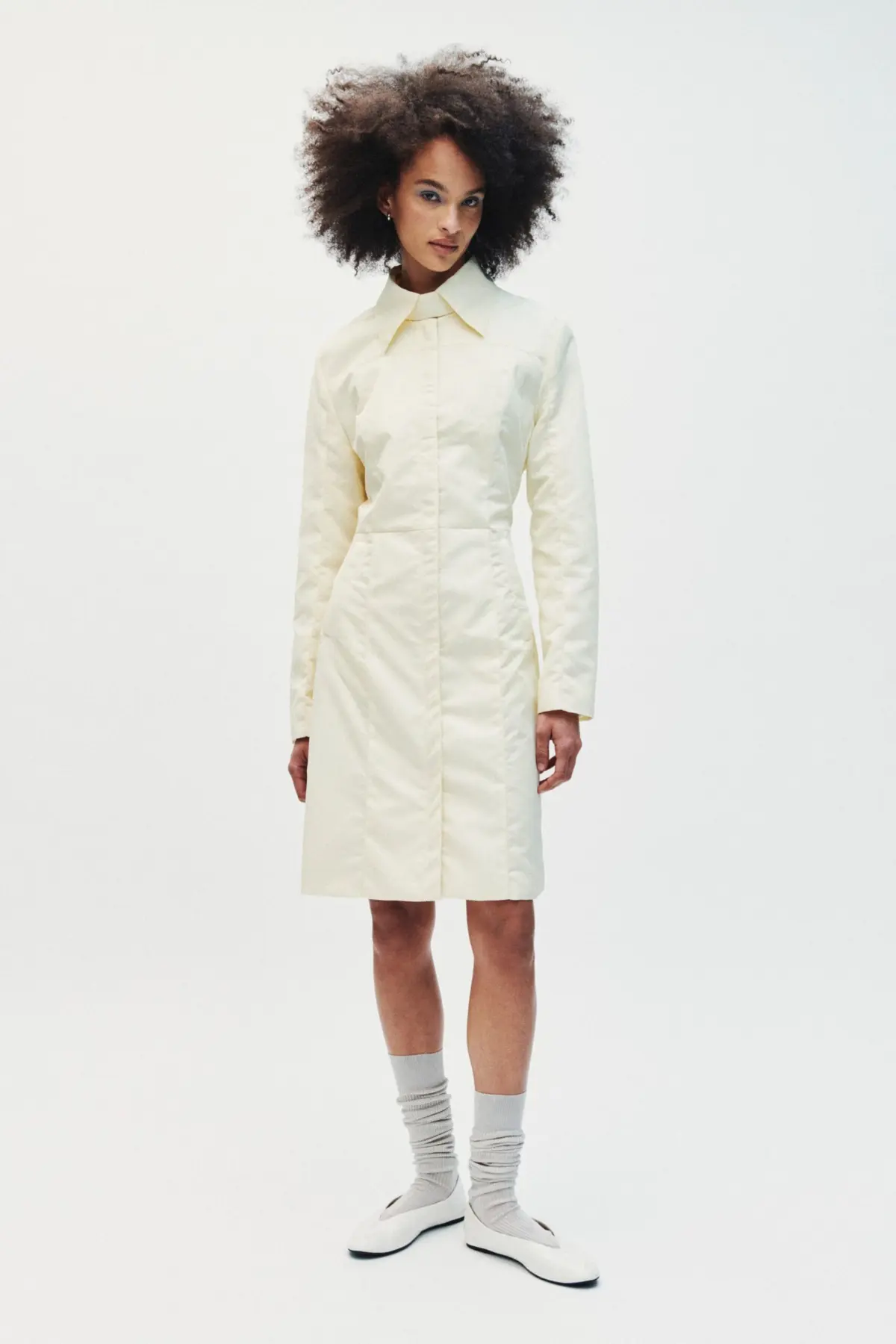
The trajectory of a fashion designer’s career is rarely a straight line, but for Bianca Saunders, the path to her debut womenswear collection has been paved by the persistent voices of her own clientele. A celebrated force in menswear since 2017—having honed her craft during her formative research project at the Royal College of Art—Saunders has spent years observing the nuanced intersection of body language, comfort, and exposure. Now, buoyed by the prestigious BFC/Vogue Designer Fashion Fund prize, she is officially expanding her creative footprint, answering a demand that has grown organically alongside her reputation.
For years, Saunders operated within the focused ecosystem of men’s tailoring, analyzing how garments interacted with the male form. Her early work was deeply personal, rooted in the study of her friends and the way they navigated space, posture, and the vulnerability inherent in being "exposed" through clothing. Yet, even as her menswear collections garnered critical acclaim and industry accolades, a secondary story was unfolding in the background. Her clothes were increasingly being purchased by women, a development she described as both "lovely" and professionally challenging.
"When I first started doing menswear, it was about the people around me and me studying my friends, and watching their body language and their comfortabilities of being exposed," Saunders reflects. "Then as time went on, I kept on having women buying the clothes, and coming up to me at events, which is lovely, but more difficult, because it doesn’t fit so well: because it was made for a man’s body."
This recurring friction—the desire for her specific design language coupled with the technical reality that the cuts were engineered for a different silhouette—became a catalyst for change. The transition was not an impulsive decision, but a thoughtful response to the "popular demand" that had been building since she first stepped onto the scene.
The final push toward this new chapter came from an unexpected source of inspiration: the renowned designer Louise Trotter. Their relationship, which grew from mentorship to a profound professional bond, played a pivotal role in Saunders’ decision to commit to womenswear. The connection was solidified following Saunders’ win of the Andam Prize in 2022, when Trotter reached out with words of encouragement that deeply moved the younger designer.
"I’m actually inspired by her so much," Saunders says, recalling the emotional impact of their early interactions. "When I met her, I started crying because there’s not many who come forward to help like that. We just had a conversation, just talking about her process, her team, and how she has things set up. Which is really interesting, and just gave me stuff to think about." It was this candid transparency—a rare look behind the curtain of a seasoned professional’s operation—that provided Saunders with the confidence and the logistical roadmap to undertake such a significant expansion of her label.
The resulting collection is a deeply personal project, explicitly titled in homage to the woman who first shaped Saunders’ understanding of style: She Was the Most Beautiful Woman I’ve Ever Seen. The title is an act of devotion to her mother, Yvonne, whose own history as a hairdresser and business owner in the mid-1990s serves as the aesthetic bedrock for the line.
Saunders speaks of her mother with a mixture of reverence and creative nostalgia. She points to photographs that capture the duality of her mother’s life: one image shows Yvonne commanding space in a bold, canary yellow jacket, exuding the professional confidence of a woman running her own business; another depicts her in a moment of pure, sun-drenched relaxation on a beach in Jamaica. These snapshots of a life lived fully inform the collection’s ethos, bridging the gap between the structured formality of a workday and the effortless ease of island life.
For those familiar with Saunders’ signature menswear, the debut womenswear collection offers a sense of continuity, though it is far from a mere repetition of her past work. Traces of her distinct DNA remain—the asymmetric "pulled" necklines that have become a hallmark of her tank tops, and the soft, fluid, shirt-like construction of her gray tailoring. Yet, the collection introduces a new narrative arc, one that reflects Saunders’ own personal evolution and her desire to explore facets of her identity that had remained untapped in her previous designs.
"I guess it was more looking to how I present and show up to events and stuff, because I’m always very much on the ultra-feminine side," she explains. "I love changing my hair, wearing fitted clothes, wanting to feel sexy. So I guess this is about me discovering myself."
This journey of self-discovery manifests in a summer-ready palette and silhouette that feels both timely and timeless. Launching with a collection designed for the warmer months, Saunders introduces a striking hot pink slip dress, a piece that signals a departure into bolder, more traditionally feminine territories. The collection also incorporates photographic prints of Jamaican sunsets—images taken by Saunders herself during trips to visit relatives—which are woven into the fabric of the garments, grounding the ethereal designs in a specific, tangible sense of place.
Beyond the aesthetics, the collection maintains the practical versatility that has always been a priority for the designer. Alongside draped jersey pieces, there is an elevated tracksuit that successfully bridges the gap between casual comfort and a "semi-formal go-to-work presence." This duality is a cornerstone of her philosophy. "I like the fact that I can wear it from early morning and still look great at night," she notes, highlighting a design sensibility that respects the pace and demands of the modern woman’s life.
As a designer, Saunders is characterized by a thoughtful and considered approach to her craft, a trait that has earned her the respect of the industry and the support of prestigious institutions. The BFC/Vogue Designer Fashion Fund prize has been instrumental in this transition, providing not just the financial backing, but the creative leeway to experiment and solve the complex technical problems that come with launching a new category.
"It’s come at a time where I needed to problem solve for my customer," Saunders says, clearly invigorated by the process. "I’m excited."
By successfully blending her established structural expertise with a new, deeply personal exploration of femininity, Saunders has managed to create a collection that feels like both a logical progression and a bold new beginning. It is a testament to her ability to listen to her audience while staying true to the inspirations that first sparked her desire to design. As she moves forward, the fashion world will be watching to see how this promising expansion continues to take shape, and how Saunders further defines the intersection of her heritage, her technical skill, and her evolving personal vision.