
To understand the core philosophy of AMG, one must picture a specialized company originally acquired by Mercedes-Benz specifically to transform luxury cruisers into true-blooded sports cars. In practice, that performance-focused formula translates to heightened horsepower, sharper throttle response, agile handling, strategic carbon fiber integration for weight reduction, and an amplification of everything that makes an automobile thrilling to pilot. A monumental portion of that engineering magic occurs beneath the bonnet, where range-topping variants feature hand-built engines. Each of these powerplants is meticulously assembled by a single technician operating under AMG’s renowned "one man, one engine" philosophy. It represents an exquisite blend of traditional craftsmanship and cutting-edge engineering, serving as a fundamental pillar of what the AMG badge ultimately stands for in the automotive world.
Yet, despite its immense cultural footprint and engineering prowess, AMG does not hold a monopoly on fast Mercedes-Benz vehicles—nor has it ever completely cornered the market on the manufacturer’s own turf. Ever since AMG was fully integrated into the broader corporate structure of Mercedes-Benz in 1999, the performance division has maintained a relentless development schedule. Concurrently, however, the parent company has consistently rolled out remarkably quick and immensely powerful machines that never received an AMG badge. Some of these exceptional vehicles hid genuine performance hardware beneath deceptively sensible limousine coachwork. Others were developed as ambitious motorsport experiments, groundbreaking electric SUVs, or ultra-exclusive luxury flagships that simply operated on a plane where the traditional AMG treatment was entirely unnecessary. A close examination of five distinct models illustrates how Mercedes-Benz has continually mastered the art of speed and power, even when it wasn’t actively marketing its performance subsidiary.
Mercedes-Benz SLR McLaren
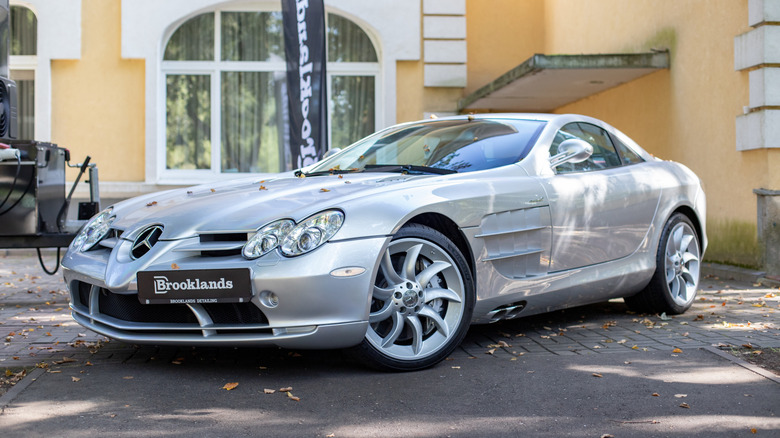
Jointly developed by British sports car maker McLaren and German luxury titan Mercedes-Benz, the iconic Mercedes-Benz SLR McLaren consciously bypassed the traditional AMG treatment, meaning prospective buyers will search in vain for any AMG insignia on its sweeping composite bodywork. Granted, the ferocious engine resting within its engine bay was engineered and hand-built by AMG technicians in Affalterbach, serving as a prime example of how some of the most potent Mercedes-Benz models conceal AMG powerplants beneath their hoods.
The rationale behind the omission of the AMG badge lies in the vehicle’s unique genesis. The SLR was conceived as a collaborative halo car between Mercedes-Benz and McLaren, acting as a modern spiritual successor to the legendary 300 SLR racers of the 1950s. This partnership flourished during an era when Mercedes-Benz heavily supplied engines to McLaren for Formula 1 competition. McLaren assumed responsibility for constructing the advanced carbon-fiber monocoque and executing final vehicle assembly at its facility in Woking, England. Consequently, the finished automobile proudly wore the SLR and McLaren identities rather than carrying the nomenclature of Mercedes’ in-house performance division.
As noted, AMG’s primary contribution was the hand-assembled powerplant rather than the badge adorning the rear decklid. The supercharged 5.4-liter V8 engine nestled within the SLR generates a staggering 617 horsepower and 575 pound-feet of torque. In the even more potent, range-topping 722 Edition SLR, output is elevated to 641 horsepower and 605 pound-feet of torque. This immense output is channeled exclusively to the rear wheels via a robust five-speed automatic transmission. Industry consensus indicates that approximately 2,157 total examples of the SLR were manufactured between 2003 and 2010, distributed across coupe, roadster, and the open-top Stirling Moss speedster configurations. In terms of raw acceleration and top-end velocity, very few contemporary AMGs could rival the envelope-pushing capabilities of the SLR. For collectors fortunate enough to possess adequate garage space, the SLR 722 can accelerate from a standstill to 60 miles per hour in a blistering 3.6 seconds, ultimately achieving an astonishing top speed of 209 miles per hour.
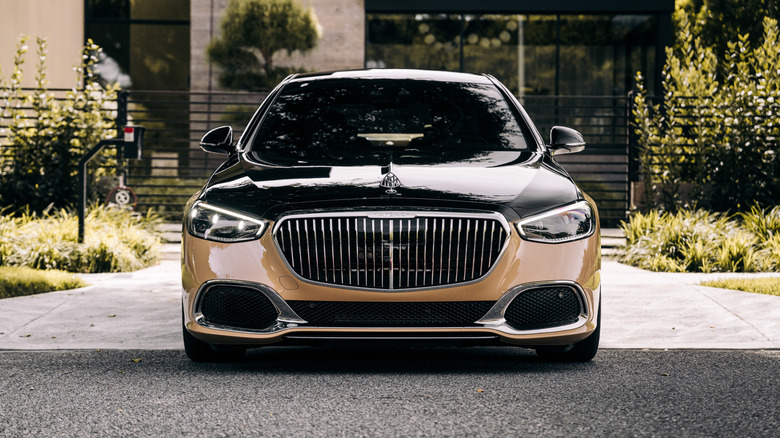
Mercedes-Maybach S 680
For enthusiasts seeking the most powerful internal combustion Mercedes-Benz currently available without an AMG moniker, the answer lies in an engine that historically wore one. The Mercedes-Maybach S 680 features a magnificent 6.0-liter twin-turbocharged V12 designated as the M279. This is the exact same mechanical architecture that previously propelled the S65 AMG before Mercedes-Benz systematically phased out its V12-powered performance lineup. While AMG ultimately stepped away from twelve-cylinder badged passenger cars, the venerable engine endured, leaving the Maybach S 680 as the sole remaining Mercedes model available with this legendary configuration.
Within the S 680, this twelve-cylinder masterpiece produces an effortless 621 horsepower and 664 pound-feet of torque. This output is more than sufficient to propel a full-size ultra-luxury limousine from zero to 60 miles per hour in just 4.3 seconds, continuing onward to an electronically governed top speed of 155 miles per hour. Furthermore, with the introduction of the W223 generation in 2021, the S 680 marked a historic milestone by becoming the first V12-powered Mercedes-Benz road car to distribute its immense power to all four wheels through a 4MATIC all-wheel-drive system.
Acquiring one of these engineering marvels, however, comes with a notable caveat. Because the V12 powerplant no longer complies with increasingly stringent European emissions regulations, Mercedes-Benz was forced to withdraw the engine from the continental market entirely. Consequently, prospective buyers wishing to secure a twelve-cylinder S 680 must reside in or shop within the United States, China, the Middle East, Japan, or South Korea, as standard Maybach S-Class offerings in other regions are capped at the V8-powered S580. This geographic scarcity, combined with a V12 engine operating on borrowed time, makes it a vehicle of immense intrigue. Although the S 680 matches the peak horsepower output of the aforementioned SLR, their intended operational contexts are vastly different. The twin-turbo V12 in the S 680 is meticulously calibrated for supreme smoothness above all else, reflecting the reality that many owners prefer to be chauffeured in these serene environments rather than pilot them personally.
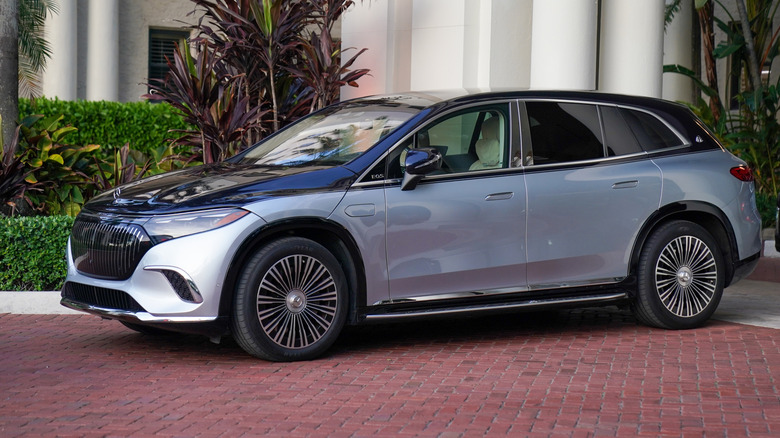
Mercedes-Maybach EQS 680 SUV
Moving into the realm of electrification, the Mercedes-Maybach EQS 680 SUV stands as the most powerful non-AMG Mercedes-Benz vehicle driven by battery power. Nevertheless, its sophisticated electric propulsion system shares direct lineage with an AMG product. The vehicle utilizes a dual-motor layout identical to the architecture Mercedes-Benz installs in the performance-oriented AMG EQS 53 sedan. This shared foundation enables the Maybach variant to deliver an impressive 649 horsepower and 700 pound-feet of torque—representing a substantial leap over the 536 horsepower generated by the standard EQS 580 SUV.
This immense output allows the substantial 6,779-pound ultra-luxury sport utility vehicle to surge from zero to 60 miles per hour in an estimated 4.1 seconds, while its top speed is electronically restricted to 130 miles per hour. By comparison, the AMG EQS 53 begins its performance envelope at that same 649-horsepower baseline but can expand to 751 horsepower when equipped with its optional Dynamic Plus boost function, a performance party trick that is omitted from the Maybach specification to preserve a more dignified driving demeanor.
The vehicle draws energy from a sizable 118-kilowatt-hour battery pack, which yields an estimated driving range of approximately 280 miles under official testing cycles. When connected to a high-capacity direct current fast charger, the battery can replenish its state of charge from 10 to 80 percent in roughly half an hour. Despite these formidable technical specifications, market adoption for the ultra-luxury electric SUV has faced challenges, prompting significant promotional incentives and retail discounts within the marketplace.
2026 Mercedes-Benz G 580 with EQ Technology
While the previously discussed models all incorporate hidden AMG components—whether through hand-assembled engines or shared electric architectures—the fully electric G-Wagon departs radically from that established pattern. Mercedes-Benz attributes the cutting-edge four-motor propulsion system of this vehicle to the broader engineering resources of the Mercedes-Benz Group itself, explicitly designating the G 580 with EQ Technology as the first mass-produced model from the company to feature genuine individual-wheel drive.
In this configuration, an independent electric motor is dedicated to driving each individual wheel. Combined, these four motors generate a phenomenal 579 horsepower and an immense 859 pound-feet of torque. Interestingly, the electric G 580 manages to out-torque even the top-spec, internal-combustion AMG G 63, which tops out at 627 pound-feet of torque. Straight-line acceleration, however, still favors the traditional AMG G 63, largely because the gasoline-powered variant enjoys a weight advantage of approximately 1,200 pounds over its heavily battery-laden electric sibling.
Despite its substantial mass, independent testing indicates that the G 580 can accelerate from zero to 60 miles per hour in approximately 4.1 seconds, reaching an electronically limited top speed of 112 miles per hour. This velocity ceiling is dictated more by structural platform limitations inherent to the classic G-Class chassis geometry than the maximum rotational limits of the electric motors, given that even the high-performance G 63 AMG is restricted to a top speed of 137 miles per hour. Furthermore, the G 580 introduces an innovative operational feature known as the "G-TURN" mode, which utilizes opposing wheel rotation to pivot the heavy SUV around its own axis when operating on loose terrain.
Beneath the floorboards, a heavy 116-kilowatt-hour battery pack is integrated low within the traditional ladder frame chassis, providing an EPA-estimated driving range of roughly 239 miles. Additionally, support for 200-kilowatt DC fast charging enables the vehicle to replenish its battery capacity from 10 to 80 percent in approximately 30 minutes.
Maybach 57 S
During the early 2000s, Maybach operated as a distinct, standalone ultra-luxury brand operating under the broader Mercedes-Benz corporate umbrella, launching the ultra-exclusive 57 S and the extended-wheelbase 62 S models in 2005. Both prestigious limousines were powered by a formidable 6.0-liter twin-turbocharged V12 engine lifted directly from the contemporary Mercedes S65 AMG, producing an initial 604 horsepower and 738 pound-feet of torque. This immense mechanical output allowed the slightly shorter 57 S variant to achieve a zero-to-60-miles-per-hour acceleration time of under five seconds while attaining a manufacturer-claimed top speed of 172 miles per hour.
The evolution of these ultra-luxury flagships did not conclude there. During a mid-cycle product refresh showcased at the 2010 Beijing Motor Show, Mercedes-Benz quietly updated the 57 S and 62 S models by modifying the AMG-built V12 engine to produce 630 horsepower, while peak torque remained steady at 738 pound-feet. This output represented not only a notable increase over the initial production run but also surpassed the 621-horsepower output generated by the modern Mercedes-Maybach S 680 that currently carries the Maybach designation.
In its updated 630-horsepower configuration, the 2010 Maybach 57 S could sprint to 60 miles per hour in as little as 4.6 seconds, accompanied by an unrestricted top speed estimated to exceed 190 miles per hour. These figures serve to highlight the extraordinary positioning and uncompromising engineering ambitions of the original Maybach revival. When the standard Maybach 57 debuted in 2003, its initial base price was established at $308,000, and by the time the more potent 604-horsepower S variant arrived for the 2006 model year, the starting price had climbed past $367,000. Over subsequent years, heavy automotive depreciation has significantly impacted these ultra-luxury flagships, with well-maintained examples of the 57 S occasionally changing hands on the secondary market for a fraction of their original sticker prices.