
"Wish you were here" is a phrase typically scrawled onto a postcard, a shorthand message sent from a location more idyllic than the one currently occupied by the sender. For Ukrainian designer Masha Popova, however, the inspiration for her Spring 2027 collection arrived from a place that does not exist at all—a destination crafted entirely within the confines of her imagination while she remained tethered to the relentless demands of the London fashion calendar.
Speaking from the heart of Studio Smithfield, the fashion residency program now nurturing its second cohort of emerging design talent, Popova reflected on the origins of her latest work. Amid the hum of castings and the logistical choreography of a busy meat-market-turned-creative-hub, she admitted that her vision of escape was born from proximity to her workbench. "I didn’t have a chance to go anywhere," she explained. "I was just working and dreaming of somewhere else."
This dreamscape became the blueprint for Spring 2027. Rather than leaning into the traditional tropes of resort wear—bright, breezy, and literal—Popova chose to build a fantasy of escape from the remnants of a journey never taken. The collection is a testament to what she calls "residuals": the errant sand left in the crevices of a suitcase, the way saltwater might restructure the silhouette of a garment, and the muted, smoky colors associated with a dying bonfire. It is a collection defined not by the destination, but by the artifacts of the travel experience itself.
Popova, a NewGen alumnus who has carved out a distinct niche for her experimental approach to denim and texture, approached these imagined remnants with a refreshing, almost obsessive literalism. Her signature design elements—the V-shape waist and the bias-cut, acid-wash denim jean—were reimagined through the lens of her phantom vacation. Pieces were flocked in intricate, swirling patterns that mimicked the behavior of sand clinging to hems and fraying seams. On a top-and-skirt combination, the designer utilized damp-looking marks to replicate the telltale outline left on fabric when a garment is pulled over a still-wet swimsuit.
Texture has always been the cornerstone of Popova’s design language, and in this collection, it served as the primary storyteller. Burnout cotton was employed to create the high-summer shadows of palm fronds, casting a silhouette of vacation leisure across the wearer. In another standout piece, she captured the abstract, ghostly outline of someone holding a camera—a visual metaphor for the observer capturing a moment of peace that, for the designer, remained strictly conceptual.
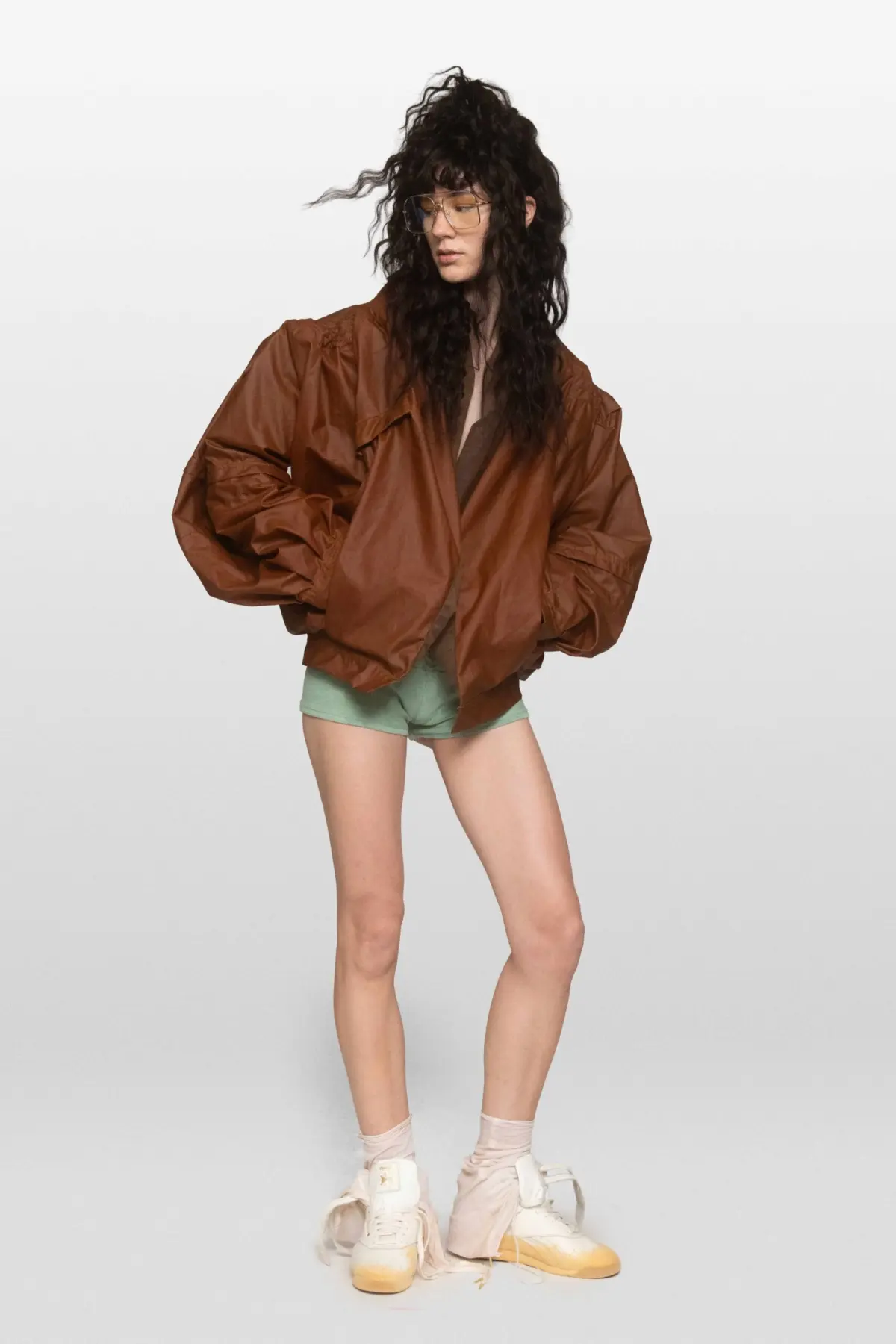
Beyond the evocative surface treatments, Popova utilized this season to push the boundaries of her own construction techniques. She challenged herself to rethink the structural integrity of the garment, most notably in a shiny bomber jacket that felt both futuristic and worn-in. The front, back, and sleeves of the jacket were essentially formed from a single component, with the complex shape determined by dense, deliberate lines of stitching. The effect was one of perpetual motion, the jacket appearing to billow even when static, providing a deliberate contrast to the lightness of the minty knit cardigan and short-shorts layered underneath.
A sharp-lapeled trench coat provided another masterclass in tactility. The garment was finished with a layer of leather paint that had been meticulously rubbed away at the high-friction points where a body would naturally wear through the material over time. The resulting texture was almost reptile-like, shifting in character depending on the light and touch. It was a deliberate exercise in eerie beauty. "I like when fabrics are kind of eerie and playful," Popova noted, articulating a philosophy that balances the macabre with the wearable.
The collection was further grounded by a collaborative effort with Reebok, which saw the iconic Freestyle sneaker treated as an artifact washed ashore. The "Denim Ghost" iteration of the shoe featured a gauzy, layered denim overlay, while a secondary version was flocked to simulate the texture of a shoe that had been dragged through wet, clumping sand. It was a continuation of the theme—the idea of an object being reclaimed by the environment, or in this case, by the designer’s own nostalgic projection.
To showcase this "phantom resort," Popova opted for her first truly immersive presentation at 180 Studios. Eschewing the traditional runway format, she opted for a static, sculptural installation. "We casted mannequins," she said with a wry smile. "They arrive on time. It is an opportunity to get people really comfortable and up close with the pieces." By removing the distraction of a moving model, the audience was forced to engage with the construction, the flocked denim, and the paint-rubbed leather in intimate detail.
The environment itself was a conjured reality. Against the brutalist, industrial backdrop of 180 Studios, Popova installed a sandcastle complete with a custom Masha Popova flag flying from the turret. A series of vignettes featured mannequins reclining in deck chairs, holding surfboards aloft as if waiting for the final, fading light of a summer evening. The aesthetic of the mannequins drew heavily from the 1980s Brat Pack era, with mullets, perms, and angular aviator sunglasses providing a nostalgic, cinematic touch. The atmosphere was rounded out by a soundscape of slow-tempo, "strung-out" pop ballads layered over the rhythmic, meditative sound of the surf.
There is a distinct, almost neat perversity in building an entire resort collection while locked into the rigid, high-pressure rhythm of a London fashion schedule. The irony is not lost on Popova, but there is a clear sense of purpose in her approach. By transforming the constraints of her environment into a source of creativity, she has managed to find a way to travel without leaving the room.
As the industry navigates an era of constant change and shifting consumer appetites, Popova’s ability to remain committed to her own unique vision is striking. Her work this season suggests that while the tides of the fashion world may be ever-changing, a designer with a strong enough narrative can create their own current. By grounding her "phantom resort" in the tactile, the construction-heavy, and the eerily playful, Masha Popova has affirmed her position as one of the most compelling voices in the new guard of London design. Her Spring 2027 collection does not just invite us to dream of somewhere better; it proves that the most vivid destinations are often those we construct for ourselves, piece by piece, stitch by stitch, in the quietest corners of our own ambition.