
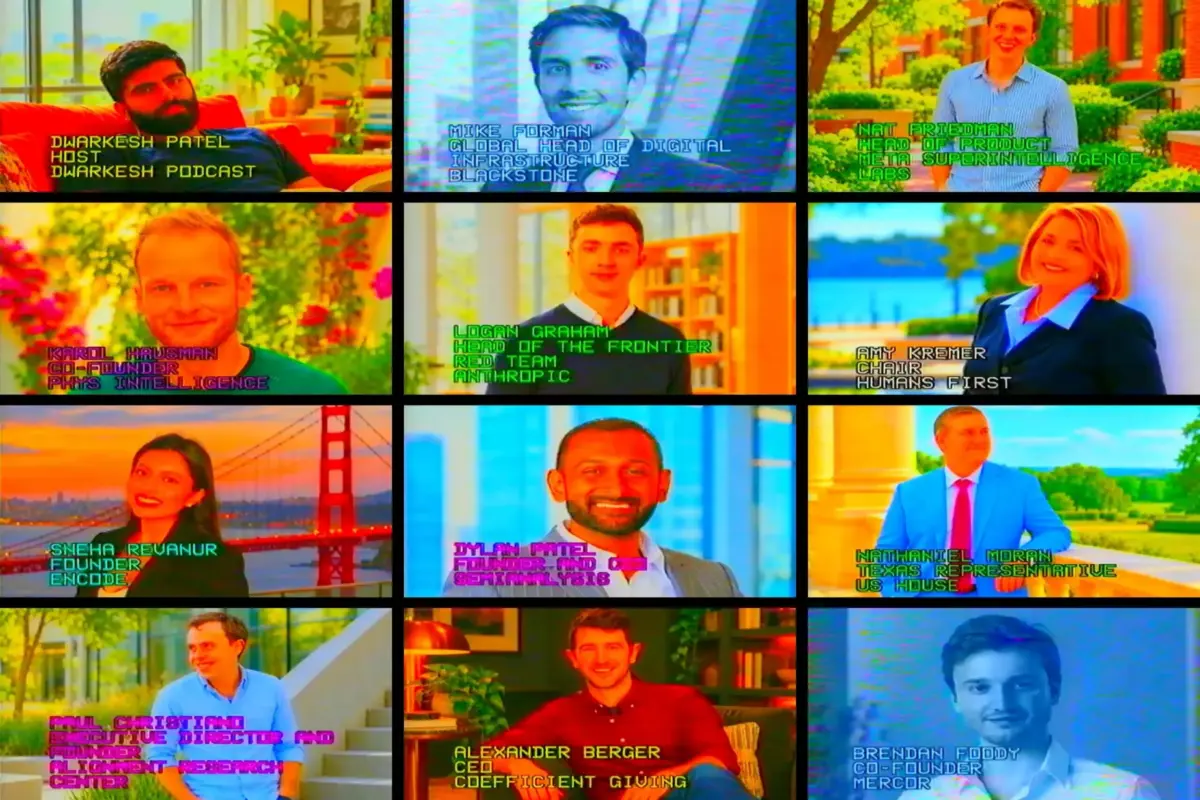
In its latest “Power” issue, New York Magazine has turned its investigative lens toward the invisible architects of the artificial intelligence revolution. To illustrate the feature titled “So Few People, So Much Influence,” the magazine commissioned Berlin-based artist Simon Denny to visualize the 26 individuals whose work is fundamentally reshaping the global landscape, yet whose names often remain absent from the public discourse. The collaboration, which also involved the AI-focused Substack newsletter Transformer, highlights a paradox of the modern age: the immense power concentrated in the hands of a small, relatively unknown cohort of engineers, founders, and safety researchers.
The feature identifies figures who operate at the bleeding edge of technological development, often in roles that hold profound consequences for society. Among those spotlighted are Logan Graham of Anthropic, whose work involves the precarious task of "red teaming" AI models—essentially pushing them to their limits to determine if they can be coerced into dangerous activities, such as executing cyberattacks or facilitating the creation of bioweapons. The list also includes Beth Barnes, the founder of METR, a nonprofit organization dedicated to the rigorous testing of AI systems before they are unleashed into the public sphere. Furthermore, the article features Brendan Foddy of Mercor, a firm focused on training AI models to assume roles across various industries, signaling a significant shift in the future of labor and employment.
To capture the essence of these powerful but largely anonymous figures, Denny created a series titled Technologists Portraits. The artist, who has long been fascinated by the intersection of art, technology, and political infrastructure, turned to the very tools he was documenting to create the imagery. A footnote accompanying the article reveals that Denny utilized AI to generate the portraits, deliberately imbuing them with the aesthetic of vintage VHS tapes.
Each portrait presents a smiling subject set against a backdrop that feels deliberately artificial, rendered in the crackly, oversaturated color palette of analog magnetic tape. This choice of medium is far from accidental. By utilizing the distorted, low-fidelity aesthetic of 1980s and 90s media, Denny creates a jarring juxtaposition: these cutting-edge, high-stakes engineers are presented through a lens of technological obsolescence. The effect is a visual meditation on the fragility and speed of the current digital paradigm, where the innovators of today are rendered in the aesthetic of a bygone era.
"With each major paradigm shift in the past 20 years, I have tried to map and unpack some of this community’s stories as they narrate our experience of a changing technological world," Denny explained regarding his process. "The distortions of the final compositions are traces of the changes that are coming and the people bringing them about."
Denny’s interest in the hidden mechanics of power is well-documented. His career has been defined by his ability to translate complex, often opaque technical systems into tangible art. His work frequently investigates the infrastructure of the internet and the institutions that govern it. This was perhaps most famously exemplified during his representation of New Zealand at the 56th Venice Biennale in 2015. His exhibition, titled Secret Power, served as a critical interrogation of surveillance states and global intelligence networks. Denny transformed server hardware into museum-quality vitrines, using them to display leaked documents and visual data concerning the National Security Agency (NSA) and the "Five Eyes" intelligence alliance—a clandestine partnership between the United States, the United Kingdom, Canada, Australia, and New Zealand.
More recently, Denny has expanded his practice into the realm of written criticism, positioning himself as an observer of the shifting relationship between Silicon Valley and global governance. His recent contributions to Artforum have dissected the aesthetics of defense technology and the rise of prediction markets like Polymarket, further establishing him as a chronicler of the tech industry’s cultural impact.
The New York Magazine project is an extension of this ongoing inquiry into how machine learning is mythologized and normalized. In his Machine Painting series, specifically the piece Output 0971 (2025), which was featured in the Sentient Earth exhibition at Amant, Denny continued to explore the tension between human intent and machine execution.
"I’m interested in the stories that are woven by the people making the technology that we end up using," Denny told ARTnews. "It’s hard to parse what’s mythology and what’s truth when we’re confronting machine learning; it’s really unfamiliar even to those actors who are building it. This is why myth-making is so important in the tech space. How does all of this become familiar and normalized?"
The Technologists Portraits series functions as a bridge between these two worlds: the rarefied, high-pressure offices where AI is constructed and the broader public consciousness that must grapple with the consequences. By using the AI tools themselves to generate the images, Denny forces the viewer to confront the "black box" nature of the medium. The VHS distortion serves as a reminder that every digital image is a product of an underlying process, one that is subject to degradation, interpretation, and, ultimately, human curation.
The choice to portray these 26 influential individuals—the people building the foundations of the next century—in such a dated, unstable style underscores the instability of the current technological moment. As society hurtles toward an uncertain future shaped by automation, synthetic biology, and predictive modeling, Denny’s work suggests that we are looking at our future through a screen that is already beginning to crack.
As the influence of these individuals grows, so too does the need to demystify the institutions and the personalities driving the AI revolution. Through his collaboration with New York Magazine, Denny has provided a unique vantage point on this cohort. He does not offer a clear, high-definition portrait of power; instead, he provides a distorted, glitchy, and deeply human look at the people who, despite their relative anonymity, are currently authoring the next chapter of human history. The "traces of the changes" that Denny speaks of are visible in every saturated hue and pixelated edge of his portraits, serving as a quiet warning that the architects of the future are often hidden in plain sight, their influence as significant as their personal fame is fleeting.