
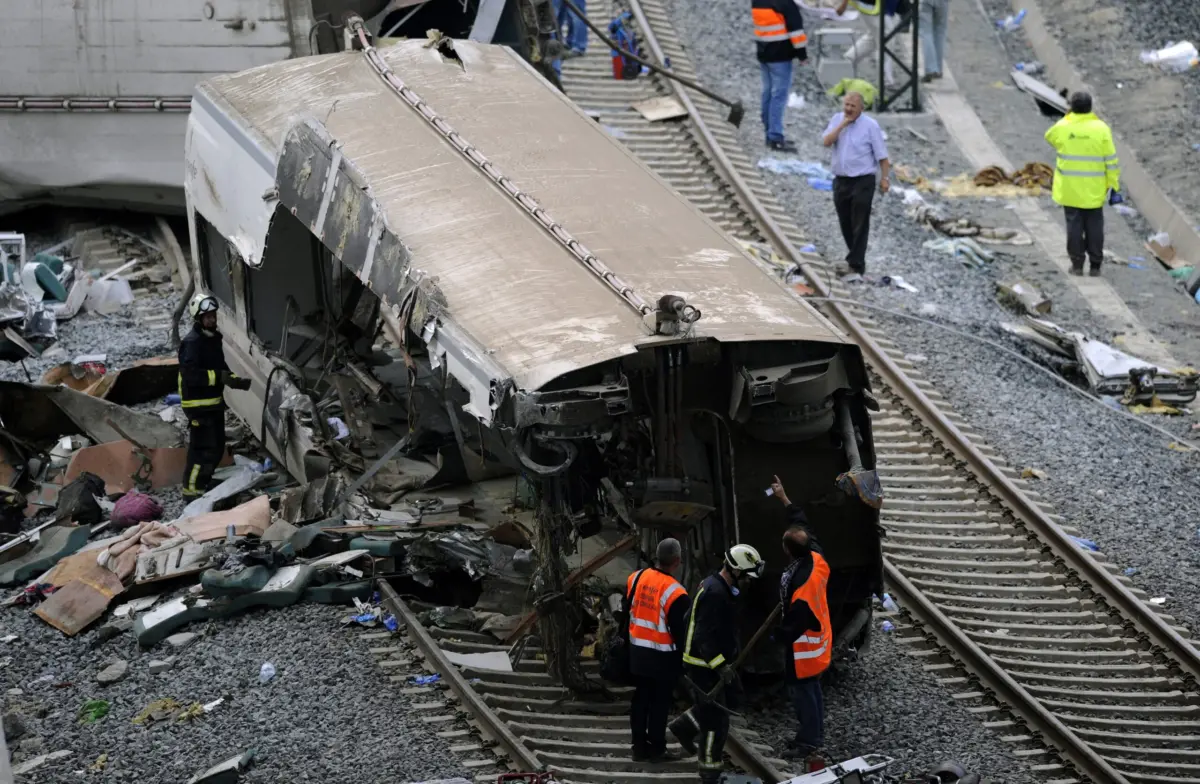
MADRID, Spain — Standing in the shadow of historical trauma, survivors of Spain’s deadliest rail disasters are raising their voices in unified alarm, demanding immediate and sweeping changes to a high-speed network that they argue is increasingly plagued by systemic neglect. Thirteen years after a horrific high-speed derailment near Santiago de Compostela claimed 80 lives, the haunting reality of rail tragedy has struck Spain once again, leaving communities in deep mourning and experts pointing to chronic underinvestment in infrastructure and outdated technology.
The latest catastrophe unfolded on a Wednesday near Urda, a town close to Toledo in central Spain, where a catastrophic collision involving two trains resulted in the deaths of at least 69 people. The shockwaves of this disaster are compounded by the terrifying recency of another fatal incident on the exact same high-speed corridor. Only 10 months prior, two other trains collided further south in Adamuz, near Cordoba, killing 46 people.
For survivors of these harrowing events, the recurring nature of these disasters is both baffling and unforgiving. Cristobal Gonzalez, a 64-year-old retired army captain who survived the catastrophic 2013 Angrois disaster, still carries the profound psychological and physical scars of that fateful day.
"I survived, but the mental scars are still there all these years later. We must stop more accidents happening," Gonzalez said in an interview. "Now we have seen three dreadful crashes in Spain, at Angrois, Adamuz, and Urda. They will keep happening if we do not act."
Gonzalez was traveling with a friend, Oscar, on July 24, 2013, aboard a high-speed train that was supposed to be navigating a bend at 80 kilometres per hour (50 miles per hour) when it hurtled off the tracks at a staggering 200 km/h (125 mph) near Santiago de Compostela, on the eve of the city’s traditional festivities. Sitting in the front carriage, Gonzalez experienced the sheer terror of the train "flying" off the tracks and smashing violently into an embankment.
Rather than fleeing immediately, Gonzalez remained inside the wreckage to aid fellow passengers during their final, desperate moments. Years later, the trauma remains an oppressive weight. He struggles with severe post-traumatic stress disorder, finding it nearly impossible to articulate the horrors of that evening.

"I will keep what happened to myself. It is very hard to share it, even if I wanted to—it is something that defies imagination," Gonzalez said. Reflecting on the systemic failures underlying these disasters, he added, "At Angrois, the driver was going too fast; at Adamuz, an investigation said there was a problem on the track; and at Urda, it might have been human error and a problem with the control system. Whatever, we must stop these crashes happening by investing more in safety."
The parallels between the recent disasters and past tragedies have left current survivors reeling. Santiago Rosendo was among the passengers aboard the Renfe train involved in the January crash in Adamuz. Traveling alone from Madrid to Huelva on a Sunday night, Rosendo suddenly found himself trapped in a nightmare of disorientation and panic as the train met a catastrophic fate.
"There was a sudden stop—a very sudden stop—and then following that, a loud crash. Then the train moved from side to side until the train slid onto its side and we were left entirely in the dark. The first thing I saw when I got off the train was a body," Rosendo recounted.
An initial investigation into the Adamuz derailment revealed that a broken rail had forced one train to veer directly into the path of an oncoming service. For Rosendo, the recurrence of fatal accidents on the same high-speed network is a sobering indictment of current oversight. "I cannot believe that this has happened again on the same line," he said. "We have to do something."
Experts Call for Investment in Maintenance
The consecutive disasters have ignited an intense national debate over where financial resources are being allocated within Spain’s vast rail network. According to European Commission data covering the period from 2018 to 2022, Spain invested an average of approximately $1.67 billion annually into its high-speed lines, outspending several other European nations with comparable rail networks. However, only 16 percent of that substantial budget was directed toward maintenance and necessary repairs, with the vast majority consumed by the construction of new infrastructure.
By comparison, countries like Italy, Germany, and France allocated between 33 and 39 percent of their respective budgets to ongoing maintenance, despite operating significantly smaller rail networks than Spain’s expansive 4,000-kilometer (2,485-mile) grid.

Jose Maria Goicolea, a spokesman for the Spanish Association of Civil Engineers, emphasized that the rapid expansion of rail usage necessitates a fundamental shift in governmental priorities.
"With the increase in use of the rail network, there has to be more spent on maintenance," Goicolea said. "In 1982, when there was the first line, it was a very small network. Now it is much bigger with much more usage. It is a whole new ball game now. The emphasis cannot be only on building new lines but doing more maintenance."
The statistics underscore this exponential surge in demand. Approximately 40 million passengers utilized Spain’s high-speed rail network in 2024, nearly doubling the passenger volume recorded in 2019. Even amid recent disruptions, about 25 million people traveled via the high-speed network during the first half of the year.
Compounding the maintenance debate is the technological state of specific corridors. The vital artery connecting Madrid and Seville—the site of both railway disasters this year—remains the only line in Spain reliant on a German-made LZB control system dating back to the 1970s, a legacy technology currently undergoing a sluggish phase-out.
"I would close the line between Madrid and Seville while the LZB system is phased out. It was only partly responsible for Wednesday’s crash. It failed. But the other reason was human error, it seems," Goicolea noted, acknowledging the complexities of the latest incident while adding, "However, this is up to the politicians, not me." He reiterated that the January disaster stemmed directly from structural faults within the track itself.
Ramiro Aupin Lopera, an infrastructure expert and former lecturer at the Universitat Politecnica de Catalunya, voiced severe criticism regarding the trajectory of public spending. He pointed to a steep decline in maintenance investment following the 2011 financial crisis, describing the reduction as "ridiculous."

"At the same time that there has been growing use of the network, there has been less investment in maintenance. It is no surprise that we have had two crashes in less than a year," Lopera said. "It may come from ignorance or disdain towards science and infrastructure on the part of the politicians."
The reliance on aging infrastructure has also drawn sharp criticism from private operators competing alongside state-run Renfe, including France’s Ouigo and the Italian consortium-backed Iryo. Helen Venezuela, former director of Ouigo Espana, did not mince words when addressing the technological lag on Spanish television and radio networks last year.
"This line is equipped with an obsolete system like LZB," Venezuela said during an interview with Cadena Ser, vividly illustrating the technology gap by stating, "It is like watching Netflix in black and white. We are Netflix and the system is still in black and white."
As political leaders, transport authorities, and independent experts grapple with the unfolding inquiries into the Urda and Adamuz tragedies, representatives of railway workers are urging caution against scapegoating frontline personnel. Diego Martin, speaking for the Spanish train drivers’ union SEMAF, argued that focusing prematurely on individual culpability distracts from the systemic changes required to protect the traveling public.
"Blame does not prevent accidents," Martin said. "Identifying and determining the causes does."